This is a set of reviews of Roseanne episodes. My general thoughts about that show are here. I will focus only on the political aspects and will mention what percent of lines spoken by non-family members are spoken by people of color.
“Lover’s Lane” Episode 6, Season 1. The wikipedia summary is: “On a night out at the bowling alley, Roseanne sneaks a peek at Becky's first boyfriend. Meanwhile, Booker makes a bet with Jackie for very high stakes; if he wins she has to spend the night with him.”
The only significant political thing here is that they bowl, which is definitely more of a working-class thing than a middle-class thing.
Also, out of about 50-75 lines spoken by non-family members, none are spoken by a person of color, which really sucks.
“The Memory Game” Episode 7, Season 1. The wikipedia summary is: “Dan's enthusiastic plan to take photographs for his and Roseanne's 15th high school reunion yearbook exposes a 15-year-old secret he has kept from Roseanne. His attempt to explain to an angry Roseanne bring hilarious results.”
There are two bits of pro-labor stuff. First, the female part of a mostly-female factory workforce threaten to strike over the paper-towel supply in their bathroom. And a female worker speculates earlier that management wants them distracted by that instead of focused on pay and benefits. It’s far from a full-throated endorsement of unions, but we see that at least once in the show later on and there MIGHT be a union at the factory, it’s not clear.
There are about 30 lines by non-family members and about 10% are by a Latina work friend of Roseanne's who started the mimi rebellion over paper towels .
“Here’s To Good Friends” Episode 8, Season 1. The wikipedia summary is: “Roseanne and Jackie console a brokenhearted Crystal after her boyfriend breaks up with her. A night at the Lobo Lounge, reflecting on love and men, help to set her right. While at the Lobo, a miffed Jackie embarrasses Booker when he shows up with another woman after telling her he was spending the evening with his mother.”
Only thing worth mentioning is that out of about 50-75 lines by non-family members, only about 5% are by are by people of color (in this case, a Latina work friend of Roseanne's), which really sucks.
“Dan’s Birthday Bash” Episode 9, Season 1. Wikipedia summary is: “Roseanne and the kids surprise Dan with an elaborate birthday breakfast. Later that evening, Roseanne throws Dan a party at the Lobo. During the celebration, Dan barely avoids a fight with a loud-mouthed jerk after Roseanne stops him. Afraid of looking like a wimp, Dan vows to beat up the bully the next time he sees him. Becky is invited to Chip's home for dinner.”
Only thing worth mentioning is that out of about 45 lines by non-family members, none are by people of color, which really sucks.
“Saturday” Episode 10, Season 1. Wikipedia summary: “It is Saturday at the Conners', and Dan plans to spend the afternoon "working on" (that is, drinking beer and talking in front of) an old truck with his friends. Roseanne, having heard Dan make similar claims before, bets him that the guys will not finish the repair work by the end of the day. Dan takes the bet, but soon realizes he may lose.”
There’s some class stuff as they fix their own truck instead of paying someone else to and look for clothes on really good sales at the mall. There a bit feminism, although the response to the sexism could have been more devastating.
And even though they added a new recurring character whose a friend of Dan’s a few episodes earlier and have one brand new minor character that’s a friend of Dan’s in this episode, all 50 or so lines by non-family members are by white characters. That DOES change at least briefly and to a moderate degree at some point in the series. I think so far it’s about 2% of such lines are by people of color but I think that in the first 8 seasons it’s closer to 20%. Also, in all fairness I should mention that about 1/4-1/3 of the extras at the factory Roseanne and Jackie work at are Black at this point in the show, and maybe around 20% of the extras in general are people of color.
Sunday, June 7, 2020

Saturday, June 6, 2020
The Black Lives Matter Protests and the Trunp Administration
Although I have been following developments and reading commentary about the Black Lives Matters protests like crazy, I have not attended any protests. For MULTIPLE reasons, taking part in protests would cause me the kind of anxiety and stress that would make my mental disabilities much worse than they are.
But, even though I currently am not getting a lot of visitors to this blog (I’m getting some and will soon get more), here are my thoughts about the issues thrown up by the protests.
Many people (like Trump) don’t understand this, but this is not about George Floyd. This is about hundreds of years of black lives being valued less than white lives in this country, including an apparent surge in the murders of unarmed Black people by police in the last several years, as well as some modern-day lynchings that more or less don’t involve the police. I was told at a BLM protest march around 2015 that in a 365-day period ending shortly before that day about 200 black people, armed or unarmed, had been killed by American police. I’m sure some of them were armed, but A) I’m very open-minded about allegations that cops plant guns and B) around that time there were SEVERAL highly publicized cases where undeniably unarmed Black people were killed by police. Police are practically never convicted, or even prosecuted (and rarely fired) for such deaths. Although there isn’t solidly comprehensive information about how often unarmed black people are killed by police here like there’s information about the security forces killing Catholic civilians in Northern Ireland’s Troubles, one reason I believe it’s a widespread and serious problem is that both the Southern Poverty Law Center and the Anti-Defamation League, two organizations that generally get along with police, have expressed support for BLM. That’s here and here. They are making these statements because even though they are sort of pro-cop, they are even more anti-racist and anti-injustice and anti-inequality. And that’s the agenda they see in BLM. (And in the case of the ADL, their support for BLM is also despite the fact that BLM has expressed criticism of Israel)
Trump claims to be sensitive to the death of Floyd, but he clearly isn’t beyond the death of that one individual. He isn’t sensitive to what Floyd’s death symbolizes. His National Security Advisor has said “No, I don't think there's systemic racism. I think 99.9% of our law enforcement officers are great Americans.” Based on multiple facts, a lot more than .1% of police are racist. That’s based on simple common sense, but also the following:
1) What I wrote about the SPLC and the ADL and BLM.
2) In 1992, when the controversy over the Body Count (Ice-T’s heavy metal band) song Cop Killer broke, the (then- 35,000 member) National Black Police Association kind of backed Ice-T. According to an article in the Orlando Sentinel:
3) From what I’ve heard, some massive majority of cops are registered to vote GOP and for the following reasons I believe that is a racist party.
There’s also the fact that, according to HuffPost, the Trump Justice Department ignored police brutality:
(Also, see this).
(There’s a lot of things I will gloss over because there’s so much attention on them anyway, like Trump’s use of the phrase “when the looting starts, the shooting starts,” or what happened to facilitate his photo-op with the Bible)
Trump is a racist. Here’s some of the most solid evidence:
1) A few years ago was the first time Trump called Antifa a terrorist organization. It was after Antifa members had done what they’re defined by, and that’s not actually or allegedly rioting. They were fighting people clearly identifiable as fascists, and no, I don’t believe that cops are clearly identifiable as fascists. They were fighting FASCISTS.
2) On a similar note, when an anti-fascist was killed in 2017 in Charlottesville by a fascist, Trump said there were “fine” people on both sides.
3) There’s his attitude to the exonerated victims of a racial miscarriage of justice.
4) When asked about David Duke endorsing him, his response in an interview was:
5) There’s his opinion that Lincoln screwed up dealing with what led to the Civil War. Trump thinks that if the then-late former President Andrew Jackson had been President in 1861 the Civil War would have been avoided. Since Jackson was a slave owner and an opponent of abolitionism, that would have involved, at best, a compromise friendly to the South that would have barely affected the life-span and geographic scope of slavery or the treatment of slaves. There’s information about that here and here.
6) His Veterans Affairs Secretary is a neo-confederate.
(As far as those last two, I should explain two facts about the Confederacy. First, they considered ending slavery so they could get military support from Europe and win the war, but decided not to- slavery was more important to them than independence. Also, when Black Union soldiers were captured, they were treated differently than White POWs and in at least one case were simply executed instead of taken to POW camps. The Confederacy was about slavery and racism)
I recently had a bit of a breakthrough on what needs to be done to make significant progress on ridding this country of racism. In addition to everything else people are doing, we need more unions. That’s based on the following:
1. Union households are more likely to vote Democratic than non-union households, and many of the organizers and staff in the labor movement are people of color and most of the whites are anti-racist and most union supporters are people of color or anti-racist whites.
2. In 2000 in a discussion on the email list of the Young Democratic Socialists (now YDSA) a member who was organizing workers in Indiana said that his competition was the Klan (UPDATE 1/26/22 That is, competition for the hearts and minds of the workers).
3. Eammon McCann is a socialist and anti-Unionist activist in Northern Ireland. He was one of the main leaders of the N. Ireland Civil Rights Movement in the late 1960s and early 1970s (he was one of the speakers at the rally/march that was attacked by the British Army on Bloody Sunday in Derry in 1972, and he was an organizer of the second Civil Rights march, the one in Derry in Oct. of 1968). He has held several different senior and very senior positions in the Northern Irish TRADE-union movement in the last 40 years. In 2016 he was elected to the Northern Ireland Assembly and in 2017 he would have been but they reduced the number of seats returned from each constituency form 6 to 5 so he was basically runner-up. As far as I can tell, in the last 40 years at any given time two mainstream or professional news publications have been publishing his columns. He is an expert on sectarianism in N. Ireland. In a column written in the 1980s or 1990s and included in the 1998 anthology of his columns “McCann: War and Peace in Northern Ireland” he wrote:
(Mark Langhammer, who was the leader of the Northern Ireland part of the Irish Labour Party for several years around 2010, told me in 2005 that he agrees with McCann)
I think you could easily say the same thing about racism in this country.
Unfortunately, in recent decades, as the labor movement has become more and more anti-racist, it has gotten smaller and smaller, thanks to the GOP, corporations, and moderate Democrats.
In conclusion, although I’m concerned the protests will result in the spread of COVID-19 and I have been unable to take part in them, I am glad that the protests are happening. They seem likely to be successful in multiple ways and have exposed more than usual the fact that our society is racist and that Trump is a racist.
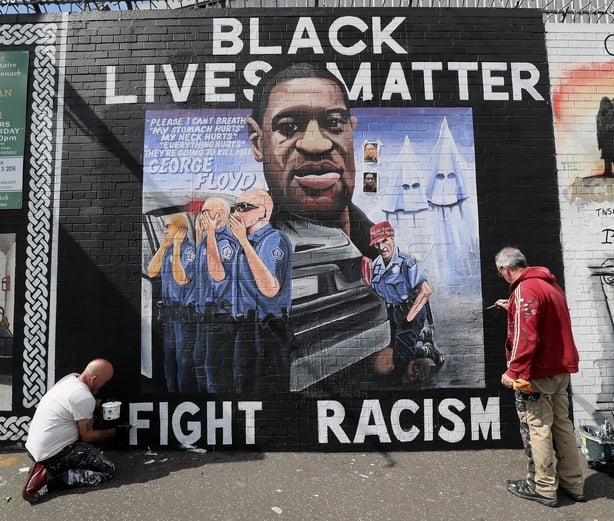
A new mural in Belfast, N. Ireland.
But, even though I currently am not getting a lot of visitors to this blog (I’m getting some and will soon get more), here are my thoughts about the issues thrown up by the protests.
Many people (like Trump) don’t understand this, but this is not about George Floyd. This is about hundreds of years of black lives being valued less than white lives in this country, including an apparent surge in the murders of unarmed Black people by police in the last several years, as well as some modern-day lynchings that more or less don’t involve the police. I was told at a BLM protest march around 2015 that in a 365-day period ending shortly before that day about 200 black people, armed or unarmed, had been killed by American police. I’m sure some of them were armed, but A) I’m very open-minded about allegations that cops plant guns and B) around that time there were SEVERAL highly publicized cases where undeniably unarmed Black people were killed by police. Police are practically never convicted, or even prosecuted (and rarely fired) for such deaths. Although there isn’t solidly comprehensive information about how often unarmed black people are killed by police here like there’s information about the security forces killing Catholic civilians in Northern Ireland’s Troubles, one reason I believe it’s a widespread and serious problem is that both the Southern Poverty Law Center and the Anti-Defamation League, two organizations that generally get along with police, have expressed support for BLM. That’s here and here. They are making these statements because even though they are sort of pro-cop, they are even more anti-racist and anti-injustice and anti-inequality. And that’s the agenda they see in BLM. (And in the case of the ADL, their support for BLM is also despite the fact that BLM has expressed criticism of Israel)
Trump claims to be sensitive to the death of Floyd, but he clearly isn’t beyond the death of that one individual. He isn’t sensitive to what Floyd’s death symbolizes. His National Security Advisor has said “No, I don't think there's systemic racism. I think 99.9% of our law enforcement officers are great Americans.” Based on multiple facts, a lot more than .1% of police are racist. That’s based on simple common sense, but also the following:
1) What I wrote about the SPLC and the ADL and BLM.
2) In 1992, when the controversy over the Body Count (Ice-T’s heavy metal band) song Cop Killer broke, the (then- 35,000 member) National Black Police Association kind of backed Ice-T. According to an article in the Orlando Sentinel:
The 35,000-member National Black Police Association says it won't join the boycott. Police should try to get at the root of black discontent and try to change it, said Ronald Hampton, the group's executive director.
"Where were these police groups when the police beat up Rodney King?" Hampton asked. "Why were they not appalled by the actions of their brothers? It rings of hypocrisy.”
3) From what I’ve heard, some massive majority of cops are registered to vote GOP and for the following reasons I believe that is a racist party.
A) Not only do they get no more than about 10% of the Black vote, and only around 25% of the Latino vote (and that would be lower if (more or less) white Latinos were excluded from the calculations), they also get no more than around 25% of the Asian-American vote. That last fact is crucial. Even though Asian-Americans as a group do at least as well financially as white people do as a group, and even though there is the history of FDR and Internment, Asian-Americanss look at the GOP and see it as even less attractive than the Dems.
B) There ’s also the fact that in the 1960s and 1970s Segregationist Democrats migrated to the GOP because the Dems became a civil rights party. In 2005 the GOP ADMITTED (and in all fairness apologized for) using the “Southern Strategy” of 1968 where they appealed to segregationist southerners in order to elect Nixon.
C) As I’ll explain further down, Trump is a racist.
There’s also the fact that, according to HuffPost, the Trump Justice Department ignored police brutality:
“Since President Donald Trump took office, his appointees at the Justice Department have all but eliminated the federal government’s police reform work. The Civil Rights Division’s police practices group has shrunk by half, and it hasn’t opened any major pattern-or-practice investigations that could rein in police departments that regularly violate constitutional rights.”
(Also, see this).
(There’s a lot of things I will gloss over because there’s so much attention on them anyway, like Trump’s use of the phrase “when the looting starts, the shooting starts,” or what happened to facilitate his photo-op with the Bible)
Trump is a racist. Here’s some of the most solid evidence:
1) A few years ago was the first time Trump called Antifa a terrorist organization. It was after Antifa members had done what they’re defined by, and that’s not actually or allegedly rioting. They were fighting people clearly identifiable as fascists, and no, I don’t believe that cops are clearly identifiable as fascists. They were fighting FASCISTS.
2) On a similar note, when an anti-fascist was killed in 2017 in Charlottesville by a fascist, Trump said there were “fine” people on both sides.
3) There’s his attitude to the exonerated victims of a racial miscarriage of justice.
4) When asked about David Duke endorsing him, his response in an interview was:
Well, just so you understand, I don’t know anything about David Duke. OK? I don't know anything about what you’re even talking about with white supremacy or white supremacists. So, I don't know. I don’t know, did he endorse me or what’s going on, because, you know, I know nothing about David Duke. I know nothing about white supremacists. And so you're asking me a question that I'm supposed to be talking about people that I know nothing about.
5) There’s his opinion that Lincoln screwed up dealing with what led to the Civil War. Trump thinks that if the then-late former President Andrew Jackson had been President in 1861 the Civil War would have been avoided. Since Jackson was a slave owner and an opponent of abolitionism, that would have involved, at best, a compromise friendly to the South that would have barely affected the life-span and geographic scope of slavery or the treatment of slaves. There’s information about that here and here.
6) His Veterans Affairs Secretary is a neo-confederate.
(As far as those last two, I should explain two facts about the Confederacy. First, they considered ending slavery so they could get military support from Europe and win the war, but decided not to- slavery was more important to them than independence. Also, when Black Union soldiers were captured, they were treated differently than White POWs and in at least one case were simply executed instead of taken to POW camps. The Confederacy was about slavery and racism)
I recently had a bit of a breakthrough on what needs to be done to make significant progress on ridding this country of racism. In addition to everything else people are doing, we need more unions. That’s based on the following:
1. Union households are more likely to vote Democratic than non-union households, and many of the organizers and staff in the labor movement are people of color and most of the whites are anti-racist and most union supporters are people of color or anti-racist whites.
2. In 2000 in a discussion on the email list of the Young Democratic Socialists (now YDSA) a member who was organizing workers in Indiana said that his competition was the Klan (UPDATE 1/26/22 That is, competition for the hearts and minds of the workers).
3. Eammon McCann is a socialist and anti-Unionist activist in Northern Ireland. He was one of the main leaders of the N. Ireland Civil Rights Movement in the late 1960s and early 1970s (he was one of the speakers at the rally/march that was attacked by the British Army on Bloody Sunday in Derry in 1972, and he was an organizer of the second Civil Rights march, the one in Derry in Oct. of 1968). He has held several different senior and very senior positions in the Northern Irish TRADE-union movement in the last 40 years. In 2016 he was elected to the Northern Ireland Assembly and in 2017 he would have been but they reduced the number of seats returned from each constituency form 6 to 5 so he was basically runner-up. As far as I can tell, in the last 40 years at any given time two mainstream or professional news publications have been publishing his columns. He is an expert on sectarianism in N. Ireland. In a column written in the 1980s or 1990s and included in the 1998 anthology of his columns “McCann: War and Peace in Northern Ireland” he wrote:
The trade union movement is better placed than any other to purge the politics of this island of sectarianism. No other institution brings Catholic and Protestant workers together on a regular basis in pursuit of a common purpose which is antipathetic to sectarianism
(Mark Langhammer, who was the leader of the Northern Ireland part of the Irish Labour Party for several years around 2010, told me in 2005 that he agrees with McCann)
I think you could easily say the same thing about racism in this country.
Unfortunately, in recent decades, as the labor movement has become more and more anti-racist, it has gotten smaller and smaller, thanks to the GOP, corporations, and moderate Democrats.
*************
In conclusion, although I’m concerned the protests will result in the spread of COVID-19 and I have been unable to take part in them, I am glad that the protests are happening. They seem likely to be successful in multiple ways and have exposed more than usual the fact that our society is racist and that Trump is a racist.
A new mural in Belfast, N. Ireland.
Tuesday, June 2, 2020
In Memory of JFK
I know that, according to Noam Chomsky, JFK may have been more into escalating the low intensity conflict in Vietnam (it wasn’t much of a war until after he was killed) than Oliver Stone would have us believe. And he was more of a capitalist than FDR was, and he was a Cold Warrior (I don’t know if Stone was right about his attitude towards anti-Castro Cubans). But I still think that he was one of our better Presidents. Although I’m not real familiar with his civil-rights record, a LOT of Black people and Chicana/os and Latina/os greatly admire(d) him (what he was about). He was a mainstream Dem back before the party shifted towards the center, and back when the rich and corporations were taxed more than they have been in the last 45 years, and when privatization was a bad word.
And he was the only Catholic President we have had. And until about the time he was elected, there was a massive history of anti-Catholic bigotry in this country. I’ll get back to that soon.
This post is about the Catholic population of the US (and to some extent elsewhere), the Catholic Church, anti-Catholic bigotry of the sort we find in America, MY relationship to Catholicism, and to a very small degree, Catholicism (although I won’t get theological or philosophical). It might not be incredibly well integrated, so please read the entire post.
I’d been thinking of doing this post for about 2-4 years. What convinced me to do it recently is that I have become more sensitive to the existence of anti-Catholic bigotry in this country, I think because I have become even more sensitive to anti-Semitism than I used to be (it’s come up frequently on my blog in the last 4 months, and between when Trump revealed his “peace” plan for Israel and the Palestinians and early March I read an average of 5 articles a day in the Times of Israel (before COVID-19 it looked like that conflict was going to explode and I wanted to be very informed, and TTI is only slightly pro-Israel)). The most immediate cause of me typing this now instead of two months from now is a joke in a movie I generally like. It’s called “Five Feet Apart” and it’s the perfect combination of comedy, tragedy, and romance. At one point one of the characters says that his life-time to-do list includes having sex in the Vatican. The Vatican is much more religious than political- the Vatican barely counts as a State. I know people will try to wiggle out of this by pointing to differences in hierarchy, but what if he said “in a mosque” or “in a synagogue?” What about the Dalai Lama’s residence? I know people will say that Tibetan Buddhism isn’t as offensive as the Catholic Church, but overall that’s only sort of true, and it doesn’t matter. I know people will point to the differences in hierarchy, but if you identify the politics of the average Muslim, and compare that to either the official positions of the Vatican and/or the politics of the average Catholic, I find the Muslim population more politically offensive (before you get the wrong idea, A) wait till I describe the Catholic part of that comparison, and B) see this and C) see this). And like I said, what if it were a Mosque? I would find that just as offensive.
I have experienced anti-Catholic bigotry 2-3 times.
1. A woman who is clearly more right-wing than left-wing said something in my presence that was anti-Catholic. It was about 5 years ago and I can’t remember what it was but it was not a reasonable criticism of the Church or a reasonable theological disagreement. I am not giving her name, and if I have to, the next time I see her I’ll casually ask her how she feels about Catholics and will be able to provide more solid evidence that she’s anti-Catholic.
2. After a Northern Ireland event I organized, a fairly prominent, progressive local activist came up to me and said that it was weird to think of Catholics as the good guys (she only showed up because a prof. she really likes was supposed to speak). Now, in all fairness, she also said that, as someone who's half Jewish and supports the Palestinians, she considers Jews to be the bad guys, too (that is, she's an equal opportunity idiot). And to a large degree her comment indicated some degree of concern for the Catholic population in the North. But it does indicate a problem.
3. I'm not sure this really counts as anti-Catholicism, in fact this person was fairly interested in Northern Ireland and fairly concerned about the Nationalist (Catholic) community in N. Ireland. In all fairness, when she said this I don't think I knew anything about what she raised that I know now. But she indicated she wasn't real enthusiastic about a United Ireland because Protestant women would be disadvantaged in terms of access to abortion. The thing is, while abortion is something like 99% illegal in the Republic, it was about 95% illegal in the North. That conversation was in the late 1990s and only very recently has the Abortion Act has been extended to N. Ireland. And it was done over the objections of a majority in N. Ireland. And in fact, the Protestant population is a little bit more pro-life than the Catholic population (at a political level as evidenced by statements made during an Assembly debate on the subject in 2000).
The thing is, she was making this assumption about Catholic and Protestant attitudes on abortion that is evidence of anti-Catholicism on the Left. Her statement ignored all the CATHOLIC women who would like access to abortion. (she also suggested that the abortion issue for Protestant women is more important than all the issues that argue in favor of uniting Ireland)
Here are some other things that convince me there is anti-Catholic bigotry on the Left.
1) In 2003 there was a survey done of American non-Catholics which found that some significant minority (I'm almost certain it was 30%) believe that Catholics go along with whatever the Vatican says. Although I'm going to keep this fairly brief, that's ridiculous. There's plenty of dissent. For example, Spain is a leader in gay rights. As I describe here, Catholics in Ireland support gay rights, and in 2015 same-sex marriage was legalized (by a Constitutional Amendment, so it would be difficult to reverse (there wasn’t anything in their Constitution about “a man and a woman”)). As far as I can tell, about 1/3-1/2 of European Catholic majority countries are pro-choice (outside of Europe, it's not as good, overall it's probably some small minority of majority Catholic countries). According to polls by the Pew Research Center, in America in 2013, 76% of Catholics believed the Church should permit birth control, 54% supported same-sex marriage and only 33% believed that homosexual behavior is a sin . As far as I can tell, overwhelmingly the worst the clergy do is inconsistently harass pro-choice Catholic politicians.
The thing is, the liberal positions of the Church (the death penalty, national oppression, war, economic justice) are not nearly as well known as the conservative positions (abortion and homosexuality). Odds are a significant percentage (maybe 30%) of the Left (and liberals, too) assume that all Catholics are conservative, and I've found evidence of that.
2) I've heard at least one comment from a leftist that they're surprised to learn that on most issues, most American Catholics are liberal.
3) This one will take some time. I'll explain shortly why this should have been condemned. First though, as far as I can tell, the Left failed to condemn the Dec. 11th 1989 disruption of a Catholic Mass in New York City by AIDS, pro-choice, and gay rights activists. Now, the Cathedral targeted was ridiculously bad on those issues. But it should have been condemned as a violation of the right to religious freedom, and that doesn't just refer to the Cardinal, but all the parishioners. If Palestinians and their supporters had identified a very anti-Palestinian synagogue and did the same thing, the left would have mostly condemned that. The differences in the situations facing Catholic Americans and Jewish Americans are not big enough to justify that double standard.
If anyone has heard that the Mass was only disrupted by one demonstrator, that's not true.
I have heard nothing to indicate that the Left condemned this protest. All I have heard from the Left is good stuff about the group most associated with the protest- ACT-UP.
4) According the Pew Research Center for the People and the Press, in 1996 "by a margin of 44% to 33% the public thinks that Protestants should have less rather than more political power. Somewhat greater margins want to see Roman Catholics (53% to 27%), evangelicals (51% to 27%) and Jews (49% to 27%) have less power." Odds are about half those people saying that Catholics should have less power (and that figure is greater than it is for any of the other main religious groups mentioned) are to the left of center, and the figure for people on that side of the political spectrum is probably 53%. I'm going to keep this brief, but most or all of these people probably under-estimate what percentage of Protestants (Protestants are almost three times more numerous than Catholics are in America) are pro-life and certainly must be exaggerating the percentage of Catholics who are pro-life- one Pew poll found it was a minority. Catholics are probably no more than a large minority of pro-lifers in America. When it comes to gay rights, Catholics look even better- the homophobic ones are a small minority of homophobes in America (a 2008 Pew poll found that 45% of American Catholics support gay marriage, and I'd estimate there's probably a bloc of 10-20% who oppose gay marriage but nonetheless are difficult to call homophobic). These leftists I'm referring to probably look at conservative Supreme Court Justices and think Catholics having power is a greater threat to liberal goals than Protestants having power is. But look at, for example, conservative Presidents of the US and you'll see just Protestants. The Bible Belt is Protestant. And in general I'm not a fan of talking about this religious group or that religious group being the problem, I'm simply trying to point out how wrong these leftists and liberals are about Catholics being the problem.
There is also the question of equality for Catholics in America. As I explain in another post, NO I DON’T THINK CATHOLICS IN AMERICA ARE OPPRESSED. But overall there is a small degree of inequality for Catholics here.
In an average Presidential election year here, Catholics were about 15% of the population. IF, in some bizarre hypothetical political system that I DO NOT ADVOCATE FOR, Presidential election victories were distributed based on figures for religion and population, there should have been about 9 elections won by a Catholic. Instead we have had one election where a Catholic won. Also, we have only had two elections where a Catholic running for Vice President won.
On the other hand, on the Supreme Court, Catholics have a surplus of power. I am not going to re-do the math I did 1-2 years ago, especially because there are different time periods to look at, but if we look at the last 20 years, about 40-60% of the Supreme Court has been Catholic. Some would point to this as evidence that I am greatly exaggerating anti-Catholic bigotry in this country. But, bearing in mind that the vast majority of such Justices in the last 20 years are conservative and the Dems have a better history (in the last 100 years) of nominating Catholics for President or VP and electing them and admiring them, I think it's similar to anti-Semitic Christian Zionists putting Jews in the spotlight- it's harder for supporters of the Palestinians to attack Jewish supporters of Israel and it's easier for conservative Catholics than it is for conservative WASPs to counter-attack when liberals and leftists call them bigots.
I don’t seriously believe this is because of anti-Catholic bigotry (it’s because a massive chunk of American Catholics are Chicana/o or Latina/o), but it’s not irrelevant that (according to the Pew Research Center) in 2016 only 19% of Catholic households earned $100,000 or more. The following groups were ahead of Catholics- Muslims, Mormons, Lutheran Church-Missouri Synod, Unitarian Universalist, Presbyterian Church in America, United Method Church, Evangelical Lutheran Church in America, United Church of Christ, Orthodox Christian, Agnostic, Atheist, Presbyterian Church (USA), Episcopal Church, Hindu, Jewish (and ALL US ADULTS (I think that means that Catholics are below average)). (I mention this partly because it says something about how much ECONOMIC power Catholics in America have)
Although this may not qualify as anti-Catholic bigotry, I’m going to say it anyway.
Elsewhere on my blog I offered this description of the Irish “Famine.”
Tony Blair was the first British Prime Minister to apologize for British policy during the Famine.
Consider this. Although it’s true that America, in terms of immigration policy, opened its door to the Irish during the Famine, there was incredible nativism and anti-Catholic bigotry at the same time. And, although the UK may have been much less than a fully fledged democracy (today, the monarchy, as far as I’m concerned has got so little power in practice that it almost doesn’t matter, but I think that during the Famine, the monarchy may have been more powerful than it is today, and I’m pretty sure that the un-elected and elitist House of Lords had more power than it does today) and was an imperialist power and was occupying a foreign nation where it’s policies were resulting in something close to genocide, no country in the world militarily took on the UK. America took on Nazi Germany, but not the UK during the Famine. Back then the US was, admittedly, perhaps not as strong militarily as the UK, but they could have assembled a coalition with some European nations, probably some of the Catholic ones, and landed troops in Ireland to kick the British out and stop the shipment of food out of Ireland. (Some would say it was a different USA back then, but has any American President ever apologized for the failure of the US to do something? In some bizarre alternate history where the US sat out WWII and Nazi Germany was defeated anyway and there were a whole bunch of Holocaust survivors, the US would have at some point between then and now apologized for their inaction)
Catholics in N. Ireland went through a nightmare 1969 to 1998 or 2005 (for more information than I provide in this post, you should read all of this).
The Catholic community in N. Ireland experienced high levels of inequality in the first 50 years of NI ’s existence (for more on this see this (describes the undemocratic and sectarian creation of N. Ireland, the inequality Catholics experienced, and how the Troubles began)). Around 1970 the situation transformed. Although there were fewer laws that could be compared to Jim Crow, job discrimination continued or got worse (in 1971 Catholics were twice as likely to be unemployed as Protestants and in 1988 they were TWO AND A HALF times more likely to be unemployed as Protestants) repression got worse, and violence against the Catholic population skyrocketed like you wouldn’t believe. During the Troubles (roughly 1969-2005) they went through a nightmare. 856+ Catholic civilians were killed in the years 1969 to 2005 by either loyalist paramilitaries or the security forces (a comparable scenario in America would have meant around 67,000 unarmed people of color killed by cops or Nazi skinheads (etc.) in the same time period). (A: based on what I’ll describe in the very last section, I would guess that the actual number for that was probably somewhere around 7,000-8,000; B: I'm not saying the racist system in this country wasn't, ideologically or programmatically, capable of killing 67,000 people of color in those years if the "rebellion" among people of color here had been as militaristic as the one among Catholics in N. Ireland; but the reality is that as bad as it was for people of color here in those years, it was, in terms of deaths, MUCH worse for Catholics in N. Ireland). Between 1975 and 1998, with practically zero influence on law and policy beyond local government, they were ruled by a state they quite reasonably saw as both foreign and hostile.
And here are my thoughts about US foreign policy on N. Ireland:
The government most responsible for that nightmare (see this) is the most important ally of the US government in the entire world (in addition to some other relevant info, that post exposes the fact that the British were no more concerned by the sectarian slaughter of Catholic civilians (by organizations that did little else) than they were concerned by IRA attacks that almost never resulted in civilian death). I realize that we are not propping them up like we do with Israel, but who helped us patrol the “No Fly” zones over Iraq 1991-2003?; who contributed something like 20% of the military forces for the invasion of Iraq? And who made a similar contribution during the occupation of Iraq? I believe that the British have a problem- an Ireland problem, or an imperialism problem or whatever you would call it. They need an intervention and you get friends, not enemies or strangers for interventions. The US needs to convince the British to begin, ASAP, a decades-long process of getting out of Ireland.
Ways in which Washington DC was bad on N. Ireland:
1) It seems that D.C. never privately put firm pressure on the British to dramatically change its policy in N. Ireland and/or create a significant role for the South in the affairs of the North (or even, better, begin a process of withdrawal). If they did this privately, it didn't work, and they should have done it publicly (it's possible that to some degree it was done privately between Clinton and Blair, and had some small effect on the GFA, but the GFA could have been much better, and then there's the ultimate goal of a British withdrawal).
2) At some point, possibly for a long period of time, an American company was selling the UK the plastic bullets they were using in N. Ireland.
3) Although at some point in the 1970s the President or Vice President of SF did speak at a committee hearing of the US Congress, from 1983 until 1994 the President of SF was Gerry Adams (he continued in that role until a few years ago, but was first allowed into the U.S. in 1994), and he was not allowed into the US. During this time SF was getting 40% of the Nationalist vote and probably about 60% of the vote from the poorest half of the Nationalist community (go here and type "SDLP" and "Ireland" in the first field and "middle-class" in the second field) (remember what I wrote about unemployment, and see this).
4) During the entire conflict, something like 20 former republican Volunteers went through either extradition or deportation proceedings. I think all the extradited were sent back to the UK, I think most of the deportation cases were deported. I know of at least one deportation, and this was probably the case with all of them, where the issue was that he said on the immigration paperwork that he was never convicted of a crime, and the U.S. government said that he in fact had been. The thing is, republican Volunteers don't consider themselves criminals, and even the British government, to some degree, has recognized this by treating them as prisoners of war during most of the conflict. But the U.S. Government disagrees. There's evidence that some very large majority of the nationalist community more or less supported the hunger-strikers of 1981 whose struggle convinced the British to extend status as prisoners of war (or political status, basically the same thing), which makes me think that some very large majority of the nationalist community was more or less unhappy about the extraditions and deportations (see this and the middle third of this).
5) About 17 years ago Bush was putting so much pressure on SF over policing and decommissioning that Blair told him to ease up.
6) Bush's Immigration had Bernadette Devlin-McAliskey deported, claiming she was a "threat" to the U.S. Devlin-McAliskey has little connection to violence, and half of that connection (the Battle of the Bogside) was widely considered completely justified; the other half, there's less widespread agreement about how justified it was, but she was only associated with the Irish National Liberation Army for something between a few months and about a year in the mid-1970s. Although she has no chance of getting elected to parliament, she's still very popular among the Nationalist population.
It’s not like the US didn't have a relationship with the British, they were best friends. I doubt that anti-Catholic bigotry was more than a very small part of it, and Clinton (in contrast to Reagan of the Reagan and Thatcher friendship) played a slightly positive role in the Peace Process, but still…
After explaining why politically conscious Americans should have seen N. Ireland as an important issue (and I think largely of progressives when I think about this), I should say that very little was done. That’s based partly on America’s policy decisions regarding N. Ireland and the fact that there was never a “million-mick march” and my own experience with the issue. On a liberal-progressive campus in a liberal-progressive city (University of Colorado at Boulder), my activism on the North was about 1/7 as successful as my non-NI activism on a range of leftist issues. On average about 25 people were at the NI events, about 175 people were at the other events (that's between 1994 and 2004; between 94 and 01 it was 30 for NI, 75 for everything else). Also in Boulder, CO, the Rocky Mountain Peace and Justice Center has been a very well-respected and successful progressive organization for decades. They often have some representation among the speakers at the official Martin Luther King Jr. day rally in Boulder. Carolyn Bninski, one of the two main staff people in the last 15-20 years wrote me in an email: “We may have anywhere from 5 to 100 people at an event.” In 2005 RMPJC organized three events about the North of Ireland. On average each one had 2 people in the audience. In 2008 they organized another event which attracted about 5 people. (RMPJC has been involved with at least two earlier events about the North, but in this paragraph I’m only looking at the ones where they were the only sponsor). The point of mentioning attendance at RMPJC events is that among the rank and file of the broad progressive movement there is almost no interest in the subject.
On one hand, very few Catholics, outside about 25% of the Irish-American population and about 10% of the Chicana/o population, cared about the North. But I believe that what I wrote above about anti-Catholic bigotry and what I write in the next section explains why there was so little interest.
A lot of Religious Right Evangelical people in America complain about anti-Christian persecution in other countries. I am more or less okay with them being concerned about that, although I think they tend to target countries that they don’t like for other reasons and I wouldn’t be surprised if they sometimes exaggerate the degree of persecution. The main problem though, is that they were silent during decades of Catholics being, to one degree or another, oppressed in Northern Ireland. There WERE other factors that determined how Catholics were treated (anti-Irish bigotry) and some Catholics were Unionists (supported N. Ireland remaining in the UK) but anti-Catholic bigotry was a big factor in how Catholics were treated. Read this and this (the first of those two links is the more relevant one).
The Pope has never visited N. Ireland and there’s a reason for that. Former British Prime Minister Tony Blair didn’t convert to Catholicism until AFTER he resigned and there’s a reason for that. And until recently the Monarch of the UK couldn’t be a Catholic or MARRIED to a Catholic (that second part has been changed, but not the first part).
(I’m not saying that Catholics are prevented from practicing their faith, but if you read the first of those posts, you’ll see there were a lot of ways where the government, at every level, was anti-Catholic (bear in mind that the Army was controlled by London and almost the entire time during The Troubles, the police were also controlled by London))
They were also silent during Indonesia’s genocidal occupation of East Timor. The East Timorese are Catholic and the Indonesians are Muslim. When I listened to a recording of Noam Chomsky talking about East Timor, he was introduced by a graduate student who had researched East Timor and who said that it had become a religious conflict (I can’t remember to what degree it had become a religious conflict according to him). But, because the leader of Indonesia was anti-Communist, the US supported Indonesia.
(And these Evangelical people hate Muslims and love talking about Muslims hating Christians, but weren't at all alarmed about Catholics being oppressed by Muslims- they must really be unconcerned about Catholics (see below) (if you're getting the wrong idea, see this))
I did a search and looked at several results and as far as I can tell, a lot of Evangelicals don’t believe that Catholics are Christians.
Here are my thoughts on the idea that Catholics aren’t Christians.
A: With the exception of a tiny minority (about 1% if not less) called “Radical, Traditionalist Catholics,” who I believe have been told by the Vatican to fuck off, we recognize Protestants as Christians.
B: It’s simply sectarian.
C: We believe that Christ was the Son of God.
D: As far as I can tell, these Evangelicals who don’t believe Catholics are Christians recognize other Protestants as Protestant even though they have some different ideas about Protestantism and Christianity in general.
And he was the only Catholic President we have had. And until about the time he was elected, there was a massive history of anti-Catholic bigotry in this country. I’ll get back to that soon.
This post is about the Catholic population of the US (and to some extent elsewhere), the Catholic Church, anti-Catholic bigotry of the sort we find in America, MY relationship to Catholicism, and to a very small degree, Catholicism (although I won’t get theological or philosophical). It might not be incredibly well integrated, so please read the entire post.
*****************
I’d been thinking of doing this post for about 2-4 years. What convinced me to do it recently is that I have become more sensitive to the existence of anti-Catholic bigotry in this country, I think because I have become even more sensitive to anti-Semitism than I used to be (it’s come up frequently on my blog in the last 4 months, and between when Trump revealed his “peace” plan for Israel and the Palestinians and early March I read an average of 5 articles a day in the Times of Israel (before COVID-19 it looked like that conflict was going to explode and I wanted to be very informed, and TTI is only slightly pro-Israel)). The most immediate cause of me typing this now instead of two months from now is a joke in a movie I generally like. It’s called “Five Feet Apart” and it’s the perfect combination of comedy, tragedy, and romance. At one point one of the characters says that his life-time to-do list includes having sex in the Vatican. The Vatican is much more religious than political- the Vatican barely counts as a State. I know people will try to wiggle out of this by pointing to differences in hierarchy, but what if he said “in a mosque” or “in a synagogue?” What about the Dalai Lama’s residence? I know people will say that Tibetan Buddhism isn’t as offensive as the Catholic Church, but overall that’s only sort of true, and it doesn’t matter. I know people will point to the differences in hierarchy, but if you identify the politics of the average Muslim, and compare that to either the official positions of the Vatican and/or the politics of the average Catholic, I find the Muslim population more politically offensive (before you get the wrong idea, A) wait till I describe the Catholic part of that comparison, and B) see this and C) see this). And like I said, what if it were a Mosque? I would find that just as offensive.
I have experienced anti-Catholic bigotry 2-3 times.
1. A woman who is clearly more right-wing than left-wing said something in my presence that was anti-Catholic. It was about 5 years ago and I can’t remember what it was but it was not a reasonable criticism of the Church or a reasonable theological disagreement. I am not giving her name, and if I have to, the next time I see her I’ll casually ask her how she feels about Catholics and will be able to provide more solid evidence that she’s anti-Catholic.
2. After a Northern Ireland event I organized, a fairly prominent, progressive local activist came up to me and said that it was weird to think of Catholics as the good guys (she only showed up because a prof. she really likes was supposed to speak). Now, in all fairness, she also said that, as someone who's half Jewish and supports the Palestinians, she considers Jews to be the bad guys, too (that is, she's an equal opportunity idiot). And to a large degree her comment indicated some degree of concern for the Catholic population in the North. But it does indicate a problem.
3. I'm not sure this really counts as anti-Catholicism, in fact this person was fairly interested in Northern Ireland and fairly concerned about the Nationalist (Catholic) community in N. Ireland. In all fairness, when she said this I don't think I knew anything about what she raised that I know now. But she indicated she wasn't real enthusiastic about a United Ireland because Protestant women would be disadvantaged in terms of access to abortion. The thing is, while abortion is something like 99% illegal in the Republic, it was about 95% illegal in the North. That conversation was in the late 1990s and only very recently has the Abortion Act has been extended to N. Ireland. And it was done over the objections of a majority in N. Ireland. And in fact, the Protestant population is a little bit more pro-life than the Catholic population (at a political level as evidenced by statements made during an Assembly debate on the subject in 2000).
The thing is, she was making this assumption about Catholic and Protestant attitudes on abortion that is evidence of anti-Catholicism on the Left. Her statement ignored all the CATHOLIC women who would like access to abortion. (she also suggested that the abortion issue for Protestant women is more important than all the issues that argue in favor of uniting Ireland)
Here are some other things that convince me there is anti-Catholic bigotry on the Left.
1) In 2003 there was a survey done of American non-Catholics which found that some significant minority (I'm almost certain it was 30%) believe that Catholics go along with whatever the Vatican says. Although I'm going to keep this fairly brief, that's ridiculous. There's plenty of dissent. For example, Spain is a leader in gay rights. As I describe here, Catholics in Ireland support gay rights, and in 2015 same-sex marriage was legalized (by a Constitutional Amendment, so it would be difficult to reverse (there wasn’t anything in their Constitution about “a man and a woman”)). As far as I can tell, about 1/3-1/2 of European Catholic majority countries are pro-choice (outside of Europe, it's not as good, overall it's probably some small minority of majority Catholic countries). According to polls by the Pew Research Center, in America in 2013, 76% of Catholics believed the Church should permit birth control, 54% supported same-sex marriage and only 33% believed that homosexual behavior is a sin . As far as I can tell, overwhelmingly the worst the clergy do is inconsistently harass pro-choice Catholic politicians.
The thing is, the liberal positions of the Church (the death penalty, national oppression, war, economic justice) are not nearly as well known as the conservative positions (abortion and homosexuality). Odds are a significant percentage (maybe 30%) of the Left (and liberals, too) assume that all Catholics are conservative, and I've found evidence of that.
2) I've heard at least one comment from a leftist that they're surprised to learn that on most issues, most American Catholics are liberal.
3) This one will take some time. I'll explain shortly why this should have been condemned. First though, as far as I can tell, the Left failed to condemn the Dec. 11th 1989 disruption of a Catholic Mass in New York City by AIDS, pro-choice, and gay rights activists. Now, the Cathedral targeted was ridiculously bad on those issues. But it should have been condemned as a violation of the right to religious freedom, and that doesn't just refer to the Cardinal, but all the parishioners. If Palestinians and their supporters had identified a very anti-Palestinian synagogue and did the same thing, the left would have mostly condemned that. The differences in the situations facing Catholic Americans and Jewish Americans are not big enough to justify that double standard.
If anyone has heard that the Mass was only disrupted by one demonstrator, that's not true.
I have heard nothing to indicate that the Left condemned this protest. All I have heard from the Left is good stuff about the group most associated with the protest- ACT-UP.
4) According the Pew Research Center for the People and the Press, in 1996 "by a margin of 44% to 33% the public thinks that Protestants should have less rather than more political power. Somewhat greater margins want to see Roman Catholics (53% to 27%), evangelicals (51% to 27%) and Jews (49% to 27%) have less power." Odds are about half those people saying that Catholics should have less power (and that figure is greater than it is for any of the other main religious groups mentioned) are to the left of center, and the figure for people on that side of the political spectrum is probably 53%. I'm going to keep this brief, but most or all of these people probably under-estimate what percentage of Protestants (Protestants are almost three times more numerous than Catholics are in America) are pro-life and certainly must be exaggerating the percentage of Catholics who are pro-life- one Pew poll found it was a minority. Catholics are probably no more than a large minority of pro-lifers in America. When it comes to gay rights, Catholics look even better- the homophobic ones are a small minority of homophobes in America (a 2008 Pew poll found that 45% of American Catholics support gay marriage, and I'd estimate there's probably a bloc of 10-20% who oppose gay marriage but nonetheless are difficult to call homophobic). These leftists I'm referring to probably look at conservative Supreme Court Justices and think Catholics having power is a greater threat to liberal goals than Protestants having power is. But look at, for example, conservative Presidents of the US and you'll see just Protestants. The Bible Belt is Protestant. And in general I'm not a fan of talking about this religious group or that religious group being the problem, I'm simply trying to point out how wrong these leftists and liberals are about Catholics being the problem.
**************
There is also the question of equality for Catholics in America. As I explain in another post, NO I DON’T THINK CATHOLICS IN AMERICA ARE OPPRESSED. But overall there is a small degree of inequality for Catholics here.
In an average Presidential election year here, Catholics were about 15% of the population. IF, in some bizarre hypothetical political system that I DO NOT ADVOCATE FOR, Presidential election victories were distributed based on figures for religion and population, there should have been about 9 elections won by a Catholic. Instead we have had one election where a Catholic won. Also, we have only had two elections where a Catholic running for Vice President won.
On the other hand, on the Supreme Court, Catholics have a surplus of power. I am not going to re-do the math I did 1-2 years ago, especially because there are different time periods to look at, but if we look at the last 20 years, about 40-60% of the Supreme Court has been Catholic. Some would point to this as evidence that I am greatly exaggerating anti-Catholic bigotry in this country. But, bearing in mind that the vast majority of such Justices in the last 20 years are conservative and the Dems have a better history (in the last 100 years) of nominating Catholics for President or VP and electing them and admiring them, I think it's similar to anti-Semitic Christian Zionists putting Jews in the spotlight- it's harder for supporters of the Palestinians to attack Jewish supporters of Israel and it's easier for conservative Catholics than it is for conservative WASPs to counter-attack when liberals and leftists call them bigots.
I don’t seriously believe this is because of anti-Catholic bigotry (it’s because a massive chunk of American Catholics are Chicana/o or Latina/o), but it’s not irrelevant that (according to the Pew Research Center) in 2016 only 19% of Catholic households earned $100,000 or more. The following groups were ahead of Catholics- Muslims, Mormons, Lutheran Church-Missouri Synod, Unitarian Universalist, Presbyterian Church in America, United Method Church, Evangelical Lutheran Church in America, United Church of Christ, Orthodox Christian, Agnostic, Atheist, Presbyterian Church (USA), Episcopal Church, Hindu, Jewish (and ALL US ADULTS (I think that means that Catholics are below average)). (I mention this partly because it says something about how much ECONOMIC power Catholics in America have)
***********
Although this may not qualify as anti-Catholic bigotry, I’m going to say it anyway.
Elsewhere on my blog I offered this description of the Irish “Famine.”
During the Famine, 10-15% of the population died and 10-15% of the population would have died if they hadn’t emigrated. This was concentrated in the South and West of Ireland where there very few settlers- if you ignore the settlers and their descendants, it was probably closer to 15-20% and 15-20% of the population. Why did a potato blight result in something close to genocide? First, the indigenous Catholic population was still recovering from about 1.5 centuries of political and legal disempowerment that occurred because of the Penal Laws which denied them most of the rights enjoyed by most or all Protestants (it varied from right to right). “Catholic Emancipation” was only made about 90% complete about 15 years earlier. Because of this and general poverty, the indigenous population was largely dependent on land owned by land lords and the potato crop. For about 45 years before the Famine and during the Famine, Ireland didn’t have a devolved parliament, they were completely ruled from London. Crucially, during the Famine, MASSIVE amounts of food were being shipped from Ireland to Britain, something that involved seventy-five British Army regiments. … the deaths only stopped when the blight stopped. … The British were more or less racist towards the Irish at that point in Anglo-Irish history and were more concerned about practicing Laissez-faire economics and feeding the British population than they were concerned about mass starvation among the Irish
Tony Blair was the first British Prime Minister to apologize for British policy during the Famine.
Consider this. Although it’s true that America, in terms of immigration policy, opened its door to the Irish during the Famine, there was incredible nativism and anti-Catholic bigotry at the same time. And, although the UK may have been much less than a fully fledged democracy (today, the monarchy, as far as I’m concerned has got so little power in practice that it almost doesn’t matter, but I think that during the Famine, the monarchy may have been more powerful than it is today, and I’m pretty sure that the un-elected and elitist House of Lords had more power than it does today) and was an imperialist power and was occupying a foreign nation where it’s policies were resulting in something close to genocide, no country in the world militarily took on the UK. America took on Nazi Germany, but not the UK during the Famine. Back then the US was, admittedly, perhaps not as strong militarily as the UK, but they could have assembled a coalition with some European nations, probably some of the Catholic ones, and landed troops in Ireland to kick the British out and stop the shipment of food out of Ireland. (Some would say it was a different USA back then, but has any American President ever apologized for the failure of the US to do something? In some bizarre alternate history where the US sat out WWII and Nazi Germany was defeated anyway and there were a whole bunch of Holocaust survivors, the US would have at some point between then and now apologized for their inaction)
Catholics in N. Ireland went through a nightmare 1969 to 1998 or 2005 (for more information than I provide in this post, you should read all of this).
The Catholic community in N. Ireland experienced high levels of inequality in the first 50 years of NI ’s existence (for more on this see this (describes the undemocratic and sectarian creation of N. Ireland, the inequality Catholics experienced, and how the Troubles began)). Around 1970 the situation transformed. Although there were fewer laws that could be compared to Jim Crow, job discrimination continued or got worse (in 1971 Catholics were twice as likely to be unemployed as Protestants and in 1988 they were TWO AND A HALF times more likely to be unemployed as Protestants) repression got worse, and violence against the Catholic population skyrocketed like you wouldn’t believe. During the Troubles (roughly 1969-2005) they went through a nightmare. 856+ Catholic civilians were killed in the years 1969 to 2005 by either loyalist paramilitaries or the security forces (a comparable scenario in America would have meant around 67,000 unarmed people of color killed by cops or Nazi skinheads (etc.) in the same time period). (A: based on what I’ll describe in the very last section, I would guess that the actual number for that was probably somewhere around 7,000-8,000; B: I'm not saying the racist system in this country wasn't, ideologically or programmatically, capable of killing 67,000 people of color in those years if the "rebellion" among people of color here had been as militaristic as the one among Catholics in N. Ireland; but the reality is that as bad as it was for people of color here in those years, it was, in terms of deaths, MUCH worse for Catholics in N. Ireland). Between 1975 and 1998, with practically zero influence on law and policy beyond local government, they were ruled by a state they quite reasonably saw as both foreign and hostile.
And here are my thoughts about US foreign policy on N. Ireland:
The government most responsible for that nightmare (see this) is the most important ally of the US government in the entire world (in addition to some other relevant info, that post exposes the fact that the British were no more concerned by the sectarian slaughter of Catholic civilians (by organizations that did little else) than they were concerned by IRA attacks that almost never resulted in civilian death). I realize that we are not propping them up like we do with Israel, but who helped us patrol the “No Fly” zones over Iraq 1991-2003?; who contributed something like 20% of the military forces for the invasion of Iraq? And who made a similar contribution during the occupation of Iraq? I believe that the British have a problem- an Ireland problem, or an imperialism problem or whatever you would call it. They need an intervention and you get friends, not enemies or strangers for interventions. The US needs to convince the British to begin, ASAP, a decades-long process of getting out of Ireland.
Ways in which Washington DC was bad on N. Ireland:
1) It seems that D.C. never privately put firm pressure on the British to dramatically change its policy in N. Ireland and/or create a significant role for the South in the affairs of the North (or even, better, begin a process of withdrawal). If they did this privately, it didn't work, and they should have done it publicly (it's possible that to some degree it was done privately between Clinton and Blair, and had some small effect on the GFA, but the GFA could have been much better, and then there's the ultimate goal of a British withdrawal).
2) At some point, possibly for a long period of time, an American company was selling the UK the plastic bullets they were using in N. Ireland.
3) Although at some point in the 1970s the President or Vice President of SF did speak at a committee hearing of the US Congress, from 1983 until 1994 the President of SF was Gerry Adams (he continued in that role until a few years ago, but was first allowed into the U.S. in 1994), and he was not allowed into the US. During this time SF was getting 40% of the Nationalist vote and probably about 60% of the vote from the poorest half of the Nationalist community (go here and type "SDLP" and "Ireland" in the first field and "middle-class" in the second field) (remember what I wrote about unemployment, and see this).
4) During the entire conflict, something like 20 former republican Volunteers went through either extradition or deportation proceedings. I think all the extradited were sent back to the UK, I think most of the deportation cases were deported. I know of at least one deportation, and this was probably the case with all of them, where the issue was that he said on the immigration paperwork that he was never convicted of a crime, and the U.S. government said that he in fact had been. The thing is, republican Volunteers don't consider themselves criminals, and even the British government, to some degree, has recognized this by treating them as prisoners of war during most of the conflict. But the U.S. Government disagrees. There's evidence that some very large majority of the nationalist community more or less supported the hunger-strikers of 1981 whose struggle convinced the British to extend status as prisoners of war (or political status, basically the same thing), which makes me think that some very large majority of the nationalist community was more or less unhappy about the extraditions and deportations (see this and the middle third of this).
5) About 17 years ago Bush was putting so much pressure on SF over policing and decommissioning that Blair told him to ease up.
6) Bush's Immigration had Bernadette Devlin-McAliskey deported, claiming she was a "threat" to the U.S. Devlin-McAliskey has little connection to violence, and half of that connection (the Battle of the Bogside) was widely considered completely justified; the other half, there's less widespread agreement about how justified it was, but she was only associated with the Irish National Liberation Army for something between a few months and about a year in the mid-1970s. Although she has no chance of getting elected to parliament, she's still very popular among the Nationalist population.
It’s not like the US didn't have a relationship with the British, they were best friends. I doubt that anti-Catholic bigotry was more than a very small part of it, and Clinton (in contrast to Reagan of the Reagan and Thatcher friendship) played a slightly positive role in the Peace Process, but still…
*******************
After explaining why politically conscious Americans should have seen N. Ireland as an important issue (and I think largely of progressives when I think about this), I should say that very little was done. That’s based partly on America’s policy decisions regarding N. Ireland and the fact that there was never a “million-mick march” and my own experience with the issue. On a liberal-progressive campus in a liberal-progressive city (University of Colorado at Boulder), my activism on the North was about 1/7 as successful as my non-NI activism on a range of leftist issues. On average about 25 people were at the NI events, about 175 people were at the other events (that's between 1994 and 2004; between 94 and 01 it was 30 for NI, 75 for everything else). Also in Boulder, CO, the Rocky Mountain Peace and Justice Center has been a very well-respected and successful progressive organization for decades. They often have some representation among the speakers at the official Martin Luther King Jr. day rally in Boulder. Carolyn Bninski, one of the two main staff people in the last 15-20 years wrote me in an email: “We may have anywhere from 5 to 100 people at an event.” In 2005 RMPJC organized three events about the North of Ireland. On average each one had 2 people in the audience. In 2008 they organized another event which attracted about 5 people. (RMPJC has been involved with at least two earlier events about the North, but in this paragraph I’m only looking at the ones where they were the only sponsor). The point of mentioning attendance at RMPJC events is that among the rank and file of the broad progressive movement there is almost no interest in the subject.
On one hand, very few Catholics, outside about 25% of the Irish-American population and about 10% of the Chicana/o population, cared about the North. But I believe that what I wrote above about anti-Catholic bigotry and what I write in the next section explains why there was so little interest.
*****************
A lot of Religious Right Evangelical people in America complain about anti-Christian persecution in other countries. I am more or less okay with them being concerned about that, although I think they tend to target countries that they don’t like for other reasons and I wouldn’t be surprised if they sometimes exaggerate the degree of persecution. The main problem though, is that they were silent during decades of Catholics being, to one degree or another, oppressed in Northern Ireland. There WERE other factors that determined how Catholics were treated (anti-Irish bigotry) and some Catholics were Unionists (supported N. Ireland remaining in the UK) but anti-Catholic bigotry was a big factor in how Catholics were treated. Read this and this (the first of those two links is the more relevant one).
The Pope has never visited N. Ireland and there’s a reason for that. Former British Prime Minister Tony Blair didn’t convert to Catholicism until AFTER he resigned and there’s a reason for that. And until recently the Monarch of the UK couldn’t be a Catholic or MARRIED to a Catholic (that second part has been changed, but not the first part).
(I’m not saying that Catholics are prevented from practicing their faith, but if you read the first of those posts, you’ll see there were a lot of ways where the government, at every level, was anti-Catholic (bear in mind that the Army was controlled by London and almost the entire time during The Troubles, the police were also controlled by London))
They were also silent during Indonesia’s genocidal occupation of East Timor. The East Timorese are Catholic and the Indonesians are Muslim. When I listened to a recording of Noam Chomsky talking about East Timor, he was introduced by a graduate student who had researched East Timor and who said that it had become a religious conflict (I can’t remember to what degree it had become a religious conflict according to him). But, because the leader of Indonesia was anti-Communist, the US supported Indonesia.
(And these Evangelical people hate Muslims and love talking about Muslims hating Christians, but weren't at all alarmed about Catholics being oppressed by Muslims- they must really be unconcerned about Catholics (see below) (if you're getting the wrong idea, see this))
I did a search and looked at several results and as far as I can tell, a lot of Evangelicals don’t believe that Catholics are Christians.
Here are my thoughts on the idea that Catholics aren’t Christians.
A: With the exception of a tiny minority (about 1% if not less) called “Radical, Traditionalist Catholics,” who I believe have been told by the Vatican to fuck off, we recognize Protestants as Christians.
B: It’s simply sectarian.
C: We believe that Christ was the Son of God.
D: As far as I can tell, these Evangelicals who don’t believe Catholics are Christians recognize other Protestants as Protestant even though they have some different ideas about Protestantism and Christianity in general.
*****************
Some of this is repetitive but I’ll describe the politics of Catholics. We’re all fascist scum.
Seriously, though, overall, looking at the Vatican, the Catholic population (I’m most familiar with their politics in America and Ireland, but have some sort of idea of where the others are politically) and looking at all the issues, if we were to attach numerical values to different positions and find the average, the center of the Catholic world would be significantly to the left of center, somewhere around Barack Obama, if that's not too vague.
Abortion.
The Church is certainly pro-life. I’ll be honest, I’m not sure to what degree it’s flexible in terms of less harshly condemning abortion in the following cases: rape, incest, when the woman’s mental or physical health is in danger, or when the physical health of the fetus is in serious doubt (i.e. a fatal fetal abnormality). I’m not sure if they believe that women who have abortions should be criminalized. As I’ll mention below, they’re pretty good on economic justice issues and they probably support free or subsidized child care and other financial measures that address the financial motivation that is often part of why in some cases women have an abortion. In Ireland, there is a minority of Catholics who are more or less pro-choice (as I mentioned above, a majority of American Catholics are pro-choice).
Homosexuality.
The Church considers homosexuality a sin but there is a concept that I think most homophobic Catholics (and there aren’t many left) believe in. That is, and these are not my words: “hate the sin and love the sinner.” Ireland has had gay marriage since 2015 and the last few years the Prime Minister has been an openly gay man. UPDATE 10/21/20 The Pope recently came out in support of same-sex unions, according to this.
Economic Justice
The church is only intermittently bad about this sort of thing. In 1995 when I asked my church to take up a labor struggle, they declined and said they had done that sort of thing not long before I asked. When a grocery store strike in the greater Denver, CO area was either in effect or on the horizon, I read that there were concerns that the area’s Catholic Church might (abnormally) not support it because the owner of the chain had donated a lot of money to the Church. During the 2016 American Presidential primaries, the Vatican had Bernie Sanders take part in a conference it had organized about economic justice but didn’t extend an invitation to Hilary Clinton. There’s also the actions that El Salvador’s martyred Archbishop Oscar Romero took in support of the poor.
War
The Vatican intermittently takes the wrong position on this, in my opinion, but that includes their condemnation of the IRA. They did, correctly, oppose the invasion of Iraq.
The Death Penalty
The Church is very much against it. In America I’m not sure how many of them are partly motivated by the fact that the death penalty here is racist, but the Church opposes it.
National Oppression
In general the church is very good about this, although I’m not sure how consistently white clergy in America oppose racism, but the non-white clergy do. The Vatican has expressed a lot of support for the Palestinians, and as far as I can tell very few if any Palestinian are Catholic. The Church in East Timor was, starting 1-3 decades before their arrested achievement of independence, in favor of independence and during the Indonesian occupation I think the Vatican was fairly concerned about the East Timorese.
Anti-Semitism
Although I can’t remember the details, during the Nazi era in Germany there were two popes, first one and then the other and one was more or or less pro-Nazi. I read recently that the archives of his tenure as Pope are being opened to researchers and soon we’ll know more about his attitude towards Jews. No, 1920s Munich wasn’t Catholic. Okay, yes it was.
I recently came across an article here about the current Pope’s positive opinion of things Jewish.
UPDATE 10/31/20 Fratelli Tutti: The Pope released a new Encyclical a month ago called Fratelli Tutti. It touches on a lot of issues and is a good example of the progressive tendencies at the Vatican. There's a good opinion column about it here by EJ Dionne in the Washington Post or if you don't want to pay the Post to read it, read this.
The Mary-Knoll Sisters
They are a Catholic Congregation that is greatly concerned about injustice. They take a very multi-cultural and inter-faith approach to their work. I’m not real familiar with them but I know that in the 1990s a LOT of their work was against The School of The Americas (a training center the US Military provided for officers from various Latin American countries and that had a reputation for graduating people who either committed massive human rights violations before they attended the school or after they graduated).
*********
When I was around the age of 11, I read the children’s Bible three times. I’ve never read the whole normal version, although I’ve certainly been exposed to it in other ways. There are a lot of things in the New Testament (and maybe some in the Old Testament) that sowed the seeds which 5-7 years later became my belief in socialism. On the other hand I have never identified as a religious socialist, which is a branch or caucus of the broad socialist movement that bring their religion into it quite a bit. In general, outwardly I’m a pretty secular person and I don’t make religious arguments about politics.
I have not been to a regular Mass since my Mom’s funeral in 2000. A few weeks later I went on a retreat at a monastery in southern Colorado that had been very important to my mom (it's part of the Carmelite Order or a branch of that order that brings Brothers and Sisters together (last I heard that branch had a place in the South of Ireland) (when I briefly browsed their library I found a copy of Michael Harrington’s socialist anti-poverty book “The Other America”)). A year later, I spent a few days around the anniversary of her death at the monastery again. But besides the two retreats I have not been to Mass in 20 years.
When I was 18 I went to Confirmation class, which is one of the things Catholics do like Baptism or Communion. I was faithful and probably one of the more interested students- I think some of the others were doing it just because their parents made them. One of the volunteer lay teachers told us that he was shortly going to get a Masters in Social Work. I decided to not get confirmed. Rightly or wrongly, and I kind of regret that decision, I felt like I didn’t need the ultra-official stamp of approval by the church to be a Catholic and I wasn’t told to stop receiving communion of anything like that, I kept going to Mass (although I almost never went to Mass on my own initiative, I went with my family almost every Sunday until I left for college and after that I went on my own a few times and occasionally with my Mom).
Recently I had two thoughts that developed at roughly the same time: A) going to Mass again and B) converting. I started to wonder if I was even still considered a Catholic since I wasn’t confirmed and hadn’t been to Church in a long time. I spoke with a senior lay staff person at my old Church and he said that I was still a Catholic, but, because of the 18 years of not going to Mass I was technically a bad Catholic. We had a good talk. I was thinking that if I DID go to Mass on a regular basis, I might even get involved beyond that somehow. I have not made much progress on going to Mass- my life has been interrupted here and there since then and I have kind of dragged my feet as far as making a decision and right now, for multiple reasons, is not a good time.
(I have decided that in some ways I was a good Catholic while not going to Mass. In the last 8-10 years I have volunteered an average of 4-6 hours a week at a food-bank and I believe that my political activity on the subject of Northern Ireland also erodes the idea that I’m a bad Catholic)
Why have I considered converting? There are four things I don’t like about the Catholic Church and the fourth one is just too much because I don’t think a lot of Catholics are mad about it.
1. Abortion. I’m pro-choice for the following reasons: I don’t know whether or not the fetus is alive but I am sure that A) women should control their own bodies, B) without the right to choose they can’t have full equality, and C) if men could also get pregnant there would be a massive pro-choice majority in this country. There are of course tons of pro-choice Catholics so this isn’t a big deal as far as me continuing to identify as Catholic.
2. Homosexuality. Again, there are plenty of Catholics who don’t believe it's a sin, so I can feel at home in the Catholic Church on this issue.
3. The sex abuse scandal. First, although the Church really screwed up by moving pedophile priests around instead of turning them into the police, it’s not like the Church approved of what these priests were doing. And I think that practically all Catholics are pissed off about it and I haven’t heard of a massive number of the victims leaving the Church. So I’m not really thinking of leaving for that reason.
4. The fact that women can’t become priests. This really pisses me off and there doesn’t seem to be a lot of Catholics who agree with me. The volunteer lay teacher of the Confirmation class told us that he and some others would wear black arm-bands to Mass as a protest on this issue, but I don’t think I have EVER SEEN someone doing that at Mass. And a few years ago, after defeating a bunch of Nuns in a intra-church conflict, the Vatican announced there would be no change in this policy.
So, at some point in the next 1-2 years I might either go back to Mass on a regular basis or convert. If I convert it’ll be to a progressive Protestant Church. I think I know which one but I can’t remember the name, but I will look into the whole idea of converting and identify two Protestant churches and take a close look at them and talk with them.
*********
UPDATE 5/5/21 There's a great article about Catholic politics here.
********
What makes me confident about my statement “probably somewhere around 7,000-8,000”?
1. Between 1996 and 2005 according to the FBI there were 38 racist murders. I have read that the Department of Justice officially estimates that for every hate crime reported to the FBI there might be 20-30 that aren’t reported because not all local law enforcement agencies report such crimes to the FBI. So I came up with 1,140 for those years.
2. I heard (from organizers of a Black Lives Matter protest) that in a 12 month period during a 2014 (apparent) surge in police murders of black people including those of Eric Garner in NY, Tamir Rice in OH, and Michael Brown in MO among other highly publicized such cases, that around 200 black people armed or unarmed, had been killed by cops in America. Although I’m very open-minded about accusations that cops plant guns, this country also has a ridiculous number of guns.
3. Bear in mind that decades ago the number of people of color and the number of cops in this country were both smaller or much smaller than they are today.
4. If it’s worth much, about 10 years ago I read a huge amount of what the Southern Poverty Law Center put on their web-site in the previous 10-15 years. I also got an Ethnic Studies degree if that’s worth much.
5. There was little or no talk about “Brown Lives Matter” so I get the impression that very few Latinos/Latinas/Chicanos/Chicanas have been killed by cops in recent years (as far as I know, even Arpaio’s sheriff’s department in AZ didn’t kill a single such person) and that might reflect the situation in earlier decades. I have practically never heard of Asian-Americans being killed by cops. And if Native Americans were being killed at a high rate in the 80s and 90s I would have heard (a massive chunk of my major was Native American Studies).
UPDATE 6/9/21 I just found a Democracy Now! story relevant to this. It's about the last 20 years, but there's a small overlap between that and the period I was looking at Catholics and people of color (1969-2005), and it's possible that what I said about this comparison is off a little. Bear in mind that the figure I refer to in item #2 above came from organizers of a Black Lives Matter protest.
Sunday, May 31, 2020
Roseanne Reviews A
This is a set of reviews of Roseanne episodes. My general thoughts about that show are here. I will focus only on the political aspects and will mention what percent of lines spoken by non-family members are spoken by people of color.
“Life and Stuff” Episode one, Season one. The wikipedia summary is: “Roseanne is summoned to a parent/teacher conference after Darlene has been barking in class. Stressed from the pressures of coping with home and work, she lashes out at Dan for not doing his share.”
This is the pilot. We learn that they’re working-class poor. They seem to struggle more than a lot of people I would call working-class- for example , they can afford to donate only two cans to canned-food drive for Becky’s class, and do so reluctantly, with Roseanne saying they should be RECEIVING instead of giving. Dan, at this point is a drywall contractor. Roseanne works in a plastics factory. Most or possibly all of her co-workers are women, but apparently management is male. About 10% of the lines spoken by non-relatives are by a black woman Roseanne is work-friends with.
“We’re in the Money” Episode two, Season one. The wikipedia summary is: “Although Dan and Roseanne agree not to spend any of Dan's $500 advance on themselves, neither can resist the temptation.”
This episode, as usual, highlights the fact that they’re working-class. They can barely pay the bills and have almost nothing else for things that middle-class people buy casually. It also reminds me that the phrase “working families” is important. They struggle a lot more than working-class people without children under 18, and to one degree or another are contributing more to our society (although that might not be true if they’re horrible parents and/or their kids turn out bad, but in general I admire people raising kids).
There’s about 20 lines by non-family members and all are by white people. So that really sucks.
“D-I-V-O-R-C-E” Episode three, Season one. The wikipedia summary is: “Date night for Dan and Roseanne turns into a brush with divorce, after they run into an old, newly-single friend. Dan begins to fear the worst about their marriage and puts their relationship under a microscope. After a lot of "what ifs" he and Roseanne conclude there is hope after all. Meanwhile, Roseanne's sister Jackie inadvertently forgets she promised to baby-sit the kids, who lock her out of the house.”
The only thing worth mentioning is that of the 20 or so lines spoken by non-family members, 0% are by people of color, which really sucks.
“Radio Days” Episode five Season one. The wikipedia summary is: “As Becky and Darlene bicker over territory, Roseanne encourages Dan to enter a song writing contest (using one of her own poems as the lyrics) in hopes of crooning his way to fame and fortune. The episode features a full length rendition sung by John Goodman. Meanwhile, friction between Booker, the factory manager, and Jackie heats up.”
There are two things that remind us they’re poor. The two girls, the older one a teenager, have to share a room. Also, a recurring character mentions losing her husband years earlier. As we learn later in the series, he was killed in an on-the-job accident at a construction site, which raises the fact that a lot of working-class jobs, unlike almost all middle-class jobs, involve some physical danger and sort of brings up the issue of work-place safety.
We also learn that Roseanne went to protest marches when younger (probably in the early 70s).
About 10% of the lines spoken by non-family members are spoken by a black woman Roseanne is friends with at work and about 10% are by a Latina friend at work.
“Life and Stuff” Episode one, Season one. The wikipedia summary is: “Roseanne is summoned to a parent/teacher conference after Darlene has been barking in class. Stressed from the pressures of coping with home and work, she lashes out at Dan for not doing his share.”
This is the pilot. We learn that they’re working-class poor. They seem to struggle more than a lot of people I would call working-class- for example , they can afford to donate only two cans to canned-food drive for Becky’s class, and do so reluctantly, with Roseanne saying they should be RECEIVING instead of giving. Dan, at this point is a drywall contractor. Roseanne works in a plastics factory. Most or possibly all of her co-workers are women, but apparently management is male. About 10% of the lines spoken by non-relatives are by a black woman Roseanne is work-friends with.
“We’re in the Money” Episode two, Season one. The wikipedia summary is: “Although Dan and Roseanne agree not to spend any of Dan's $500 advance on themselves, neither can resist the temptation.”
This episode, as usual, highlights the fact that they’re working-class. They can barely pay the bills and have almost nothing else for things that middle-class people buy casually. It also reminds me that the phrase “working families” is important. They struggle a lot more than working-class people without children under 18, and to one degree or another are contributing more to our society (although that might not be true if they’re horrible parents and/or their kids turn out bad, but in general I admire people raising kids).
There’s about 20 lines by non-family members and all are by white people. So that really sucks.
“D-I-V-O-R-C-E” Episode three, Season one. The wikipedia summary is: “Date night for Dan and Roseanne turns into a brush with divorce, after they run into an old, newly-single friend. Dan begins to fear the worst about their marriage and puts their relationship under a microscope. After a lot of "what ifs" he and Roseanne conclude there is hope after all. Meanwhile, Roseanne's sister Jackie inadvertently forgets she promised to baby-sit the kids, who lock her out of the house.”
The only thing worth mentioning is that of the 20 or so lines spoken by non-family members, 0% are by people of color, which really sucks.
“Radio Days” Episode five Season one. The wikipedia summary is: “As Becky and Darlene bicker over territory, Roseanne encourages Dan to enter a song writing contest (using one of her own poems as the lyrics) in hopes of crooning his way to fame and fortune. The episode features a full length rendition sung by John Goodman. Meanwhile, friction between Booker, the factory manager, and Jackie heats up.”
There are two things that remind us they’re poor. The two girls, the older one a teenager, have to share a room. Also, a recurring character mentions losing her husband years earlier. As we learn later in the series, he was killed in an on-the-job accident at a construction site, which raises the fact that a lot of working-class jobs, unlike almost all middle-class jobs, involve some physical danger and sort of brings up the issue of work-place safety.
We also learn that Roseanne went to protest marches when younger (probably in the early 70s).
About 10% of the lines spoken by non-family members are spoken by a black woman Roseanne is friends with at work and about 10% are by a Latina friend at work.
Thursday, May 28, 2020
A Letter to Bernie Sanders About Mental Health Care and Stigma
Below is a message I sent to Bernie Sanders. UPDATE 11/18/20 I sent an almost identical letter to my congressperson, Joe Neguse. His response is below my signature at the end of the letter to Sanders.
Senator Bernie Sanders,
I am not a constituent but I voted for you in the 2016 CO caucus and also this year. My blog doesn’t get much traffic which is a problem I am working on, but I link to your campaign web-site and also Our Revolution. I used to be a DSA member and between 1994 and 2004 I did a ton of activism. Since then I haven’t done much activism, partly because of my disabilities but since 2008 I have done a political blog which until 2018 got a lot of visitors and in the last 3 months I got a lot of visitors because I include the URL for my blog when I leave progressive comments on Politico. In the last 8-10 years I have volunteered 4-6 hours a week on average at a food bank. I left DSA for a hybrid of personal and political reasons but I am a fellow traveler and link to them in 2-4 ways in my blog’s links list. In 2002 I represented the Anti-Racism Commission of DSA at the National Conference of Sinn Fein Youth in Galway, Ireland. My blog is at- https://theblackandthegreen3.blogspot.com/
I am emailing you instead of my own Senator because I’m more familiar with you, because you’re a national leader, because I know you feel strongly about funding mental health care and because I can imagine the likely thoughts that Bennet and/or his staff will have when they read about a mentally ill progressive. I appreciate what you have done- we need more funding for mental health care. Although I’m very slightly middle-class, I qualify for SSI and SSDI and am part of what you might call the low-income part of the mental health care system. The mental health center I go to is fairly well-funded (it serves two counties in Colorado, one being Boulder), but sometimes they have to ration therapy. Sometimes I have only gotten therapy every other week and at one point they were talking about me taking a break from getting therapy. For a lot of us therapy is very helpful.
But in addition to funding, we also need to address what is called stigma. As the National Alliance on Mental Illness said several months ago in ads seen in movie theaters, stigma can result in people not getting help. I think there is a major problem with stigma in our society. When I have a good reason to, I mention that I am mentally ill. I don’t hide it. But recently when I mentioned it to 4 progressive activists in an email, 2-3 of them didn’t respond (it’s a little complicated).
I usually think of things this way. As individuals and as a society, we should do whatever is reasonable so that people with disabilities can participate as much as possible in our society. But I think a lot of people have a double standard between physical disabilities and mental disabilities.
I have had for roughly 25-30 years, Depression, Tourrette’s Syndrome, Attention Deficit Disorder, and Obsessive Compulsive Disorder. Although I would have said in the past that they floated between mild and moderate, now they hover around moderate, and the ADD is a little worse than that. To give you a better idea of what I mean by “moderate,” let me give you two examples: With the ADD, if I watch a two hour movie by myself, on average I have to stop and rewind about 10 times before I’m done, just because of the ADD. One aspect of the OCD that can be measured is that, after I make sure my car or bedroom door is locked, I go back 2.5 times on average to make sure it’s locked. I suffered a brain injury in 2010. It affects my hearing, my immediate/working memory, and my ability to organize my thoughts. It MIGHT have made my short-term memory a little flawed, but my long-term memory is still really good. At the risk of putting down other mentally ill people, I have a firm grip on reality.
After my ADD got really bad in 2007 and the 2010 brain injury there was an insurmountable barrier to me doing activism. I have since gone to an occasional event or protest and I don’t refuse to have face to face conversations with people about politics but I don’t look for trouble by going to weekly or monthly meetings where events are planned and there are discussions about goals, tactics, vision, and strategy. I do my blog, I volunteer at the food bank and I go to events as an audience member.
So I understand that there are some things mentally disabled people can’t do. But I think there are a lot of times when stigma keeps mentally disabled people from participating in our society as much as they really can.
I’ll be honest, I’m not real familiar with what they do because I haven’t needed their help, but I like to think that if I encounter stigma in one form or another, if it were serious enough I could turn to the local or state or national office of the National Alliance on Mental Illness. But I am sure they could use some more money. If someone encounters bias against them because they’re physically disabled, they get plenty of help. If someone is mentally disabled and less able to deal with bias against the mentally ill, I don’t think they get much help. I would ask you to look into NAMI and when appropriate promote them.
Thanks for your time and everything you’ve done for progressive causes. I don’t expect a personal response, but if someone working for you could let me know that this message was received I would appreciate it. If I don’t get such a response, I will try to contact you via your Senate office web-site, and after that I will drop it.
Tom Shelley
Boulder, CO
Boulder, CO
********
Below the asterisks is the response I got from my congressperson. He doesn't address the issue of stigma, but he does seem fairly concerned about mental illness in a positive way.
***********
October 23, 2020
Mr. Tom Shelley
(I deleted my address)
Dear Mr. Shelley:
Thank you for contacting me with your support for mental health services. I appreciate hearing from you because it enables me to better represent the beliefs and values of our district, and I agree with you that Congress must do more to help individuals who are suffering with mental illness access the resources they need.
There are millions of Americans living with undiagnosed mental illness, and millions more who have received their diagnoses but aren't receiving the care they need to properly manage their health and wellbeing. I believe that every American has the right to high-quality, affordable healthcare, which includes mental health treatment. Too many individuals are forced to prioritize other aspects of their lives over taking care of their mental health, and too often there are not enough resources available for them to get the help they need. Mental health and substance abuse treatment facilities lack the funds they require to serve their communities, caregivers lack adequate support to assist their loved ones, and far too many people dealing with mental illness end up in prison, which only exacerbates their struggles. To that end, I am a cosponsor on H.R. 945, The Mental Health Access Improvement Act of 2019. This bill would provide coverage for marriage and family therapist services and mental health counseling under Medicare.
In addition, Colorado has one of the highest suicide rates in the country, especially for children and young adults ages 10-24. We need to be taking care of our children and youth populations and increasing resources that are available to prevent many of these tragic deaths. I am proud to cosponsor H.R. 4194, the National Suicide Hotline Designation Act of 2019, to designate the number 988 as the national suicide hotline and provide support to those in need. I also joined several of my colleagues in asking for increased funding for the National Institutes of Mental Health, Community Mental Health Services Block Grants, and other programs in the Fiscal Year 2020 appropriations process, and voted in favor of amendments to the Labor, Health, and Human Services Appropriations Bill that passed the House on June 19, 2019 to add additional funding for mental health programs to the Fiscal Year 2020 budget.
As your Representative, providing accessible mental health resources is something that I care deeply about. Should other legislation regarding mental health services come before the full House of Representatives for a vote, I will be sure to keep your thoughts in mind.
I appreciate that you took the time to contact me, it is one of my priorities that the constituents of the Second District of Colorado have their voices heard. I encourage you to continue contacting me about the issues that are important to you. Please visit my website at https://neguse.house.gov/ to sign up for my e-newsletter and receive periodic updates on my activities as your representative in Washington.
Dear Mr. Shelley:
Thank you for contacting me with your support for mental health services. I appreciate hearing from you because it enables me to better represent the beliefs and values of our district, and I agree with you that Congress must do more to help individuals who are suffering with mental illness access the resources they need.
There are millions of Americans living with undiagnosed mental illness, and millions more who have received their diagnoses but aren't receiving the care they need to properly manage their health and wellbeing. I believe that every American has the right to high-quality, affordable healthcare, which includes mental health treatment. Too many individuals are forced to prioritize other aspects of their lives over taking care of their mental health, and too often there are not enough resources available for them to get the help they need. Mental health and substance abuse treatment facilities lack the funds they require to serve their communities, caregivers lack adequate support to assist their loved ones, and far too many people dealing with mental illness end up in prison, which only exacerbates their struggles. To that end, I am a cosponsor on H.R. 945, The Mental Health Access Improvement Act of 2019. This bill would provide coverage for marriage and family therapist services and mental health counseling under Medicare.
In addition, Colorado has one of the highest suicide rates in the country, especially for children and young adults ages 10-24. We need to be taking care of our children and youth populations and increasing resources that are available to prevent many of these tragic deaths. I am proud to cosponsor H.R. 4194, the National Suicide Hotline Designation Act of 2019, to designate the number 988 as the national suicide hotline and provide support to those in need. I also joined several of my colleagues in asking for increased funding for the National Institutes of Mental Health, Community Mental Health Services Block Grants, and other programs in the Fiscal Year 2020 appropriations process, and voted in favor of amendments to the Labor, Health, and Human Services Appropriations Bill that passed the House on June 19, 2019 to add additional funding for mental health programs to the Fiscal Year 2020 budget.
As your Representative, providing accessible mental health resources is something that I care deeply about. Should other legislation regarding mental health services come before the full House of Representatives for a vote, I will be sure to keep your thoughts in mind.
I appreciate that you took the time to contact me, it is one of my priorities that the constituents of the Second District of Colorado have their voices heard. I encourage you to continue contacting me about the issues that are important to you. Please visit my website at https://neguse.house.gov/ to sign up for my e-newsletter and receive periodic updates on my activities as your representative in Washington.
Sincerely,

Joe Neguse
Member of Congress
Joe Neguse
Member of Congress
Thursday, May 21, 2020
The Palestinain-Israeli Peace Process is Over
I just sort of stumbled onto a news story about something I had been largely ignoring for about 2 months. The Peace Process between Israel and the Palestinians is over. Read this. I have done two important posts about this issue. One is about how the term "Apartheid" is an appropriate description of how Israel treats the Palestinians, and one is an argument against zionism.
A good source of information about the conflict is here. For a more frequently updated and relatively neutral source, see The Times of Israel.
Tom
A good source of information about the conflict is here. For a more frequently updated and relatively neutral source, see The Times of Israel.
Tom
Friday, May 15, 2020
Three New Poems
Three new poems. For more about how I write my poems, see this. To read the rest of the poems click on the lyrics label at the bottom.
1. Bush is a Fool. About the Iraq War.
2. Remember Bobby Sands. About the IRA Hunger-Striker.
3. Smash Internment. About the internment of Japanese and Japanese-Americans during WWII in America.
“Bush is a Fool” based on “Fools No More” by Skrewdriver. Original lyrics are here.
1. This is about the Iraq War.
2. An Improvised Explosive Device was the US military term for bombs.
3. I don’t think that Bush was honest about some of his many reasons for invading Iraq, and wasn’t honest about other things like Enron. His reasons for invading Iraq I described elsewhere in posts about anti-Semitism:
4. This is not ABOUT the Iraq Veterans Against the War (now, About Face) and hasn’t been endorsed by them.
5. Tens or hundreds of thousands of Iraqi civilians were killed and I’m sure many of them were killed when weapons were aimed at them and triggers were pulled. See the last part of a music video for a David Rovics song here.
6. My theory is that the average member of the military was less enthusiastic about the invasion of Iraq than the vast majority of GOPers.
7. Although Bush was less racist as President than Trump is, he DID express support for displaying the Confederate flag and the vast majority of his supporters are okay with that flag. Even the late GOP moderate John McCain in 2000 said he was okay with it.
8. I think one reason for invading Iraq is that it provided multiple opportunities to give money to corporations. Besides arms contractors and those doing privatized work for the military, corporations getting money for reconstruction spent about half of what they got doing actual reconstruction (often a contractor would keep half and give the rest to a subcontractor and sometimes THAT corporation would keep half and give the rest to another subcontractor).
9. Although only about 5,000 soldiers and marines were killed, because they had advanced body armor (despite Donald Rumsfeld’s best efforts) I’m sure that the wounded were in the tens of thousands.
10. I don’t care if the term MASH (a term for a kind of Army hospital in the Korean War) is technically inaccurate when it comes to the Iraq War, it rhymes.
11. I imagine that soldiers and marines who opposed the war were called hippies and were spoken to as if they didn’t have substantive and non-pacifist concerns about what was being done in Iraq.
12. In a post here I describe what I did to oppose the invasion.
13. Although some white supremacists are anti-intervention, A) they’re fine with racial homicide, and B) in the Iraq War it was reported by the Southern Poverty Law Center that a LOT of Nazis joined the military hoping to get combat experience in Iraq.
13. **46% of this poem is me, 54% is the original.
14. UPDATE 5/17/20 I just changed "your" to "America's" in the 7th line of the first verse. I could argue that the way it was written originally should have been interpreted as referring to the Bush Administration, but this makes it clearer. UPDATE 5/27/20 "May not be" almost works but I just changed it to "aren't."
Patrolling in the streets, choppers in the sky.
You’re waiting for the IED, you’re waiting to die.
You’re looking all around, with fear in your eyes,
Looking for the enemy and you start to wonder why.
Obey all your orders, and you do what they say,
but you’re a pawn in Bush's imperialistic game.
And America's leaders aren't all that they seem
Your bravery’s exploited by a crooked regime.
Chorus
Be the fools no more.
Contact the IVAW and find out the score.
Thousands of men and women are dying because of Bush’s plans,
And it’s not for the good of the American working-woman or man
They’re dying for profit and political greed,
but it’s always the soldiers not the politicians who bleed.
With few exceptions most of the GOP are total scum
who lie to the people whilst they beat on their drums
and they plead to the people to heed national pride,
But their idea of patriotism involves anti-Arab homicide
Chorus
It’s rarely been those with the flags in their hands
who have fought and have died out in the hot dessert sand.
While the leaders stay home with their massive cigars
They’re supported by those who fly the Stars and Bars
They take all the credit, and their pals take all the cash
whilst tens of thousands of working-class soldiers end up in a MASH
And if you dare to object and ask them to cease,
you’ll be accused of valuing nothing but peace
“Remember Bobby Sands” based on “Farewell Ian Stuart” by No Remorse. Original lyrics are here.
1. This is about Bobby Sands, the first of 10 Irish republican hunger-strikers to die in 1981. They were demanding to be treated as Prisoners of War instead of criminals. There’s more about that here, here, and in the middle third of this.
2. The red, white and blue are the colors of the British flag.
3. Volunteers are members of republican paramilitaries.
4. In addition to the ten who died, there were 13 more who went on hunger-strike before it was called off, and/or their relative had them taken off medically.
5. David Rovics is a progressive American singer/song-writer who has done at least two songs about Irish resistance to British rule.
6. Provos is an old term for Sinn Fein and the IRA.
7. Che is Che Guevara, Mandela is of course Nelson Mandela, and Connolly is James Connolly, Ireland’s greatest republican-socialist (a large train station in Dublin is named after him).
8. Valhalla is part of Norse mythology, it's a place where warriors go after they die, although there seems to be some debate about exactly who gets in- only people who die in combat? Anyway, the fascists love it and have sort of taken over the concept, but a friend told me that he likes the idea of the left claiming it and specifically said that if such a place exists, Che and others like him are probably there. (Do I believe in Valhalla? You could say I’m sort of an agnostic on that question and am sort of solidly a Christian. The way I see it, this is pretty flexible, don't take it too seriously, and one way to think about it is that if you believe in Heaven and would rather these people went there instead of Valhalla, maybe they can do both, spend some time in Valhalla and some time in Heaven; but my friend and I do like the idea of reclaiming it from the fash).
9. An ASU is an Active Service Unit, a component of the IRA’s structure, probably comparable to a squad. I don’t know if he was a leader of one, but if he was the POWs leader in the few months before he went on hunger-strike, he was probably a leader outside prison as well, and I am trying to get an answer from the Bobby Sands Trust, but I don’t know when they’ll get back to me.
10. An estate is a neighborhood.
11. Sands was a singer/song-writer and guitarist.
12. Sands wrote a poem about oppression throughout the world and throughout history, including one reference to what was done to American Indians.
13. The Catholic Church considered involvement with the IRA to be a sin.
14. I decided at some point to refer to Sands in the third person because I didn’t know him, and I have mixed feelings about how I should refer him to (2nd or 3rd) so it’s a little uneven in that sense, but I’m just going to leave it like that.
15. Based on a fairly scientific approach, I have estimated that only .3% of the IRA’s operations resulted in civilian death.
16. **54% of this poem is me, 46% is the original, and that ignore the last two lines that I left out entirely.
17. No Remorse were British and supported the unionist and British causes in N. Ireland.
Bobby Sands, your comrades really miss you
You gave your life in defiance of the red, white and blue
You were a Volunteer, a hero, an inspiration to them all
there were dozens of men, that heeded to your call
Nine resisted by your example, and took that short hard road
Unmatched in dedication, and hearts that knew no cold
When you took on the system, you set it on fire
By attacking the Brits you turned the North into a quagmire
So with David Rovics in ears and the Provos in mind, this poem I'll write
To honor Bobby Sands, and remember the anti-British fight
Sands is missed by comrades, and remembered by friends
He did the best, he shone above the rest
He was an Irishman 'till the end
With Che and Mandela and Connolly he resides
He lives on in Valhalla because true heroes never die
His ASU, said “we look to you,” to lead them and defend the estate
His republican songs, could never be wrong
He spent years in prison because he fought to liberate
Through all the years, with all the Provo Volunteers
And the comrades he met on the way
The times in the cell, when they gave him hell
From the course never did he stray
Against the police and the Brits, with his index finger and wits
he stood up for the oppressed of the world
on the offensive and defensive,
So proudly the flags he unfurled
And they carried on, with the hope in his songs
To turn back would have been the real sin
Inspired by him they fought, when arrested they never talked
Because of his sacrifice they knew they would win
The POWs said farewell to a comrade, one who wouldn’t bend
He did the best, he shone above the rest
He was an Irishman 'till the end
Bobby Sands was a man they held so high
He lives on in Valhalla because true heroes never die
1. Bush is a Fool. About the Iraq War.
2. Remember Bobby Sands. About the IRA Hunger-Striker.
3. Smash Internment. About the internment of Japanese and Japanese-Americans during WWII in America.
“Bush is a Fool” based on “Fools No More” by Skrewdriver. Original lyrics are here.
1. This is about the Iraq War.
2. An Improvised Explosive Device was the US military term for bombs.
3. I don’t think that Bush was honest about some of his many reasons for invading Iraq, and wasn’t honest about other things like Enron. His reasons for invading Iraq I described elsewhere in posts about anti-Semitism:
Bush's reasons for invading Iraq were many, Israel was a small part of it. There was the opportunity to give lots of money to corporations in multiple ways, the strong desire for using the US military that most GOPers have, the desire to teach the world a lesson in terms of what the US will do to them if they piss off D.C., the desire for oil, the idea of democratizing the Middle-East. I also heard something about it being connected to countering the growing strength of the Euro. It's possible they half believed that stuff about WMDs and Al-Qaeda. Israel was a small part of it.
4. This is not ABOUT the Iraq Veterans Against the War (now, About Face) and hasn’t been endorsed by them.
5. Tens or hundreds of thousands of Iraqi civilians were killed and I’m sure many of them were killed when weapons were aimed at them and triggers were pulled. See the last part of a music video for a David Rovics song here.
6. My theory is that the average member of the military was less enthusiastic about the invasion of Iraq than the vast majority of GOPers.
7. Although Bush was less racist as President than Trump is, he DID express support for displaying the Confederate flag and the vast majority of his supporters are okay with that flag. Even the late GOP moderate John McCain in 2000 said he was okay with it.
8. I think one reason for invading Iraq is that it provided multiple opportunities to give money to corporations. Besides arms contractors and those doing privatized work for the military, corporations getting money for reconstruction spent about half of what they got doing actual reconstruction (often a contractor would keep half and give the rest to a subcontractor and sometimes THAT corporation would keep half and give the rest to another subcontractor).
9. Although only about 5,000 soldiers and marines were killed, because they had advanced body armor (despite Donald Rumsfeld’s best efforts) I’m sure that the wounded were in the tens of thousands.
10. I don’t care if the term MASH (a term for a kind of Army hospital in the Korean War) is technically inaccurate when it comes to the Iraq War, it rhymes.
11. I imagine that soldiers and marines who opposed the war were called hippies and were spoken to as if they didn’t have substantive and non-pacifist concerns about what was being done in Iraq.
12. In a post here I describe what I did to oppose the invasion.
13. Although some white supremacists are anti-intervention, A) they’re fine with racial homicide, and B) in the Iraq War it was reported by the Southern Poverty Law Center that a LOT of Nazis joined the military hoping to get combat experience in Iraq.
13. **46% of this poem is me, 54% is the original.
14. UPDATE 5/17/20 I just changed "your" to "America's" in the 7th line of the first verse. I could argue that the way it was written originally should have been interpreted as referring to the Bush Administration, but this makes it clearer. UPDATE 5/27/20 "May not be" almost works but I just changed it to "aren't."
Patrolling in the streets, choppers in the sky.
You’re waiting for the IED, you’re waiting to die.
You’re looking all around, with fear in your eyes,
Looking for the enemy and you start to wonder why.
Obey all your orders, and you do what they say,
but you’re a pawn in Bush's imperialistic game.
And America's leaders aren't all that they seem
Your bravery’s exploited by a crooked regime.
Chorus
Be the fools no more.
Contact the IVAW and find out the score.
Thousands of men and women are dying because of Bush’s plans,
And it’s not for the good of the American working-woman or man
They’re dying for profit and political greed,
but it’s always the soldiers not the politicians who bleed.
With few exceptions most of the GOP are total scum
who lie to the people whilst they beat on their drums
and they plead to the people to heed national pride,
But their idea of patriotism involves anti-Arab homicide
Chorus
It’s rarely been those with the flags in their hands
who have fought and have died out in the hot dessert sand.
While the leaders stay home with their massive cigars
They’re supported by those who fly the Stars and Bars
They take all the credit, and their pals take all the cash
whilst tens of thousands of working-class soldiers end up in a MASH
And if you dare to object and ask them to cease,
you’ll be accused of valuing nothing but peace
*********
“Remember Bobby Sands” based on “Farewell Ian Stuart” by No Remorse. Original lyrics are here.
1. This is about Bobby Sands, the first of 10 Irish republican hunger-strikers to die in 1981. They were demanding to be treated as Prisoners of War instead of criminals. There’s more about that here, here, and in the middle third of this.
2. The red, white and blue are the colors of the British flag.
3. Volunteers are members of republican paramilitaries.
4. In addition to the ten who died, there were 13 more who went on hunger-strike before it was called off, and/or their relative had them taken off medically.
5. David Rovics is a progressive American singer/song-writer who has done at least two songs about Irish resistance to British rule.
6. Provos is an old term for Sinn Fein and the IRA.
7. Che is Che Guevara, Mandela is of course Nelson Mandela, and Connolly is James Connolly, Ireland’s greatest republican-socialist (a large train station in Dublin is named after him).
8. Valhalla is part of Norse mythology, it's a place where warriors go after they die, although there seems to be some debate about exactly who gets in- only people who die in combat? Anyway, the fascists love it and have sort of taken over the concept, but a friend told me that he likes the idea of the left claiming it and specifically said that if such a place exists, Che and others like him are probably there. (Do I believe in Valhalla? You could say I’m sort of an agnostic on that question and am sort of solidly a Christian. The way I see it, this is pretty flexible, don't take it too seriously, and one way to think about it is that if you believe in Heaven and would rather these people went there instead of Valhalla, maybe they can do both, spend some time in Valhalla and some time in Heaven; but my friend and I do like the idea of reclaiming it from the fash).
9. An ASU is an Active Service Unit, a component of the IRA’s structure, probably comparable to a squad. I don’t know if he was a leader of one, but if he was the POWs leader in the few months before he went on hunger-strike, he was probably a leader outside prison as well, and I am trying to get an answer from the Bobby Sands Trust, but I don’t know when they’ll get back to me.
10. An estate is a neighborhood.
11. Sands was a singer/song-writer and guitarist.
12. Sands wrote a poem about oppression throughout the world and throughout history, including one reference to what was done to American Indians.
13. The Catholic Church considered involvement with the IRA to be a sin.
14. I decided at some point to refer to Sands in the third person because I didn’t know him, and I have mixed feelings about how I should refer him to (2nd or 3rd) so it’s a little uneven in that sense, but I’m just going to leave it like that.
15. Based on a fairly scientific approach, I have estimated that only .3% of the IRA’s operations resulted in civilian death.
16. **54% of this poem is me, 46% is the original, and that ignore the last two lines that I left out entirely.
17. No Remorse were British and supported the unionist and British causes in N. Ireland.
Bobby Sands, your comrades really miss you
You gave your life in defiance of the red, white and blue
You were a Volunteer, a hero, an inspiration to them all
there were dozens of men, that heeded to your call
Nine resisted by your example, and took that short hard road
Unmatched in dedication, and hearts that knew no cold
When you took on the system, you set it on fire
By attacking the Brits you turned the North into a quagmire
So with David Rovics in ears and the Provos in mind, this poem I'll write
To honor Bobby Sands, and remember the anti-British fight
Sands is missed by comrades, and remembered by friends
He did the best, he shone above the rest
He was an Irishman 'till the end
With Che and Mandela and Connolly he resides
He lives on in Valhalla because true heroes never die
His ASU, said “we look to you,” to lead them and defend the estate
His republican songs, could never be wrong
He spent years in prison because he fought to liberate
Through all the years, with all the Provo Volunteers
And the comrades he met on the way
The times in the cell, when they gave him hell
From the course never did he stray
Against the police and the Brits, with his index finger and wits
he stood up for the oppressed of the world
on the offensive and defensive,
So proudly the flags he unfurled
And they carried on, with the hope in his songs
To turn back would have been the real sin
Inspired by him they fought, when arrested they never talked
Because of his sacrifice they knew they would win
The POWs said farewell to a comrade, one who wouldn’t bend
He did the best, he shone above the rest
He was an Irishman 'till the end
Bobby Sands was a man they held so high
He lives on in Valhalla because true heroes never die
************
“Smash Internment” based on “Smash the IRA” by Skrewdriver. Original lyrics are here.
1. This is about the WWII Internment of Japanese people in America, which included many American citizens. It's written from the perspective of a non-Japanese American in about early 1944. I'm not sure when the fighting was in Italy and when the internment camps were closed, but there must have been several months when there was fighting in Italy and the camps were open.
2. The 3rd line might sound a little weird, but it rhymed and makes sense and although they contributed in many ways (as workers for example), they also made our society richer culturally.
3. Although unemployment was above zero (so there wasn’t a shortage of workers) I’m sure that many of those interned would have been, for example, better on airplane assembly lines than some of the non-Japanese-Americans doing that job. In general, some should have been kept out of the Defense industry, but there should have been an assumption of innocence until they were proven to be sympathetic to Japan. If that were done with high standards in the the following cases, the US could have recruited many more native or at least fluent Japanese speakers for things like intelligence, interrogating prisoners, etc. I doubt they had 100% of the people they needed for that. And those that would have been kept out of certain jobs could have been surveilled and those who were serious security risks could have been interned like a handful of Germans and Italians were with good reason. But the indiscriminate wholesale internment of Japanese and Japanese-American people was very wrong and counter-productive.
4. Those who advocated for internment were in conflict with, for example, the FBI who said they had the situation under control and that internment wasn’t needed. I think the military also didn’t request internment. Also, in Hawaii, where there was a small but actual threat of a Japanese attack, hardly any members of the Japanese community were interned, because if they had been interned wholesale, the economy and society of those islands would have collapsed. The Japanese community wasn’t, with some exceptions, a threat to the security of the US.
5. The 442nd Regimental Combat Team was a segregated Japanese-American unit of the US Army. I think some of the officers were white but I think a lot of them were Japanese-American. They fought in Europe and saw more combat than any other similarly sized unit of the US Army in Europe during the war. After the war, it was the most decorated Army unit its size in all US military history up to that point. There’s more information about them and a poem I wrote here.
6. My thoughts about FDR are found in note #2 of the first poem here, in a post with two poems about the Allied effort during WWII, something I have positive thoughts about. My posts that are partly about WWII are here.
7. Although the original lyrics are about the IRA, Skrewdriver was a Nazi skinhead band. So, this version is in conflict with what the authors of the original lyrics believe.
8. **80% of this poem is me, which ignores the last line of the chorus, which I ignored. Also, in the last verse, I switched the first two lines with the last two lines and remembered that when calculating what % is me.
On the West Coast, because of America’s racist syndrome
Japanese people were taken away from their homes.
They contribute to our nation and society beautifully
Gotta stand with them, support the Japanese community
Smash. Smash. Smash Internment.
Smash. Smash. Smash Internment.
Smash. Smash. Smash Internment.
Gotta end internment and release the Japanese
Let them help our nation defeat the Axis disease
Stupid politicians and sniveling racist scum
Justify Internment with bullshit analyses
Come on America!
Are we gonna continue disgracing our country?
Are we gonna listen to racists spreading nativist lies?
Japanese-Americans in the 442nd are marching on the Axis in Italy.
Are we gonna intern their families while they fight and die?
Come on America!
Saturday, May 9, 2020
COVID-19, Blaming China, and Churches: Two More Thoughts
Two more thoughts about COVID-19.
1. After I read an article here (about Trump blaming China for COVID-19), I posted a comment almost totally reflected below:
A good response to this is to point to other countries that did a better job of responding to COVID-19 than Trump did. They also would have been affected by whatever bad actions China engaged in. Also, there were intelligence reports in Jan. and Feb. about the virus, so even if China was not forthcoming (to be honest I haven't looked at that very much), Trump knew anyway. But there are certainly many countries that did a better job than Trump, with the same or less information about what was happeing in China (they probably didn't have the intelligence reports that Trump had). One country is Israel. For more about that, see this (remember that on Feb. 29th Trump said it was a hoax) and for more see this.
As far as criticizing China for letting people leave the country, at what point did TRUMP ban Americans from leaving this country?
As far as what Trump knew and when he knew it, see this, and this.
UPDATE 10/24/20 An article about an increase in anti-Asian-American racism in connection with COVID-19 is here.
UPDATE 2/16/21 A CNN video story about anti-Asian-American racism is here.
2. After reading an article here (about lock-down orders and places of worship), I posted the following comment:
Although I haven't been to Church in roughly 19 years, I have spoken with a senior church employee about coming back (it's complicated, but I have done more than just think vaguely of going to Mass again) and I am a religious person. But I have no problem at all telling places of worship that there are serious limits on what they can do right now for public health reasons. And when they compare the limit on them and the limit on businesses, that at least sort of doesn't make sense. A lot of the businesses letting more than 10 people in at a time are much larger than the average church. Some, maybe a lot of, businesses DO limit how many people can come in, and I'm fine with that. And going to a place of worship is not essential. A lot of people live where there is no place of worship for them, and they worship at home. We have fire department regulations about occupancy for public safety. I'm not sure if anyone was asked to leave or was denied entry, but I have been at City Council meetings where fire-fighters have kept an eye on occupancy numbers, and we certainly have a right to attend city council meetings.
Subscribe to:
Posts (Atom)