This is a set of reviews of Law & Order: Special Victims Unit episodes. My general thoughts about that show are here. I’ll often do no more than make brief notes about an episode, although occasionally I’ll go deeper. Also, often there are dissenting main characters on almost any political issue, but you can usually tell what the general position of the show is. All the rest of the reviews are available by clicking on the l&osvu label at the bottom.
“Debatable” Season 24. See this for a plot summary.
Racism/Homophobia
There are two minor items to mention.
1. A Black man (whose son is cleared of the crime SVU are investigating shortly after his Dad’s statement) says something brief but pretty powerful about how Blacks get treated by the police. He says: “give me one good reason why any black man should trust the cops.”
2. One of the detectives says a witness is a total homophobe, and although we already know that that detective is anti-homophobic, it’s good of the show to remind viewers how the people involved in making the show feel about homophobia.
“Truth Embargo” Season 25. See this for a plot summary.
Racism/Criminal Justice System
This is an interesting episode. Towards the end I thought I detected a significant political shift towards the center, but I think I was wrong.
First, the woman, Natalie, who gets raped is a white woman married to another white woman.
Natalie seems pretty uncomfortable with the whole process of helping the police find her attacker. Pretty early we know that the police suspect a black youth. When the charged individual is on trial Natalie testifies and after answering some questions about what happened, she is asked to identify her attacker, with the defendant seated in the courtroom. She doesn’t answer and after several seconds there’s a recess in the trial. As we learn a few minutes later, she IS certain the defendant raped her and that kind of complicates one part of this that I found politically pleasing.
A few minutes before Natalie testifies Benson (the woman who is head of SVU) speaks briefly with Natalie’s wife, Brook. We learn from Brook that she and Natalie are “acutely“ aware of racist problems in the criminal justice system and worry that the defendant won’t get a fair trial (I could see how even though they were certain of his guilt, good White allies like them would still worry about that). During the recess Natalie tells Benson and the Assistant DA that when she was growing up she had an adopted brother who was Black. One day at a store when they were about 12yo she dared him to steal something. He got caught (apparently she was implicated by the police) and while she got to go home with a warning, her adopted brother spent the night in jail and got a criminal record, something which had a very negative effect on his life.
It emerges in all of this that the main thing which motivates Natalie’s failure to identify her rapist is her belief that once someone gets convicted, that can affect the rest of their life in many ways that are detrimental. There’s a brief discussion about rehabilitation. I am far from an expert on rehabilitation but I recently wrote that a lot of people in prison don’t need rehabilitation. Although in general it would be really nice if rehabilitation was an outcome of going to prison, I get the impression that it often or usually isn’t, and that having a record and experiencing the nightmare of prison must make it difficult to survive once released.
At one point, I thought this episode was going to be a hatchet job on progressives, suggesting that we believe that racial justice requires that all guilty people of color be acquitted and that there is something wrong with cooperating with the police when a white woman has been raped by a black man.
I have a little more to say about this episode’s place on the political spectrum, but first I want to say this. I imagine it’s difficult to be an anti-racist white person victimized by a crime committed by a person of color. More specifically I imagine that anti-racist tendencies in the feminist movement experience a lot of stress when a White woman accuses a Black man of rape.
My conclusion? There’s a fair amount of dialogue involving Benson agreeing (at least to some degree) with Natalie and Brook. Natalie not only identifies her rapist in court, she pushes back when the defense attorney suggests that she is lying about his client.
“Duty to Report” Season 25. See this for a plot summary.
Police Corruption
I am not sure I should be reviewing this one. There are two incidents where a VERY senior NYPD officer commits a very serious crime against a civilian and Benson (the head of SVU) enlists the Internal Affairs Bureau (which investigates corruption, etc. in the police) in her investigation of a crime that involves her superior’s daughter. Benson apparently gets along pretty well with at least one senior IAB officer- a Black woman who Benson was investigated by a few years earlier. At the end, that IAB leader and Benson agree that she will join SVU. Assuming it lasts at least the rest of this brief season, it’s significant in that it’s only the third time there’s been a woman of color in the squad (there was one in the first season, and then in season 24 there was a RECURRING character in the squad matching that description).
In general it’s a pretty solid endorsement of IAB which I think is either probably a good thing or definitely a VERY good thing.
Benson does, while laughing, say that together they might even break some rules. At the risk of going too easy on them, I think it might either be an insignificant line that goes nowhere or maybe there are some rules they can break that are bad and that are not foci of IAB. In general I am very happy with this episode.
“Third Man Syndrome” Season 25. See this for a plot summary.
Homophobia
This is a very political episode, as I define that, but there’s nothing very special about it. It’s about a gay bashing that seemed like a possible sex crime (which is why SVU gets it). There’s some confusing dialogue about the gay bashers possibly also being anti-immigrant and I think the fact that one of them appears Latino doesn’t rule that out- weird stuff like that happens, at least in TV and movies and real life. The victim, who is straight but presumed gay by his attackers, is a visitor and future resident from Columbia. His cousin, who’s with him, is an undocumented resident- SVU doesn’t do anything in relation to that.
It’s overall a pretty good anti-homophobic episode.
Tuesday, December 23, 2025
Law and Order: SVU Reviews NN

Friday, October 11, 2024
Law and Order Reviews I
I have done reviews of many episodes of Law and Order: Special Victims Unit and published some more general thoughts about it here. In that post I offer a smaller number of general thoughts about the original Law and Order show (the one that went from 1990-2010). Although I do not like L&O as much as I like the SVU version, I do like it. There’s some liberal or even progressive stuff here and there and they’re good detective stories, and they’re homicide detectives- if they were narcotics, I’d probably be a lot less fond of the show.
Although I’m not sure I have done and will do this consistently, with the original Law and Order show I will make a note and maybe offer some comments when the issues that are at the core of Law and Order: SVU appear on this show.
“Scoundrels” Season 5. See this for a plot summary.
To a large degree this is about a convicted white-collar swindler (who headed a mainstream “Savings and Loan” financial institution) who arranges for a threat to him to be eliminated (killed). The Assistant DAs prioritize prosecuting the swindler over the man who actually pulled the trigger. Earlier, when we first hear about the swindler, one of the detectives says that instead of being sentenced to a short stay at “Club Fed” (a very minimum-security prison) he should have gotten life.
“Progeny” Season 5. See this for a plot summary.
This episode is about abortion and is generally pro-choice. The commanding officer of the two detectives speaks briefly about how massive chunks (probably less than 100% but still a large majority) of the pro-life community don’t care about what happens to babies after they are born. SO MANY of these pro-lifers consistently support centrist or center-right economic policies which make it very difficult for children born to poor people (and to a large degree you could say something very similar about the children of working-class people).
“Seed” Season 5. See this for a plot summary.
There was a gay couple.
“Wannabe” Season 5. See this for a plot summary.
This is generally about classism. I don’t talk a lot about classism on my blog because A) it’s not the same thing as Capitalism, and B) I don’t believe it’s quite as dehumanizing as racism or homophobia or sexism, etc. But I think it’s usually a good thing to expose it once in a while.
There is one minor aspect of this episode that I want to talk about. Towards the very beginning there’s a brief reference to unions by someone who is a corporate opponent of unions and the senior detective cautions him to watch what he says because the cops are in a union. I get the impression that occasionally it’s a good thing that cops are unionized (i.e. when there’s some kind of attack on public sector workers below the federal level, they MIGHT, to a SMALL degree stand in solidarity with the other public sector workers in that area). But I also get the impression that a big part of the contracts negotiated by cop unions make it easier for cops to get away with murder, etc. And cops are FREQUENTLY mobilized in support of management during strikes, organizing drives, and lock-outs.
Sometime around 2004 “The Labor Exchange” (the pro-labor bi-weekly show on Boulder’s progressive KGNU radio station) interviewed a representative of the cop union in a nearby city (Longmont). It was very non-confrontational and I’m open-minded that maybe it was okay. As I said, I am not in favor of constant hostility towards cop unions. But I also remember reading, at some point between about 2002 and about 2008, that when a strike in Longmont was broken, management had the local SWAT team present when the workers first came back to work. On one hand, the strike was already broken, so in all fairness this probably wasn’t as offensive as it would be if they had tried to intimidate pickets with the police DURING the strike. But it still pisses me off (and it’s possible they DID try to intimidate pickets but the article I read left that out for some reason).
“Bad Faith” Season 5. See this for a plot summary.
This is about the Catholic Church sex abuse scandal.
Wednesday, February 14, 2024
Law and Order Reviews H
I have done reviews of many episodes of Law and Order: Special Victims Unit and published some more general thoughts about it here. In that post I offer a smaller number of general thoughts about the original Law and Order show (the one that went from 1990-2010). Although I do not like L&O as much as I like the SVU version, I do like it. There’s some liberal or even progressive stuff here and there and they’re good detective stories, and they’re homicide detectives- if they were narcotics, I’d probably be a lot less fond of the show.
Although I’m not sure I have done and will do this consistently, with the original Law and Order show I will make a note and maybe offer some comments when the issues that are at the core of Law and Order: SVU appear on this show.
“Kids” Season 4. See this for a plot summary.
Although it’s a minor aspect of the story, the main characters are concerned that police friends of the defendant’s father (an ex-cop) may have conspired to get a key witness killed, without whose testimony the defendant would probably be acquitted.
“Old Friends” Season 4. See this for a plot summary.
This episode is about a whistle-blower being killed by someone trying to protect a small (or at most medium) sized business from lethal exposure about moldy baby food that could easily sicken or even kill babies. On the other hand, I am not absolutely sure I should be doing this review because it’s a mobbed-up business and the mob is responsible for the murder, so it’s less damning of capitalism than it would be if there was no mob involvement.
“Blue Bamboo” Season 5. See this for a plot summary.
There is one small part of this episode I want to highlight. It sounds like one of the detectives is saying there should be more funding for education. I realize that’s hardly something the Left has a monopoly on, but it is also an important part of our agenda.
In general there’s something that’s a bigger part of the episode but which I am unsure I should comment on. It basically says that there is some massive problem with anti-Japanese bigotry in America. It says nothing about bigotry towards Japanese-AMERICANS. I think it might be exaggerating how much anti-Japanese bigotry there was in the mid-1990s in America. I do have one little anecdote about this. When I was about 6-7 years old in the early 1980s I saw that in a men’s room stall someone had written “Remember Pearl Harbor, stone a Toyota” (or something very similar to that). To be honest, at the time I thought it was clever and/or neat. I had no idea that shortly before or after that day a Chinese-American (Vincent Chin), mistaken for a Japanese-American by two white Michigan auto-workers, was killed in a hate crime in 1982.
“White Rabbit” Season 5. See this for a plot summary.
To some degree this episode could be considered in conflict with the New Left of the 1960s, but the DA and the senior ADA, to one degree or another express some degree of sympathy with those who passionately opposed the Vietnam War. Although I’m not that familiar with him, William Kunstler was for decades an important civil rights and civil liberties lawyer, and in this episode he played himself.
Overall, politically it’s one of the best episodes.
Thursday, September 7, 2023
Law and Order Reviews G
I have done reviews of many episodes of Law and Order: Special Victims Unit and published some more general thoughts about it here. In that post I offer a smaller number of general thoughts about the original Law and Order show (the one that went from 1990-2010). Although I do not like L&O as much as I like the SVU version, I do like it. There’s some liberal or even progressive stuff here and there and they’re good detective stories, and they’re homicide detectives- if they were narcotics, I’d probably be a lot less fond of the show.
Although I’m not sure I have done and will do this consistently, with the original Law and Order show I will make a note and maybe offer some comments when the issues that are at the core of Law and Order: SVU appear on this show.
“Manhood” Season 3. See this for a plot summary.
This episode is about homophobia in the police. Four cops conspire to fail at backing up a fifth one (a gay man) who is in need of assistance, because they’re homophobes and either want him dead or at least wounded. It seems like the head of their precinct (a geographical division of the NYPD that probably includes something like 100-300 cops) was at least opposed to the Assistant DA’s effort to prosecute the four cops and may have encouraged the homophobia of his men.
At one point one of the four cops talks about gay people and political influence the same way that anti-Semites talk about Jews and political influence.
The prosecution loses when the jury acquits 3 defendants (one testified against them as part of a deal). In some ways it’s a sad ending, but probably more realistic than convictions would have been and sort of more likely to inspire anti-homophobic action (in general, not necessarily in relation to homophobia in the police).
“Volunteers” Season 4. See this for a plot summary.
This is about a homeless man being beaten (almost to death) by a middle-class resident of the NYC neighborhood he (the homeless man) lives in. To a large degree the residents and business-people of that area are jerks, but this specific homeless character is possibly worse (until you factor in the attempt at murdering him by the residents of the neighborhood, that is). That kind of undermines the liberal-progressive message the show is trying to give about being sensitive to the problem of homelessness but the writers probably needed the homeless character to provoke the people he lived near. The jury’s vote to convict on one count related to the attempted homicide is practically over-turned when the judge sentences the defendant to time served (a couple days) and a short period of probation. I think that highlights that a lot of this country’s elite is hostile to the homeless.
“Profile” Season 4. See this for a plot summary.
Although not especially noteworthy or inspirational, this is a pretty good anti-racist episode. At one point there’s a brief statement about racial scapegoating. I think that racial scapegoating is a major problem. There’s a lot of white capitalists out there who, to one degree or another like the idea of convincing white workers that their economic misery is the fault of people of color and/or white anti-racists, and/or policies like Affirmative Action.
“Black Tie” Season 4. See this for a plot summary.
In general I was thinking that maybe I should make a brief note when the defendant is a rich person. Especially with episodes like this when they use their influence to obstruct the investigation and/or get away with it because of their wealth.
Thursday, March 2, 2023
Law and Order Reviews C
I have done reviews of many episodes of Law and Order: Special Victims Unit and published some more general thoughts about it here. In that post I offer a smaller number of general thoughts about the original Law and Order show (the one that went from 1990-2010). Although I do not like L&O as much as I like the SVU version, I do like it. There’s some liberal or even progressive stuff here and there and they’re good detective stories, and they’re homicide detectives- if they were narcotics, I’d probably be a lot less fond of the show.
Although I’m not sure I have done and will do this consistently, with the original Law and Order show I will make a note and maybe offer some comments when the issues that are at the core of Law and Order: SVU appear on this show.
“Sonata for Solo Organ” Season 1. See this for a plot summary.
This episode is about an INCREDIBLY wealthy man spending 1-2 million dollars on a plot to extract a kidney from an unwilling donor (who almost dies) so that his (the wealthy man’s) daughter can get a new kidney. The head of the national agency handling organ transplants demands that the prosecutors go after the wealthy man who demanded special treatment because of his wealth- instead of just the MD and nurse who did the dirty work. He says that his organization “is the one true democracy. One of the few instances where money doesn’t talk- at all.”
“The Blue Wall” Season 1. See this for a plot summary.
There are three aspects of this episode which are good politically.
1. It’s indirectly about an effort to go after white-collar crime.
2. It’s also partly about corrupt cops, including a very senior one.
3. There’s a corrupt congressman involved. He’s an ex-cop, which makes me think he’s Republican- I have gotten the impression that some massive majority of cops are Republican.
“Asylum” Season 2. See this for a plot summary.
There are two things about the senior Assistant DA. First, although he is sort of in conflict with supporters of the homeless in this episode, he DOES say that “homelessness may be the greatest tragedy of our time.” Also, it sounds like he was a member or at least an active supporter of the ACLU, and his opinion of them changed when they defended the Nazis in Skokie, Illinois. I’m not saying he’s a progressive, but I think he might be more or less a liberal (although I don’t have a philosophical definition of liberal, A) I’d say they’re to the left of former President Bill Clinton (what he was like in office) and to the right of Sen. Elizabeth Warren and B) I go into more detail here).
“In Memory Of” Season 2. See this for a plot summary.
This episode is sort of about homophobia. The original NYPD investigators (about 30 years before the events in this episode) suspected a gay couple in the disappearance of a young boy. Although at the very beginning of their investigation two of the main characters spend a little time pursuing that lead, after about 10 minutes of the 45 min. episode that assumption is illustrated as nonsense. One of the detectives says that cops know that a majority of child molesters are straight. It’s a good statement (not the first part (I imagine that back then there was a ton of homophobia among cops)), although I assume it could have been better without sacrificing accuracy- it should have been said that gays are no more likely to molest kids than straight people are (i.e. if 10% of the population is gay, 10% of child molesters are gay). They identify and prosecute another suspect who’s straight and he pleads guilty at the end.
Saturday, November 19, 2022
Law and Order: SVU Reviews LL
This is a set of reviews of Law & Order: Special Victims Unit episodes. My general thoughts about that show are here. I’ll often do no more than make brief notes about an episode, although occasionally I’ll go deeper. Also, often there are dissenting main characters on almost any political issue, but you can usually tell what the general position of the show is. All the rest of the reviews are available by clicking on the l&osvu label at the bottom.
“Silent Night, Hateful Night” Season 23. See this for a plot summary.
Overall there’s some good stuff about violent bigotry towards religious minorities, although it’s a bit muddled since they had one batch of hate crimes committed by one group (Black teens) and one batch carried out by white fascists. I have mixed feelings about this episode. I’m not saying it’s just generally bad for the show to include stuff about Black-Jewish tension in NYC, but I’m hoping they’ve only addressed it 1-2 other times on the show (out of 500+ episodes), since it should be an incredibly minor theme. In that spirit, there is one very valuable part of this episode. When the team of detectives that includes SVU learn that some of the hate crime violence was carried out by anti-Semitic Blacks, they are reluctant to act publicly on that (by involving the media in their effort to arrest someone) because they worry that it will increase tension between those two groups. They eventually go with pursuing the Black teens for the anti-semitic hate crimes (or at least some of them), but only after a little more investigation.
“Tommy Baker’s Hardest Fight” Season 23. See this for a plot summary.
This is about a boxing champ coming out of the closet, coming out as a gay man.
“Video Killed the Radio Star” Season 23. See this for a plot summary.
The rape survivor is in an inter-racial relationship.
“Promising Young Gentlemen” Season 23. See this for a plot summary.
One of the SVU detectives says that if the suspects were people of color, the investigation would be a lot more aggressive.
“Once Upon a Time in El Barrio” Season 23. See this for a plot summary.
This episode includes some statements and actions reflecting the fact that NYC does not help the federal immigration authorities. It’s also about a corrupt NYPD Captain.
Possibly the most valuable part of it politically is when the head of SVU (UPDATE 11/21/22 for a couple days that erroneously said NYPD, but it's correct now) points out that the corrupt cop was saved at one point in the past by something called “qualified immunity.” It basically means that government employees can often avoid lawsuits that are about how they do their job. It’s often cited by campaigners against police brutality as part of the problem.
Tuesday, August 23, 2022
Law and Order: SVU Reviews II
This is a set of reviews of Law & Order: Special Victims Unit episodes. My general thoughts about that show are here. I’ll often do no more than make brief notes about an episode, although occasionally I’ll go deeper. Also, often there are dissenting main characters on almost any political issue, but you can usually tell what the general position of the show is. All the rest of the reviews are available by clicking on the l&osvu label at the bottom.
“Townhouse Incident” Season 17. See this for a plot summary.
Two minor characters are in an inter-racial relationship.
“Collateral Damages” Season 17. See this for a plot summary.
This is about a senior NYPD official who gets caught with child porn.
“Manhattan Transfer” and “Unholiest Alliance” Season 17. See this and this for a plot summary.
Although it’s obscured by other suspects, part of this is about two corrupt cops moonlighting for a crime ring that traffics teenage minor girls.
“Assaulting Reality” Season 17. For a plot summary see this.
It’s about a reality TV show and at one point a member of the crew (she seems like she’s senior) basically says that using a non-union crew makes it difficult to successfully complete episodes of a reality TV show.
“Intersecting Lives” and “Heartfelt Passages” Season 17. For a plot summary see this and this.
This is about SVU investigating a jail guard who is raping inmates and ex-inmates. He’s white and all the women he targets are black and that’s part of his theory that no one will believe them. It also kind of makes it worse, as there is a history of white men using black women for non-consensual sex. Also, practically all of the other guards passionately support him and automatically believe him.
(We also learn that the ADA working for SVU has been getting threats on a frequent basis since he got a grand jury to indict three cops who killed an unarmed black man)
(The ADA is threatened by a street gang member in connection with his prosecution of a prison guard; it’s implied that the union for prison guards is behind it)
Friday, August 6, 2021
Law and Order: SVU Reviews FF
This is a set of reviews of Law & Order: Special Victims Unit episodes. My general thoughts about that show are here. I’ll often do no more than make brief notes about an episode, although occasionally I’ll go deeper. Also, often there are dissenting main characters on almost any political issue, but you can usually tell what the general position of the show is. All the rest of the reviews are available by clicking on the l&osvu label at the bottom.
(Now that I’m watching the episodes that involve the character John Munch, I’m going to ignore most of his political statements)
“Criminal Hatred” Season 14. See this for a summary.
It’s about a gay man who attacks men who are married to women but also like men. They are closeted and reluctant to work with the police because they’ll be outed in front of their families. It’s just one more reason to fight homophobia.
“Secrets Exhumed” Season 14. See this for a summary.
This episode is about an FBI agent who murdered a romantic rival and blamed it on the suspect in a string of rape-murders.
“Funny Valentine” Season 14. See this for a plot summary.
In 2010 the Supreme Court of the United States decided in favor of the plaintiffs in Citizens United vs. the Federal Election Commission, saying that when it comes to political financing corporations are people. The ADA, a main character, says something implying that it was a ridiculous decision. Although I’m not real familiar with the issue, it is ridiculous to treat corporations as people. One of the best bumper-stickers I’ve seen says “I’ll believe corporations are people when Texas executes one.”
“American Tragedy” Season 15. See this for a plot summary.
About a black teenager who is racially profiled by a rich white woman who shoots him dead. Her lawyer tried to conflate that with the search that the police were conducting for a rapist who matched the description of the teenager. I’m not super positive about the (relatively acceptable) stop and frisking of Black men who match a certain description (in this case, hoodie and baseball hat, young, tall) in a certain area, but as the detective played by Ice-T (who has criticized white officers for being racist at least a few times) says, that stop and frisk operation was different than shooting someone- although stop and frisk could result in someone innocent being shot, the white woman was pretty quick to shoot the teen when he was still at least 5 feet away. She wasn’t on trial for suspecting him as SVU would have, she was on trial for shooting him when he was still at least 5 feet away. In multiple ways it emerges that the woman is a racist and the ADA for SVU prosecutes her for a homicide. It could be a lot more critical of stop and frisk (that is, that practice in general), but overall it’s an anti-racist episode.
“Internal Affairs” Season 15. See this for a plot summary.
This is about SVU helping Internal Affairs go after a cop who is raping women. Actually, the entire precinct is corrupt and that’s exposed by IA and SVU.
Tuesday, April 27, 2021
Law and Order: SVU Reviews DD
This is a set of reviews of Law & Order: Special Victims Unit episodes. My general thoughts about that show are here. I’ll often do no more than make brief notes about an episode, although occasionally I’ll go deeper. Also, often there are dissenting main characters on almost any political issue, but you can usually tell what the general position of the show is. All the rest of the reviews are available by clicking on the l&osvu label at the bottom.
(Now that I’m watching the episodes that involve the character John Munch, I’m going to ignore most of his political statements)
“Trophy” Season 12. See this for a summary.
At the beginning there are two very minor characters that are in an inter-racial relationship.
“Penetration” See this for a summary.
A small part of this is about the FBI investigating the far-right. More specifically there’s a smaller part about anti-muslim bigots. It focuses on a protest of what some called the “ground zero mosque.” There was an effort to build a mosque close to the World Trade Center in NYC. In a post at the time, I suggested that those behind it should compare their refusal to build it somewhere else to Rosa Parks’ refusal to give up her seat on that bus.
“Pop” Season 12. See this for a plot summary.
A fairly innocent minor character says that his brother died after breathing in dust at Ground Zero (the World Trade Center on 9/11). The collapse of both towers released a huge amount of dust that included glass and other things you don’t want to breathe in. Some agency of the Bush administration, probably OSHA or the EPA, said it was safe but it wasn’t and a lot of people ended up very sick because of it.
“Mask” Season 12. See this for as plot summary.
The two victims are a gay female couple.
“Flight” Season 12. See this for a plot summary.
The rapist is a wealthy defense contractor and the SVU initially investigates cautiously because of the power and influence he has. At one point Detective Fin points out that they would approach it very differently if the suspect was blue collar.
Sunday, April 11, 2021
Law and Order: SVU Reviews W
This is a set of reviews of Law & Order: Special Victims Unit episodes. My general thoughts about that show are here.
I’ll often do no more than make brief notes about an episode, although
occasionally I’ll go deeper. Also, often there are dissenting main
characters on almost any political issue, but you can usually tell what
the general position of the show is. All the rest of the reviews are
available by clicking on the l&osvu label at the bottom.
(Now that I’m watching the episodes that involve the character John Munch, I’m going to ignore most of his political statements)
(These are the four reviews I had postponed earlier)
“Grief”
Season 4. Wikipedia summary is: “A waitress is found dead outside of a
bar. Her death is ruled a suicide because the victim's boss (Paul
Leyden) continually raped her and drove her into depression. When the
victim's father (Joe Morton) becomes too close to Stabler, the victim's
father snaps and vows revenge against his daughter's rapist.”
At
one point a suspect (who is later cleared as innocent) refers to the
1997 NYPD rape of Abner Louima with the handle of a broom or toilet
plunger. Even though it came from a suspect, it’s still worth mentioning
as an example of what’s liberal or progressive on the show because
about 5-10 episodes earlier there was another episode that was clearly
inspired by what happened to Louima. I’m sure the reference to Louima in
this episode was meant to remind people what the NYPD did In reality.
“Debt”
Season 6. Wikipedia summary is: “A child abandonment incident prompts
Benson and Stabler to investigate the disappearance of a mother. They
learn from her sister (Ming-Na Wen) that she made a deal with human
traffickers to have her teenage daughter (Jenny Wong) smuggled to New
York from China. It is revealed that the teenage immigrant has been
forced into prostitution and her life is subsequently used as a
bargaining chip by the gangsters to avoid prosecution. When the squad
captures the gang's leader (Jack Yang), Detective Stabler is able to get
help from one of his junior members (Aaron Yoo) by convincing him that
the bright future he was promised is a lie. After arresting a corrupt
immigration attorney (Loren Dean), the NYPD finally learns where the
captive women are being held. Detective Stabler arrives just in time to
keep the promise he made.”
There are five things I want to comment on:
1)
I was reminded recently by CNN that there is a stereotype of Asian
women of being both hyper-sexual and also submissive. There is something
about how non-Asian men see Asian women in this episode.
2) At one
point the detectives assure immigrants that they come into contact with
during the investigation that they aren’t Immigration officers.
3) I
recently learned from a good source something that a more recent episode
of SVU implied- that the “coyotes” who help people cross the US-Mexico
border illegally are often bad and dangerous people. This episode said
the same sort of thing about Chinese criminal organizations that help
Chinese enter America illegally. I’m pretty sure that it’s a fair and
accurate illustration of such criminals and it’s good for pro-immigrant
forces (like Law and Order: SVU) to occasionally criticize them- I
imagine that anti-immigrant forces would love to accuse us of liking
coyotes because we’d look pretty stupid if we did like them.
4) For
the second time recently a law enforcement officer on the show says that
Chinatown doesn’t like cops, although it’s not clear why- do they fear
gangs in Chinatown, or do they not like the police for roughly the same
reason police are usually unwelcome in the Black community?
5) At one
point one of the detectives offers the “we’re a nation of immigrants”
argument in support of the pro-immigrant position. It’s not the worst
thing I’ve heard, but when you think of American Indians and almost all
black Americans, it’s a bad argument in favor of a good position.
“Ghost”
Season 6. Wikipedia summary is: “A series of drug-related hits leads
the detectives back to the notorious drug lord Cesar Velez. The
detectives are left with one survivor (Reymond Wittman), a scared child
whom the drug lords are trying to finish off. The gun used in the
murders is linked to Liam Connors (Brían F. O'Byrne), one of Velez's top
agents. Connors has a strong defense which almost gets him acquitted
until Benson and Stabler arrest him for trying to kill ADA Alexandra
Cabot a year earlier. Alex returns from witness protection to assist
with the case.”
The drug cartel’s asassin is a former IRA member
who drifted away from the cause because of the cease-fire and started
working for the drug cartel. Through a character the writers say that a
lot of former Volunteers did that. This is more or less total nonsense.
It’s probably inspired by the case of the “Columbia Three,” three men
who were members of Sinn Fein and/or the IRA that were arrested in Aug.
of 2001 leaving that part of the Columbian jungle controlled at the time
by the FARC, the largest left-wing insurgent army in Columbia’s civil
war. They were accused of helping the FARC. I don’t know for sure what
they were doing, but for a lot of reasons I doubt they were helping the
FARC. There was a lot of concern in Ireland about the conditions they
were living in in a Columbian prison- so much that there were multiple
delegations of politicians and human rights activists with no connection
to the IRA traveling to Columbia to investigate those conditions. My
theory is that they were there to learn from the FARC about the military
aspect of a peace process- there was such a process going on in
Columbia and the FARC were participating in it.
There’s a scene
with an Irish-American supporter of SF who is accused of raising money
for the IRA- it’s not clear that he wasn’t doing both- supporting SF and
the IRA, although it seems like the detectives were just being lazy and
conflating SF and the IRA. Anyway, this guy said that SF are “fighting
for peace in Ireland.” The thing is, SF and the IRA bent over backwards
to make the peace process work. They compromised when they would have
been justified in refusing to do so. The Good Friday Agreement is alright but should have
been much better. The IRA also would have been justified in refusing to
decommission until after Ireland was united. The ANC’s military wing
didn’t decommission their weapons until there was major progress on
ending Apartheid- I think it was after the 1994 election that was won by
the ANC.
“Night” and “Day”, Season 6 SVU, and Season 1 Law and Order: Trial by Jury. Wikipedia summaries are, respectively,
“Benson
and Stabler investigate the rape and murder of a woman found with a wad
of money stuffed in her mouth. They trace the money to a lawyer
(Bradley Cooper) handling the finances of a wealthy family. The woman
(Angela Lansbury) demands that the detectives stay away from her son
(Alfred Molina) even though they suspect that he preys on illegal
immigrants who do not report the crimes out of fear of getting deported.
The people are short on evidence until a Bosnian immigrant has the
courage to come forward. Angry about exposing the fact that she was
raped, her brother (Stelio Savante), an Islamic fundamentalist, brutally
assaults ADA Casey Novak.”
And
“ADA Kibre works to
prosecute a serial rapist (Alfred Molina), whose trail of victims
through the years has been whitewashed by his wealthy and protective
mother (Angela Lansbury). Kibre must also overcome witness intimidation,
and even sees her crucial DNA evidence tossed out, but the slippery
suspect's lawyer has yet another surprise up his sleeve.”
Although
they end up focusing on only one rape, they believe that their suspect
is guilty of a string of rapes of working-poor undocumented immigrants.
At one point SVU detectives make it clear that they aren’t concerned
about the immigration status of witnesses and victims. A community
activist who tells them about the string of rapes accuses the NYPD of
not caring about them, but the rape survivors aren’t going to the police
because of their immigration status, and it’s believed that’s why the
rapist is targeting them. It's just one more reason to oppose
anti-immigrant politics.
The one rape survivor whose case is
prosecuted is a white muslim from Bosnia who sometimes wears a scarf
over her hair but usually doesn’t. I’m not the sort of progressive who
believes that every Muslim woman who dresses conservatively is a victim
of patriarchy, but it’s nice to see a muslim character who appears to be
religious but is flexible about it.
The brother of that woman
says he was tortured by Bosnian Serbs in the Bosnian War. And one of the
rape survivors is a Catholic from Belfast who refers to The Troubles as
an “uprising.” I haven’t typed much stuff about N. Ireland in the last
year but you can find the posts largely or totally about that topic here.
Saturday, April 10, 2021
Law and Order: SVU Reviews V
This is a set of reviews of Law & Order: Special Victims Unit episodes. My general thoughts about that show are here. I’ll often do no more than make brief notes about an episode, although occasionally I’ll go deeper. Also, often there are dissenting main characters on almost any political issue, but you can usually tell what the general position of the show is. All the rest of the reviews are available by clicking on the l&osvu label at the bottom.
(Now that I’m watching the episodes that involve the character John Munch, I’m going to ignore most of his political statements)
(I’m temporarily skipping the publication of 4 reviews from Seasons 4 and 6 that I’ll come back to in about a week)
“Venom” Season 7. Wikipedia summary is: “Tutuola's son Ken Randall (Ernest Waddell) calls Benson for help after he is picked up in an alley late at night. He claims that he was looking for a corpse after overhearing a man talk about murdering a woman and dumping her body. Although Tutuola and his ex-wife (LisaGay Hamilton) are sure that Ken is not a killer, they are puzzled about why he refuses to take a DNA test. Tutuola suspects that this has something to do with Ken's cousin, Darius Parker (Chris "Ludacris" Bridges) who has a long criminal record. When Ken eventually submits his DNA, it reveals a shocking family connection. Darius confesses to having murdered the woman and her baby but he is clever enough to get this confession thrown out. He vows revenge upon the family that has been humiliating him for his entire life.”
At one point one of the detectives says: “Prisons are full of innocent people and we both know what color most of them are.”
“Fat” Season 7. Wikipedia summary is: “With Benson transferred to the Computer Crimes Unit, Stabler is temporarily partnered with Detective Lucius Blaine (Anthony Anderson). Blaine is first to arrive on the scene of a girl (Rooney Mara), who was brutally assaulted by two overweight teenage culprits (Wallace Little and Shahidah McIntosh). The suspects are later discovered to be the siblings of an older brother (Omar Benson Miller) who has diabetes and needs a wheelchair. The detectives find out that the victim, along with her friend (Billy Wheelan) were victimizing obese people and had surprising motives for doing so.?”
There’s a couple items worth noting.
1. A black detective says of a black family, “they have no reason to trust the law.”
2. A detective says that homosexuality is not a choice.
“Infiltrated” Season 8. Wikipedia summary is: “Casey Novak is forced to get Olivia Benson, still undercover with the FBI, to come back to New York to testify on behalf of a woman who was raped in a bank. While undercover with an Oregon environmental group, she and her group members (Maria Thayer and Chris Bowers) are injured by an overzealous deputy sheriff (Steven Rishard) and charged with assault. She is eventually released but is questioned about her group's involvement with a murder. She then sets out to clear her group's name and investigates the murdered man. Despite the efforts of his widow (Debra Jo Rupp) trying to shield her daughter from the truth, Benson learns that he was a pedophile with a room under his garage that he used for kidnapping. The local sheriff (Charles Martin Smith) finds two sets of prints at the scene, the murdered man's and those of a ten-year-old girl (Molly Camp) who went missing seven years ago. Benson's case agent (Vincent Spano) tells her that she is indeed spending time with harmless activists and that her undercover work is no longer needed. As she is still unaware of the urgency of Novak's case, she decides to stay and help the FBI find the missing girl. In the end, Benson finds the girl, who had developed Stockholm syndrome and makes it back to New York just in time to testify.”
Although it’s a little mixed, this episode is sort of environmentalist and sort of critical of police who use unnecessary force. It seems like the environmental group that Benson infiltrates is a little more militant than most environmental groups and yet Benson says that they don’t deserve the label “eco-terrorist.” She defends them while being interrogated by the cops or debriefed by her FBI case agent. She also got assaulted and arrested by a cop for no reason. This highlights such behavior by a lot of cops in the real world.
“Choreographed” Season 8. Wikipedia summary is: “The body of an attractive woman (Kristine Szabo) with a mysterious cause of death is discovered in Central Park. Detective Stabler begins the investigation by talking to the victim's husband (Chris Sarandon) as his friends (Bob Saget and Catherine Bell) pay a condolence visit. Stabler's investigation unravels a case of drugs, infidelity and an elaborate plot that impacts everyone involved in the troupe. Stabler also discovers that Detective Benson is back in town and she is assigned to be his partner once again.”
There’s a brief appearance by a gay character.
“Loophole” Season 8. Wikipedia summary is: “Stabler is injured by a drug-crazed suspect (Bill Goldberg) and Benson follows up on an anonymous letter which leads to an apparent child-pornography case and the testing of pesticides on unwitting apartment tenants. After arresting the landlord (Wayne Duvall), Olivia is exposed to the pesticide and develops medical symptoms similar to those exhibited by the victim (Marquis Rodriguez) and his mother (Karen Olivo). Despite the health risks, an official (Casey Siemaszko) informs the squad that this was done legally. Casey Novak eventually pursues the CEO (Ray Wise) of a pharmaceutical company and his lawyer (James Naughton) in order to challenge a controversial United States Environmental Protection Agency rule that allows intentional dosing of human beings in pesticide experiments.”
First, there’s a moment where one of the detectives assures a victim’s mother that she’s not going to get in trouble with SVU for being an undocumented immigrant.
About 1/3 of the story is about something that’s not a sex crime. Some of the residents of an apartment building in a low-income and diverse neighborhood are used to test the effects of a new pesticide. Several people get really sick and it might be the cause of cancer in a little boy. The EPA, of George W. Bush’s administration, is also criticized by the detectives. The Tuskegee experiments, which involved Black men and Syphilis, are mentioned as another example of that sort of thing.
Monday, April 5, 2021
Law and Order: SVU Reviews T
This is a set of reviews of Law & Order: Special Victims Unit episodes. My general thoughts about that show are here. I’ll often do no more than make brief notes about an episode, although occasionally I’ll go deeper. Also, often there are dissenting main characters on almost any political issue, but you can usually tell what the general position of the show is. All the rest of the reviews are available by clicking on the l&osvu label at the bottom.
(Now that I’m watching the episodes that involve the character John Munch, I’m going to ignore most of his political statements)
(I’m temporarily skipping the publication of 4 reviews from Seasons 4 and 6 that I’ll come back to in about a week)
“Blood” Season 6. Wikipedia summary is: “A young woman (Lauren Hodges) reports that her baby has been tossed out of a car. Benson and Stabler learn that she is addicted to prescription pain killers and this leads them to an elderly woman (Melinda Dillon) who lives with her son (Matt Schulze) and daughter-in-law (Christine Elise). The young woman identifies the daughter-in-law as the one who sold her the drugs, but when the detectives go to confront her, they find the drug dealer dead. Stabler uses his influence as a police officer when his daughter, Kathleen, is arrested for drunk driving.”
Although I generally like the character Eliot Stabler, in this episode he uses his position as a cop to help his daughter when she gets arrested for DUI. His superior officer criticizes him for this and he argues back, defending what he did. I agree with Captain Cragen, who asks Stabler, “is that the message you wanna send your kids? That the law only applies to certain people?”
“Goliath” Season 6. Wikipedia summary is: “After the wife (Amy Landecker) of a police officer (R. E. Rodgers) claims her husband raped her, Benson and Stabler arrest the man and come close to believing his version of events when he attacks his captain (Ronni Lieberman). When another officer (Brian Hutchison) murders his wife and attempts to kill himself that same night, the whole force gets involved and soon realizes that the two men both recently returned home from Afghanistan, where they were given the drug Quinium, an anti-malarial. With the reluctant help of a reporter (Jon Bernthal) and a base doctor with an attack of conscience (John Dossett), Novak takes on the U.S. Army.”
I’m commenting on this episode because it illustrates corruption in the military, in this case forcing an officer to lie on the witness stand. Both the drugmaker and the military look pretty stupid manufacturing and prescribing (respectively) a medication that’s has extremely serious side effects for one of every 140 people who take it when a much safer drug just has to be taken more often than once a week.
This is based on a scandal in the real world with at least one suicide I heard about.
“911” Season 7. Wikipedia summary is: “Benson is on her way out for the evening when a call comes in from a little girl named Maria (Jeanine Monterroza and Rachel Diaz-Stand), who says she is all alone in a locked room. While trying to draw the girl out, Benson is drawn deeper into the little girl's life. Although the other officers begin to suspect that the whole thing is some sick joke, Benson is convinced that the little girl is telling the truth. By talking to Maria, Benson is able to ferret enough information to get a place to start, but Maria's captor (Christopher Evan Welch) has an affinity for electronics and has done everything he can to make sure that no one can find the little girl he bought and paid for.”
It wasn’t real clear that a coyote (someone who, for money, helps undocumented immigrants cross the US-Mexico border) was involved, but since she was sold to a pedophile after she crossed the border without documents, it occurred to me that this is another reason we need regulated but unlimited immigration into this country (I mean, there should be paperwork and some criminals should be kept out, but there shouldn’t be limits on how many people can come here, that way something like 99% of immigration will be legal and not in the shadows where things like selling children to pedophiles can happen).
“Ripped” Season 7. Wikipedia summary is: “When the teenage son (Paul Wesley) of Stabler's old partner (Noah Emmerich) comes under suspicion for attacking a classmate, Stabler is caught between his boss, who thinks he is cutting the kid too many breaks, and his friend, who thinks he is not doing enough to help. Stabler seeks counselling from another friend (Mary Stuart Masterson) when the case starts to bring out the worst in him.”
In this episode, Captain Cragen has to again come down on Elliot pretty hard when he (Elliot) goes real easy on a suspect who is the son of his old partner. Benson is also unhappy with Stabler about it.
“Strain” Season 7. Wikipedia summary is: “Police discover the bodies of two young gay men who were both methamphetamine addicts as well as victims of a new strain of HIV that can kill its victims in less than a year. Tutuola learns that his son Ken (Ernest Waddell) is gay, and has difficulty accepting it. Ken helps Benson and Tutuola infiltrate an anti-meth group and they learn that the leader (Brian Bloom) killed people who were spreading the virus. The father (Bill Smitrovich) of one of the victims realizes that this crime saved lives and asks that it be punished with a lenient sentence.”
The gay community is a major theme of this episode. First, one of the detectives learns that his son is gay. Straight drug dealers who steal drugs from gay men say that they target gay men because they (gay men) won’t go to the police because they’d be outing themselves. To whatever degree that happens in reality, it’s just one more reason to fight homophobia.
Wednesday, March 24, 2021
Law and Order: SVU Reviews S
This is a set of reviews of Law & Order: Special Victims Unit episodes. My general thoughts about that show are here. I’ll often do no more than make brief notes about an episode, although occasionally I’ll go deeper. Also, often there are dissenting main characters on almost any political issue, but you can usually tell what the general position of the show is. All the rest of the reviews are available by clicking on the l&osvu label at the bottom.
(Now that I’m watching the episodes that involve the character John Munch, I’m going to ignore most of his political statements)
“Risk” Season 4. Wikipedia summary is: “When a baby dies after drinking baby formula found to be laced with cocaine, the detectives clash with Sgt Ed Tucker (Robert John Burke), who has been pursuing a drug syndicate smuggling cocaine in baby formula. Tutuola's experience in the Narcotics Division proves useful and Stabler is sent undercover as a potential dealer. The team is led to one of their own, Detective Greg Kendall (Matt Mulhern), a highly-decorated cop who has gone rogue. However, the operation hits a snag and Stabler is faced with a choice to either kill or be killed.”
This is about a corrupt cop.
“Rotten” Season 4. Wikipedia summary is: “In their investigation of a prisoner's death, Benson and Tutuola learn that he was assaulted before being incarcerated. They subsequently discover several killings of drug dealers in the precinct where the man was arrested, and that two cops (William Mapother and Terry Serpico) from this precinct had a connection to every case.”
First, there’s a gay jail guard.
This story was obviously inspired by the real-life NYPD assault on Abner Louima in 1997 (they raped him with the handle of a toilet plunger or a broom- he survived and the cops who attacked him were convicted). SVU pursues not just the cop easiest to convict, but another cop who they believe was also involved. While investigating that officer they learn that the two suspects were killing drug dealers in summary executions and that one of them was getting paid for it by drug dealers. In this fictional version, SVU successfully indict both cops.
“Mercy” Season 4. Wikipedia summary is: “When the body of a baby girl is found inside a cooler, the detectives need to investigate just who she is, and how she got there. They soon learn that the little girl had a genetic disorder known as Tay–Sachs disease that would lead to a painful death in childhood. When the parents (Elizabeth Mitchell and Gregg Edelman) admit to having killed their daughter humanely to spare her that fate, Cabot has to prosecute them for murder, despite reservations. Taking an interest in the case, Detective Munch sits in on the trial.”
There are two minor things I want to note:
1. A character who’s innocent mentions that he has a high-paying union job. I wouldn’t say that people will be surprised to learn that union jobs pay well, but at the same time it can’t hurt to mention that here and there.
2. One of the detectives reminds people, positively, that in NY a teen doesn’t need to tell their parents that they want an abortion, they can just get it.
“Tortured” Season 4. Wikipedia summary is: “A Tibetan woman who was tortured in her home country is found murdered, with her foot missing. After an exhaustive search of potential suspects, the killer (Charlie Hofheimer) is found to be a victim of torture at the hands of his mother (Margaret Colin) who tried to use violence to cure him of his shoe fetish.”
There are two minor things and one big thing.
1. The FBI psychiatrist tells us that he’s a member of something called “Physicians for Human Rights.”
2. There’s a small aspect of the story that involves a gay couple.
3. Although it turns out to be irrelevant to why the victim was killed, she was Tibetan and there’s a lot of stuff about Tibet in the first half of the episode and you get the impression that most of the main characters are pro-Tibet. There’s talk from various sources about how bad China is to Tibet (for example the use of torture). To be honest until about 5-10 years ago I didn’t care much about Tibet. Then I watched the movies “Seven Years in Tibet” and “Kundun,” and I read a small amount about it when events there were big enough to be reported on by the BBC. I’m concerned about Tibet and believe they should have independence. I believe I have read that the Chinese are forcing some Tibetans to move elsewhere in China and are moving Chinese settlers into Tibet, which is pretty genocidal.
“Fallacy” Season 4. Wikipedia summary is: “Benson and Stabler try to prove self-defense when a rape victim (Katherine Moennig) kills her attacker. Events take an unusual turn when they learn that the victim is transgender. The victim's boyfriend (Chad Lindberg) is shocked to learn this and commits suicide. When the woman's lifelong anguish is detailed in court, Cabot begins to feel guilty about sending her to prison (which would be a male prison for a pre-op transgender woman). “
If you include the DA (a regular character on the original Law and Order show) most of the main characters are sympathetic to the transgendered woman who killed a man who had learned she had male genitals. At one point the ADA offers her a fairly good deal considering a man died, but when she realizes she’ll be in a male prison, she has the deal cancelled and goes to trial. She’s convicted. Her lawyer seems a little unethical and looking forward to the publicity he’ll get for defending her, but I don’t think that takes anything away from his statement that when people learn the truth about a transgender person they’re often just killed.
Friday, September 4, 2020
Law and Order: SVU Reviews G
This is a set of reviews of Law & Order: Special Victims Unit episodes. My general thoughts about that show are here. I’ll often do no more than make brief notes about an episode, although occasionally I’ll go deeper. Also, often there are dissenting main characters on almost any political issue, but you can usually tell what the general position of the show is. All the rest of the reviews are available by clicking on the l&osvu label at the bottom.
(Now that I’m getting into some of the episodes that involve the character John Munch, I’m going to ignore most of his political statements)
“Hate” Season 5. Wikipedia summary is: “The team find themselves threading on a thin line when a man (Reynaldo Rosales) murders two Arabs (plus a third while in custody) and claims his genes and biology enforced the hatred and violence in him. However, Detectives Benson and Stabler discover a different reason for his Islamophobia and are determined to discredit his claims of genetic predisposition to violence.”
Hate Crime Laws
I’m not going to say anything about the psychology involved, but this is a pretty good episode about hatred. One thing it touches on is the racist theory that the “others” are getting all the economic opportunities. It does suggest a theory that hate crimes laws could be used on, for example, black people that kill KKK members. I think that’s ridiculous, it’s completely different than the other way around. I think hate crime laws are a good idea. Hateful violence is more terroristic towards the community targeted than violence in general and is certainly closer to being genocidal, which is a special crime and deserves special laws (if we’re talking about murder or attempted murder, you could say it’s inching towards being genocidal).
“Ritual” Season 5. Wikipedia summary is: “A young boy is killed in a ritualistic manner which Fin identifies as that of Santeria and the detectives question the leader (Barry Shabaka Henley) of a local chapter. Their attention turns elsewhere, however when they learn that the victim was one of many slave children smuggled from Nigeria.”
Modern-day Slavery
This has a little to say about modern-day slavery. As far as I can tell it happens outside the world of SEX slavery trafficking, which is the kind of trafficking that the detectives found when they found the killer. It’s very similar to the kind we’ve studied in history books- slaves are separated from their family members and it seems that there is no schooling of slaves who are children, possibly in part to keep them from rebelling. it also appears in this episode to be racial, although there’s at least one other SVU episode about slavery and that one focuses on a different kind, where a white woman is brought to America by a single individual and not a network of criminals. At the end the highest member of the network they get their hands on is a Nigerian and I think it would have been better and perhaps even more realistic if it had been a white American.
“Lowdown” Season 5. Wikipedia summary is: “A prosecutor (Dean Strange) is found dead with HIV in his system. Suspicion points to another attorney (Michael Beach) who was secretly in a sexual relationship with his co-worker. Casey Novak puts her job on the line and involves the suspect's wife (Bethany Butler) to get a confession.”
This episode is about homophobia, especially in the Black community.
Thursday, July 2, 2020
Roseanne Reviews E
“The Little Sister” Episode 2, Season 2 Wikipedia Summary is: “Jackie takes umbrage at Roseanne's snarky remarks about her career ambitions when she reveals that she has enrolled in the police academy. Becky gets caught reading Dan's girlie magazine; and Darlene commiserates with a drunken Jackie about her frustrations over being the little sister.”
This is the first episode in which Jackie talk about becoming a cop, something she follows through with later on. Although I could put this in the negative column, since in general I’m not real fond of cops, it could be that the Landford police department have no bad apples at all- it’s probably so small it could be that they’re all good people. So, it’s pro-cop to one degree or another, but it’s also a very anti-racist show so maybe it’s not meant as an uncritical pro-cop message. For my thoughts about Black Lives Matter, see this.
This is also either THE or the first pro-porn episode, although it’s mixed. There’s some talk about the idea that women who do porn come from bad families, which is probably mostly not true. I don’t know if that’s part of the feminist anti-porn argument. In any case, overall it’s sort of pro-porn.
“Guilt by Disassociation” Episode 3, Season 2 Wikipedia summary is: “Roseanne gets her hopes up after a friend recommends her for an office job that would allow her to quit her hated telemarketing. After a quick interview, she lands the job—but the celebration is short-lived, when the offer is revoked due to her lack of computer knowledge.”
This episode is significant because out of about 60 lines by non-family members, about 85% are by people of color. And 1-2 lines is by a spanish-speaking immigrant.
“Somebody Stole My Gal” Episode 4, Season 2. Wikipedia Summary is: “Bert (Kevin Dunn), an emotionally needy architect at Dan's new job site adopts the Conners as a surrogate family, much to their chagrin.”
Out of about 50 lines by non-family members, none are by people of color.
“Five of a Kind” Episode 6, season 2. Wikipedia summary is: “A poker night becomes interesting when Roseanne receives a kiss from Dan's friend Arnie. Roseanne tells Jackie about the kiss but later realizes it was only a platonic gesture.”
Of about 60-75 lines by non-family members, about 30% are by people of color.
“BOO!” Episode 7, season 2. Wikipedia summary is: “The Conners celebrate Halloween. Roseanne and Dan compete to see who is the spookiest. Roseanne tries to rekindle the spirit of Halloween for Becky who is upset after she was not invited to a party.”
Out of about 20 lines spoken by non-family members, none are by people or color.
Friday, June 19, 2020
Law & Order: Special Victims Unit Reviews A
This is a set of reviews of Law & Order: Special Victims Unit episodes. My general thoughts about that show are here. I’ll often do no more than make brief notes about an episode, although occasionally I’ll go deeper. Also, often there are dissenting main characters on almost any political issue, but you can usually tell what the general position of the show is. All the rest of the reviews are available by clicking on the l&osvu label at the bottom.
The first episode is a two-parter, the first called “Man Up” and the second part called
“Man Down.” The wikipedia summaries are:
“The Special Victims Unit is called in after a fifteen-year-old boy (Bryce Romero) is sexually assaulted. Despite having evidence, he is too scared to name his attacker (Dylan Walsh), making things complicated for the detectives. When the identity of the attacker is discovered, the detectives do their best to protect the teenager from being abused again. Meanwhile, Rollins talks things through with her ex-boyfriend who cheated on her with an escort and also confides in Benson that she is pregnant for a second time. Benson expresses concern to Tutuola that she is not as strong or fast as she used to be.”
and
“The case involving a teenager who was sexually assaulted continues and Stone takes the rapist to court. However, an unexpected verdict comes back, shocking everyone involved. The victim ends up making a tragic decision which results in several people dead and injured and the Special Victims Unit must charge the victim. An upset Stone along with the rest of the squad decide to try their best to charge the boy's rapist as well in order to get justice for all the victims who were killed or injured in the attack. Meanwhile, Rollins starts having doubts about her pregnancy.”
Feminism
There are two feminist aspects of this. Overall it’s slightly about taking the idea of pushing someone to “man up” to a point where it becomes sexist. There’s also a moment when Benson says to Rollins about abortion: “This is your decision to make, alone, and I will defend to the death your right to make it, but regret is an awful thing to live with.”
Gun Control and Politics
The main element of the second half is a school shooting and this brings up the issue of gun control, something I largely support. I was in college when the Columbine incident took place in 1999 and I think if the “gun show loophole” had been closed it might not have happened. I was surprised to learn recently that in recent years increasingly law enforcement opposes gun control, which seems to me to mean that more than usual they have a double standard and want guns out of the hands of some of the population but are fine with conservatives having guns. They continue to introduce people of color, disproportionately, to the criminal justice system, which seems to usually have a negative effect on your second amendment rights, and search Black people for weapons more than white people, and shoot Black people who don’t even have a gun, but generally are okay with “open-carry” and more specifically treat white people who pose an armed threat to the State with kid gloves while they call for Antifa to be declared a terrorist organization (Antifa and it’s predecessor, the Anti-Racist Action Network, without arms focuses(d) on grassroots fascists (in the past that usually meant Nazi skinheads), not cops).
Homophobia
There’s also two bits about homophobia. First, in the first half, the father suggests that if someone is gay they need counseling. In the second half the son is interviewed by a psychiatrist who refers to her wife and the son just says he isn’t gay, but without any hostility, like he rejects his dad’s homophobia.
“Zero Tolerance” Season 20. Wikipedia summary is: “A nine-year-old girl (Scarlett Lopez) is taken from her mother at the U.S.–Mexico border and ends up in a child sex trafficking ring in New York, which quickly comes to the attention of the Special Victims Unit. Benson and Stone try their hardest to reunite the girl with her family within the court system but meet many obstacles along the way. Eventually, Stone decides to ask for help from an old friend. Meanwhile, Rollins decides to give her rocky relationship with Pollack another chance.”
Immigration
Even before the main story about immigrants kicks in, there is one minor pro-immigrant thing. Probably an average of 5 times a season, the detectives make it clear that they’re not “la migra” (immigration) when seeking witnesses, and that sort of thing happened here. It just occurred to me that it would be good if about 20-30% of the time that involved white immigrants who are undocumented because it wouldn’t hurt if white people understood that amnesty would benefit, for example, undocumented Irish.
The main story is about separating undocumented children from their undocumented parents, something that became a hall-mark of Trump immigration policy in recent years. The show is extremely critical of that. When someone from the Office of Refugee Resettlement comes to take the girl back to a camp, he is identified as the one who took her from her mother’s arms and Benson has him arrested for kidnapping. It doesn’t survive the courts of course, but it’s still a powerful statement.
As usual there is some probably realistic disagreement among the detectives about the issue. The Black detective (“Finn”) is less than totally pro-immigrant and unfortunately when the “we’re all the descendants of immigrants” argument is made, he (kind of reasonably) describes Black history. I think that when it comes from pro-immigrant black people, it’s a reasonable response to a flawed pro-immigrant argument, but otherwise it’s a bullshit response to a flawed pro-immigrant argument. He DOES make a good point about how Black people are treated today (but again, it really has nothing to do with a less-than-totally pro-immigrant position). (a colleague refers to immigrants “yearning to breathe free” and then Finn says “I still can’t breathe free,” likely a reference to the last words of Eric Garner, a black man who was killed in a chokehold by the NYPD)
“Exile” Season 20. Wikipedia summary is: “The Special Victims Unit is called in to investigate the sexual assault of a young homeless woman (Aimée Spring Fortier). The squad soon realizes that the woman has a dual personality which makes things complicated. However, when she goes missing, the squad becomes challenged to not only uncover her whereabouts but also her real identity. The detectives later discover that someone from her past may be responsible and that the assault may have happened a long time ago. However, the squad meet a dead end in their investigation and Benson makes a generous decision to help the victim recover from her ordeal.”
There are two main aspects of this that are abnormal (normal being about sex crimes).
Homelessness
First, it touches on homelessness. Like almost everyone I’m concerned about homelessness. I have done very little to help the homeless compared to what I’ve done to help those who just have food insecurity (the last 8-10 years I have spent an average of about 4-6 hours a week volunteering at a food-bank) but about 1% of that work was for the benefit of homeless people and probably a lot of food bank clients would become homeless if not for the food bank, and then the resources available for homeless people would have to be shared by a lot more people than is currently the case- i.e. there would be more competition for beds in shelters.
It also touches a little on the subject of homeless people with mental illness. I think that’s a major cause of homelessness- even moderate (let alone severe) mental illness makes it difficult to function and work and pay bills and stuff. Without Social Security disability programs SSI and SSDI there would be even more homelessness. Also, mental illness can be made worse by anxiety, stress and depression and I’m sure gets worse with becoming homeless. (I describe my mental illness here)
Marijuana Legalization
The subject of legal marijuana comes up, and the show expresses support for this when Finn buys a legal marijuana snack. I can’t believe that there are still states where even medical marijuana remains illegal. And when it comes to recreational marijuana, I believe there are still federal obstacles for businesses, especially when it comes to banking. Marijuana is much less deadly than alcohol or tobacco and I believe it is less addictive, although driving stoned is probably as stupid as driving drunk. In general I fully support medical and recreational marijuana, especially the former. I can’t believe how many people our nation sentenced to the hell that prison must be for marijuana-only non-violent “crimes.” It’s sick.
Lastly, the gay or bi-sexual psychiatrist working with the DA’s office has a brief appearance.
Saturday, June 6, 2020
The Black Lives Matter Protests and the Trunp Administration
But, even though I currently am not getting a lot of visitors to this blog (I’m getting some and will soon get more), here are my thoughts about the issues thrown up by the protests.
Many people (like Trump) don’t understand this, but this is not about George Floyd. This is about hundreds of years of black lives being valued less than white lives in this country, including an apparent surge in the murders of unarmed Black people by police in the last several years, as well as some modern-day lynchings that more or less don’t involve the police. I was told at a BLM protest march around 2015 that in a 365-day period ending shortly before that day about 200 black people, armed or unarmed, had been killed by American police. I’m sure some of them were armed, but A) I’m very open-minded about allegations that cops plant guns and B) around that time there were SEVERAL highly publicized cases where undeniably unarmed Black people were killed by police. Police are practically never convicted, or even prosecuted (and rarely fired) for such deaths. Although there isn’t solidly comprehensive information about how often unarmed black people are killed by police here like there’s information about the security forces killing Catholic civilians in Northern Ireland’s Troubles, one reason I believe it’s a widespread and serious problem is that both the Southern Poverty Law Center and the Anti-Defamation League, two organizations that generally get along with police, have expressed support for BLM. That’s here and here. They are making these statements because even though they are sort of pro-cop, they are even more anti-racist and anti-injustice and anti-inequality. And that’s the agenda they see in BLM. (And in the case of the ADL, their support for BLM is also despite the fact that BLM has expressed criticism of Israel)
Trump claims to be sensitive to the death of Floyd, but he clearly isn’t beyond the death of that one individual. He isn’t sensitive to what Floyd’s death symbolizes. His National Security Advisor has said “No, I don't think there's systemic racism. I think 99.9% of our law enforcement officers are great Americans.” Based on multiple facts, a lot more than .1% of police are racist. That’s based on simple common sense, but also the following:
1) What I wrote about the SPLC and the ADL and BLM.
2) In 1992, when the controversy over the Body Count (Ice-T’s heavy metal band) song Cop Killer broke, the (then- 35,000 member) National Black Police Association kind of backed Ice-T. According to an article in the Orlando Sentinel:
3) From what I’ve heard, some massive majority of cops are registered to vote GOP and for the following reasons I believe that is a racist party.
A) Not only do they get no more than about 10% of the Black vote, and only around 25% of the Latino vote (and that would be lower if (more or less) white Latinos were excluded from the calculations), they also get no more than around 25% of the Asian-American vote. That last fact is crucial. Even though Asian-Americans as a group do at least as well financially as white people do as a group, and even though there is the history of FDR and Internment, Asian-Americanss look at the GOP and see it as even less attractive than the Dems.
B) There ’s also the fact that in the 1960s and 1970s Segregationist Democrats migrated to the GOP because the Dems became a civil rights party. In 2005 the GOP ADMITTED (and in all fairness apologized for) using the “Southern Strategy” of 1968 where they appealed to segregationist southerners in order to elect Nixon.
C) As I’ll explain further down, Trump is a racist.
There’s also the fact that, according to HuffPost, the Trump Justice Department ignored police brutality:
(Also, see this).
(There’s a lot of things I will gloss over because there’s so much attention on them anyway, like Trump’s use of the phrase “when the looting starts, the shooting starts,” or what happened to facilitate his photo-op with the Bible)
Trump is a racist. Here’s some of the most solid evidence:
1) A few years ago was the first time Trump called Antifa a terrorist organization. It was after Antifa members had done what they’re defined by, and that’s not actually or allegedly rioting. They were fighting people clearly identifiable as fascists, and no, I don’t believe that cops are clearly identifiable as fascists. They were fighting FASCISTS.
2) On a similar note, when an anti-fascist was killed in 2017 in Charlottesville by a fascist, Trump said there were “fine” people on both sides.
3) There’s his attitude to the exonerated victims of a racial miscarriage of justice.
4) When asked about David Duke endorsing him, his response in an interview was:
5) There’s his opinion that Lincoln screwed up dealing with what led to the Civil War. Trump thinks that if the then-late former President Andrew Jackson had been President in 1861 the Civil War would have been avoided. Since Jackson was a slave owner and an opponent of abolitionism, that would have involved, at best, a compromise friendly to the South that would have barely affected the life-span and geographic scope of slavery or the treatment of slaves. There’s information about that here and here.
6) His Veterans Affairs Secretary is a neo-confederate.
(As far as those last two, I should explain two facts about the Confederacy. First, they considered ending slavery so they could get military support from Europe and win the war, but decided not to- slavery was more important to them than independence. Also, when Black Union soldiers were captured, they were treated differently than White POWs and in at least one case were simply executed instead of taken to POW camps. The Confederacy was about slavery and racism)
I recently had a bit of a breakthrough on what needs to be done to make significant progress on ridding this country of racism. In addition to everything else people are doing, we need more unions. That’s based on the following:
1. Union households are more likely to vote Democratic than non-union households, and many of the organizers and staff in the labor movement are people of color and most of the whites are anti-racist and most union supporters are people of color or anti-racist whites.
2. In 2000 in a discussion on the email list of the Young Democratic Socialists (now YDSA) a member who was organizing workers in Indiana said that his competition was the Klan (UPDATE 1/26/22 That is, competition for the hearts and minds of the workers).
3. Eammon McCann is a socialist and anti-Unionist activist in Northern Ireland. He was one of the main leaders of the N. Ireland Civil Rights Movement in the late 1960s and early 1970s (he was one of the speakers at the rally/march that was attacked by the British Army on Bloody Sunday in Derry in 1972, and he was an organizer of the second Civil Rights march, the one in Derry in Oct. of 1968). He has held several different senior and very senior positions in the Northern Irish TRADE-union movement in the last 40 years. In 2016 he was elected to the Northern Ireland Assembly and in 2017 he would have been but they reduced the number of seats returned from each constituency form 6 to 5 so he was basically runner-up. As far as I can tell, in the last 40 years at any given time two mainstream or professional news publications have been publishing his columns. He is an expert on sectarianism in N. Ireland. In a column written in the 1980s or 1990s and included in the 1998 anthology of his columns “McCann: War and Peace in Northern Ireland” he wrote:
(Mark Langhammer, who was the leader of the Northern Ireland part of the Irish Labour Party for several years around 2010, told me in 2005 that he agrees with McCann)
I think you could easily say the same thing about racism in this country.
Unfortunately, in recent decades, as the labor movement has become more and more anti-racist, it has gotten smaller and smaller, thanks to the GOP, corporations, and moderate Democrats.
In conclusion, although I’m concerned the protests will result in the spread of COVID-19 and I have been unable to take part in them, I am glad that the protests are happening. They seem likely to be successful in multiple ways and have exposed more than usual the fact that our society is racist and that Trump is a racist.
A new mural in Belfast, N. Ireland.
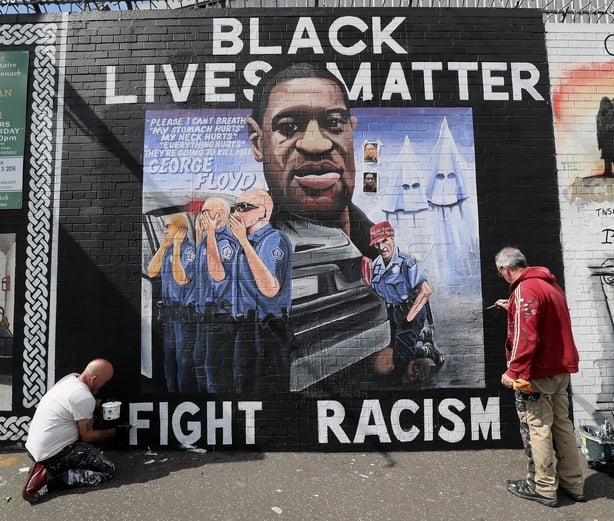
Friday, April 24, 2020
Motherfuckin' Detective Odafin "Fin" Tutuola (My Thoughts on Law and Order: Special Victims Unit)
I love TV shows, although only about 40% of what I watch is from the last two decades. My top six favorite shows are Star Trek: Deep Space Nine, Star Trek: Voyager, The Big Bang Theory, Supergirl, Roseanne, and Law and Order: Special Victims Unit. There’s a more complete list of shows I like under the “Movies” part of my profile. This is going to be about Law and Order: SVU.
I’m going to assume you are at least sort of familiar with the show, and if you’re not, you can read that wikipedia page.
I have seen every episode (with one exception where I couldn’t fix the disc and Netflix sent another disc that also had the same problem) up to season 18 and in about a month I’ll be done with season 19. I have 6 seasons on DVD in my collection, most of which I got at thrift stores.
Besides the obvious (it’s opposition to sex crimes and child abuse/kidnapping and sexism and misogyny) which is pretty awesome, there’s a lot of other things I like about L&W: SVU.
1) It’s incredibly anti-racist. Not 100% because it is, of course, a little soft on cops. But in general there's a lot of anti-racism. On average, in any episode, something like 25% of the main and recurring characters have been people of color. Of course the population of NYC is much more diverse, but we are talking about the NYPD and I think that 25% is probably a reflection of how diverse the NYPD is, or an appropriately mild exaggeration of how diverse it is. My memory of specific examples is a little fuzzy, but there are a lot of times when the anti-racism gets a little sharper than that.
There is one episode involving a hispanic SVU detective who might qualify as a person of color in a bad fatal shooting that I think the show could have dealt with more critically- I remember thinking that it was too pro-cop. But there is another episode on almost the same topic that is, overall, much better. Some white non-SVU cops, while helping SVU, fire about 15-30 bullets into an unarmed black man. The (main character) Assistant DA who works with SVU insists on prosecuting the cops and I think the last we hear about that is that he gets an indictment from the Grand Jury. The head of SVU disagrees with him but they don’t have a heated argument and there is no falling out and for about 2 seasons after that episode that character is still the Assistant DA for SVU, and I think it would be totally unrealistic if all the SVU members agreed with the Assistant DA. Unfortunately it DOES end on a fairly racist note. There’s a notice about the fatal shooting of a cop, which is kind of a lame ending for what otherwise is a very good episode. I mean, it’s even worse than saying “All Lives Matter” in response to the statement “Black Lives Matter.” It’s responding with “Police Lives Matter.”
As I mention below, Ice-T has played a main character since season 2 and there are now 21 seasons.
I think that the % of defendants that are people of color is probably a lot less than the % of NYC’s population that is people of color, and I’m almost certain it’s not more.
2) It’s incredibly anti-homophobic. Other than the idea that the Assistant DA in seasons 15-19 is gay (there is a lot of speculation but it’s apparently all wrong and he's actually straight (but played by a bi-sexual man)), I can only think of two examples. First, when an off-duty cop witnesses a sex-related crime (while on a date with another man) and notifies SVU, SVU offers to keep his name out of it to avoid outing him to the “brass” of NYPD. Also, the son of the character played by Ice-T is gay.
3) It’s incredibly anti-transphobic. In one episode, for example, a woman transitioning from being male kills her boyfriend when he sees a penis. I can’t remember exactly what SVU does, but I don’t think they prosecute her or they go easy on her or something. I DO remember the Assistant DA saying that in that situation, when a man learns his girlfriend has a penis or used to be male, he simply kills her. In general it highlights violence against transgender people.
4) It’s pro-immigrant. For example, there’s a two-parter about a witness who is gay and an undocumented immigrant from Syria who will be killed if he is deported. SVU tries to keep ICE from deporting him but fail. It’s as damning of our immigration policy as an innocent person being executed would be damning of the death penalty.
5) There are miscellaneous other liberal-progressive elements like OCCASIONAL negative portrayals of the military or corporations.
6) Since the second season there’s been a character, detective Odafin "Fin" Tutuola, played by Ice-T. In the near future I’ll do a post about why I greatly admire Ice-T, but his long-time presence on this show is one reason I like him and his presence on the show is one reason I like the show so much.
7) They infrequently go after other cops.
One thing that I would largely put in the very small negative column is the five or so cross-over episodes with the TV show “Chicago PD.” The main thing is that the senior officer on that show is comfortable with things that at least come close to torture. But it’s not as damning of the creative people behind the show L&O: SVU as you might think because in one of those episodes, the head of SVU criticizes that officer for that, although she focuses exclusively on the impact it’ll have on getting a conviction. It’d be better if she was more principled about it, but A) I think she figured the pragmatic appeal would work better, and B) if I’m wrong about that and she’s not principled about it, that’s disappointing but realistic, and C) it’s better than nothing.
I’ll soon start going through these episodes for the second time and doing “reviews” on this blog of the ones that have something that politically goes beyond the liberal feminism and basic anti-racist stuff that’s dominates the political dimension of the show (when I say “dominates” I mean there are minority tendencies, some progressive and some moderate). (You could say that I'll focus exclusively on highlighting the issues raised that are NOT sex crimes, because of course they have material about that, but they also have stuff about, for example, homophobia or marijuana or homelessness or abortion)
(Mariska Hargitay, who has been on the show since day one (and whose character has been head of SVU for about 6 seasons) and has been a director and producer on L&O: SVU since 2014, founded the Joyful Heart Foundation)
Law and Order
I also watch the original, homicide-focused show. It is overall less liberal-progressive (I think the cops and Assistant DAs are a little more flexible ethically than their SVU counterparts are as far as how they figure out who to arrest and/or get convictions). In an average episode I think that about 25% of the main or recurring characters are women, which isn’t too good considering that of the six main characters, only three are cops. But in an average episode, about 25% are people of color, which isn’t too bad considering that it should be either a reflection of reality or a little more diverse than reality, in my opinion (it’s about the NYPD and the Manhattan DA’s office) (I think that the % of defendants that are people of color is probably a lot less than the % of NYC’s population that is people of color, and I’m almost certain it’s not more). There are some progressive elements here and there, some anti-racism, some anti-homophobia, some stuff where a corporation is the bad guy, etc. (they infrequently go after other cops). At some point in about 2-10 years at the rate I’m going I’ll do the same sort of reviews I mentioned above.
Corporations on both shows
From what I remember, the last thing these shows do is criticize capitalism or express more than infrequent support for labor, but the episodes about corporate people are better than the old TV show Cops which focused exclusively on poor people. And I wouldn’t be surprised if it’s more likely to feature rich criminals than other cop shows, although I wouldn’t know for sure because outside the L&O franchise, I’ve probably watched a total of 30 episodes of cop shows since I became an adult and a socialist (at 18) (I’m 44).