Boiler Room (IMDB Wikipedia)
It falls short of indicting Wall Street, but it’s about a rogue investment firm. At the beginning the main character compares selling stock with selling crack. The stock brokers are violent, homophobic and use drugs.
I give it 3 stars out of 5.
Bowfinger (IMDB Wikipedia)
A non-political but very funny comedy.
I give it 5 stars out of 5.
Boycott (IMDB Wikipedia)
An amazing movie about the Montgomery bus boycott during the Civil Rights campaign in the American South. I don’t know how historically accurate it is, but it’s very inspirational. It includes as a character Bayard Rustin. The thing is Rustin was gay and told Dr. King that. I don’t know how homophobic King was, but in this movie he gets along with Rustin.
I give it 4 stars out of 5.
But I’m a Cheerleader (IMDB Wikipedia)
This is a COMEDY about the idea that gay people can convert to straight through therapy. It’s sort of serious (it’s a serious issue and the other movie I’ve seen about it (Boy Erased) is much more serious) but also pretty funny. It does a great job of illustrating how ridiculous the idea of gay conversion therapy is. It isn’t explicit, but it’s kind of implied that a lot of gay teens end up homeless because their families reject them.
I give it 4 stars out of 5.
Come See The Paradise (IMDB Wikipedia)
This is about the internment of Japanese and Japanese-Americans during World War II. I’m not sure if it’s based on a true story or how historically accurate it is, but it seems pretty accurate and about 1/5 of my BA is Asian-American Studies. The male main character is an Irish immigrant and a labor activist.
I give it 5 stars of 5.
Sunday, April 18, 2021
Movie Reviews C

Thursday, June 11, 2020
Don't Vote GOP: Three New Poems
Here are three more poems. They are all based on offensive lyrics, I explain that here.
For all the poems, you can click on the "lyrics" label the bottom.
1. Stop the Klan. What you think it's about.
2. Irish Citizen Army. The Irish workers' militia of 1913-1916.
3. Don't Vote SDLP. What's wrong with Northern Ireland's Social Democratic and Labour Party.
“Stop the Ku Klux Klan” based on “Stand Up and Be Counted” by either The Klansmen in the 1980s or the racist assholes who originally wrote it several decades ago. Original lyrics are here.
1. In 2017 or 2018 or 2019 there were reports that caravans of refugees from Central America were traveling through Mexico on their way to the US. Trump used this, probably successfully, to whip up anti-immigrant hatred. These were definitely refugees and they were traveling in caravan for security.
2. I believe that there is a spectrum between democratic and undemocratic and I believe that, politically, the US is closer to the democratic end of the spectrum. But my thoughts about how we can make it more democratic politically are here. I worry greatly that Trump is a fascist, literally, and my thoughts about that are in the middle of a post here.
3. Trump is a racist. See this and this. There’s also his comments on the murder of an anti-fascist by a fascist in Charlottesville in 2017. And there’s this, that I published elsewhere on my blog:
Well, just so you understand, I don’t know anything about David Duke. OK? I don't know anything about what you’re even talking about with white supremacy or white supremacists. So, I don't know. I don’t know, did he endorse me or what’s going on, because, you know, I know nothing about David Duke. I know nothing about white supremacists. And so you're asking me a question that I'm supposed to be talking about people that I know nothing about.
4. The Torah is the main Jewish text.
5. My thoughts about religion are found here, although a lot of those posts are only partly relevant.
6. **58% of this version is me, 42% is the original.
7. I give this poem 3 stars out of 5.
8. UPDATE 6/1/22 I believe there's a spectrum between democratic and undemocratic and I USED to believe we were in the middle but closer to the democratic end of the spectrum. With what the GOP has done in the last couple years I think we might be closer to the UNdemocratic end of the spectrum.
Chorus:
Stand up and be counted, welcome the caravans
Stand up and be counted, and stop the Ku Klux Klan
We are anti-racists and love our democracy true
We always can be counted on, when there's a job to do
We educate our communities day and night, to keep them Klan-free
And proudly display anti-racist bumper-stickers, promoting diversity
Chorus
The Bible’s pretty cool, but so are the Torah and Koran
We believe in gay rights, so fuck the Ku Klux Klan
In search of peace and liberty, with the constitution in hand
We will defeat Trump to save our democratic land
“Irish Citizen Army” based on “Blackshirt and Roses” by Razor’s Edge. Original lyrics are here.
1. This is written from the perspective of an Irish Republican in the 1970s, or 1980s or 1990s in Ireland. The Irish Citizen Army was started in 1913 during a general lock-out (where, in response to labor activism, an employer throws their employees out of the factory, etc.) in Dublin. It was formed to protect workers from attacks by the police. In 1916, when the Easter Rising (an attempt at getting the British out) took place, while most of the moderate Irish Volunteers failed to participate the (admittedly much smaller) ICA participated fully and James Connolly, the leader of the ICA, was the de facto leader of the uprising. Connolly was a Marxist theoretician and union organizer and considered Ireland’s greatest socialist- there is a train station in Dublin named after him.
2. The Starry Plough is basically the flag of republican socialism, although some non-republican socialists use it. At one point about 10-15 years ago, and maybe still today, the youth wing of the Irish Labour Party used it.
3. Connolly was one of the few European socialists to oppose the nationalism of World War I. (The original refers to WWII)
4. Razor’s Edge were/are British and support(ed) the British and Unionist causes in N. Ireland.
5. **54% of this version is me, 46% is the original.
6. I give this poem 4 stars out of 5.
They created the Starry Plough, an emblem of the Irish working-class
And they spread Marxism, patriotic workers struggling en masse.
(Chorus)
Fuck the British Empire
Ireland still recalls
The Irish Citizen Army
Heroes one and all.
Opposed the nationalist war in Europe, they knew the real enemy.
With the European Working-Class, they were in solidarity.
The flame they lit was not extinguished, still burning in our hearts today.
We're carrying on the fight because the ICA led the way.
(Chorus)
Fuck the British Empire
Ireland still recalls
Connolly and the ICA
Heroes one and all.
“Don’t Vote SDLP” based on “Freedom” by Razor’s Edge. Original lyrics are here.
1. This is NOT written from my perspective, but the perspective of the type of person I probably could have collaborated with politically if I had lived in the Nationalist community of Northern Ireland in the 1970s, 80s or 90s (I’m American). It’s from the perspective of someone who lives in a working-class Nationalist area in the 1990s and is sort of pacifist and a left-wing social-dem and doesn’t like Sinn Fein very much because of the violence and doesn’t like the Social Democratic and Labour Party for the reasons I give here (there are some more thoughts about the SDLP here, while discussing the episode “Rising Star”).
The thing is, the British Labour Party hasn’t ever organized in the North and recently had to be taken to court to allow Northerners to join, but they refuse to let the Party run candidates there (which is more of a good thing than a bad thing). There are multiple tendencies in the BLP when it comes to N. Ireland and I think the dominant one is to support their official sister organization the SDLP. I don’t think they ever called for the IRISH Labour Party to organize there and it wasn’t until tension developed between the ILP and the SDLP in 2001, 2002, and 2003 that the ILP started a transitional process of organizing there that was supposed to result in them running candidates as rivals to those of their official sister party. I did an essay/article/post PARTLY about that here.
So, this person has little or no options for voting (even if the BLP had been running candidates there, this person wouldn’t have voted for them (unless they were comparable to Tony Benn or Ken Livingstone)).
2. The red, white, and blue are the colors of the British flag.
3. The SDLP encouraged their supporters to do little more than vote. They were more or less against marching and probably against rallies as well. It’s true that non-SDLP supporters could have become involved and the inevitable friction with the security forces may have been difficult for stewards to control and a riot could have developed. But they still should have tried it, maybe with double the usual number of stewards. If there weren’t enough good stewards in the SDLP, maybe, in the 1970s and 1980s, they could have acquired the help of members and former members of the Official IRA, whose movement the Provisionals (SF and the IRA) had split from, and which was committed to a relatively non-violent path (I just think it would have been great if they HAD organized marches and I wanted to explain that they could have found a way to do it with a low risk of them turning into riots). The failure to offer mass struggle as an alternative to armed struggle weakened the overall effort to advance the interests of the Nationalist population.
4. The SDLP was socially conservative and although they probably did a better job of attracting Protestants than the Provos did, they were also closer to the Catholic Church.
5. Critics sometimes call the SDLP the Stoop Down Low Party.
6. In the 70s and 80s and probably the 90s as swell, I can imagine SDLP canvassers at election time being uncomfortable when whoever they’re talking with informed them that they’re gay. That homophobia is largely gone now, and I don’t think it was all that hateful in the first place, but they were homophobes.
7. They’re in the Socialist International and today maybe the SI almost deserves them, but with their social conservatism and moderate, almost capitalist, economics, they certainly didn’t belong there in the 1990s and 2000s and probably not in the 70s and 80s.
8. My thoughts about what the Provos did are here.
9. Razor’s Edge were/are British and support(ed) the British and Unionist causes in N. Ireland.
10. **66% of this version is me, 34% is the original.
11. This poem gets 5 stars out of 5.
Sell-out politicians always seem confused
They can’t figure out how to eject the red, white and blue
the only time you matter is on Election Day
so they can grab your vote and then tell you to go pray
(Chorus)
Options, no options
For pacifist social-dems in this community
Options, no options
The Stoops offer no mass struggle opportunities
A community defended by heroes but who then go too far
There are too many problems with their repertoire
But the only time you matter to the Stoops is on Election Day
They really want your vote unless you’re lesbian, bi or gay
Chorus
With their moderate instincts, the community gets left behind
if you think they’re helping us, you must be f*cking blind
the only time you matter is on Election Day
They’re in the International, but they’re pro-life and anti-gay
Saturday, June 6, 2020
The Black Lives Matter Protests and the Trunp Administration
But, even though I currently am not getting a lot of visitors to this blog (I’m getting some and will soon get more), here are my thoughts about the issues thrown up by the protests.
Many people (like Trump) don’t understand this, but this is not about George Floyd. This is about hundreds of years of black lives being valued less than white lives in this country, including an apparent surge in the murders of unarmed Black people by police in the last several years, as well as some modern-day lynchings that more or less don’t involve the police. I was told at a BLM protest march around 2015 that in a 365-day period ending shortly before that day about 200 black people, armed or unarmed, had been killed by American police. I’m sure some of them were armed, but A) I’m very open-minded about allegations that cops plant guns and B) around that time there were SEVERAL highly publicized cases where undeniably unarmed Black people were killed by police. Police are practically never convicted, or even prosecuted (and rarely fired) for such deaths. Although there isn’t solidly comprehensive information about how often unarmed black people are killed by police here like there’s information about the security forces killing Catholic civilians in Northern Ireland’s Troubles, one reason I believe it’s a widespread and serious problem is that both the Southern Poverty Law Center and the Anti-Defamation League, two organizations that generally get along with police, have expressed support for BLM. That’s here and here. They are making these statements because even though they are sort of pro-cop, they are even more anti-racist and anti-injustice and anti-inequality. And that’s the agenda they see in BLM. (And in the case of the ADL, their support for BLM is also despite the fact that BLM has expressed criticism of Israel)
Trump claims to be sensitive to the death of Floyd, but he clearly isn’t beyond the death of that one individual. He isn’t sensitive to what Floyd’s death symbolizes. His National Security Advisor has said “No, I don't think there's systemic racism. I think 99.9% of our law enforcement officers are great Americans.” Based on multiple facts, a lot more than .1% of police are racist. That’s based on simple common sense, but also the following:
1) What I wrote about the SPLC and the ADL and BLM.
2) In 1992, when the controversy over the Body Count (Ice-T’s heavy metal band) song Cop Killer broke, the (then- 35,000 member) National Black Police Association kind of backed Ice-T. According to an article in the Orlando Sentinel:
3) From what I’ve heard, some massive majority of cops are registered to vote GOP and for the following reasons I believe that is a racist party.
A) Not only do they get no more than about 10% of the Black vote, and only around 25% of the Latino vote (and that would be lower if (more or less) white Latinos were excluded from the calculations), they also get no more than around 25% of the Asian-American vote. That last fact is crucial. Even though Asian-Americans as a group do at least as well financially as white people do as a group, and even though there is the history of FDR and Internment, Asian-Americanss look at the GOP and see it as even less attractive than the Dems.
B) There ’s also the fact that in the 1960s and 1970s Segregationist Democrats migrated to the GOP because the Dems became a civil rights party. In 2005 the GOP ADMITTED (and in all fairness apologized for) using the “Southern Strategy” of 1968 where they appealed to segregationist southerners in order to elect Nixon.
C) As I’ll explain further down, Trump is a racist.
There’s also the fact that, according to HuffPost, the Trump Justice Department ignored police brutality:
(Also, see this).
(There’s a lot of things I will gloss over because there’s so much attention on them anyway, like Trump’s use of the phrase “when the looting starts, the shooting starts,” or what happened to facilitate his photo-op with the Bible)
Trump is a racist. Here’s some of the most solid evidence:
1) A few years ago was the first time Trump called Antifa a terrorist organization. It was after Antifa members had done what they’re defined by, and that’s not actually or allegedly rioting. They were fighting people clearly identifiable as fascists, and no, I don’t believe that cops are clearly identifiable as fascists. They were fighting FASCISTS.
2) On a similar note, when an anti-fascist was killed in 2017 in Charlottesville by a fascist, Trump said there were “fine” people on both sides.
3) There’s his attitude to the exonerated victims of a racial miscarriage of justice.
4) When asked about David Duke endorsing him, his response in an interview was:
5) There’s his opinion that Lincoln screwed up dealing with what led to the Civil War. Trump thinks that if the then-late former President Andrew Jackson had been President in 1861 the Civil War would have been avoided. Since Jackson was a slave owner and an opponent of abolitionism, that would have involved, at best, a compromise friendly to the South that would have barely affected the life-span and geographic scope of slavery or the treatment of slaves. There’s information about that here and here.
6) His Veterans Affairs Secretary is a neo-confederate.
(As far as those last two, I should explain two facts about the Confederacy. First, they considered ending slavery so they could get military support from Europe and win the war, but decided not to- slavery was more important to them than independence. Also, when Black Union soldiers were captured, they were treated differently than White POWs and in at least one case were simply executed instead of taken to POW camps. The Confederacy was about slavery and racism)
I recently had a bit of a breakthrough on what needs to be done to make significant progress on ridding this country of racism. In addition to everything else people are doing, we need more unions. That’s based on the following:
1. Union households are more likely to vote Democratic than non-union households, and many of the organizers and staff in the labor movement are people of color and most of the whites are anti-racist and most union supporters are people of color or anti-racist whites.
2. In 2000 in a discussion on the email list of the Young Democratic Socialists (now YDSA) a member who was organizing workers in Indiana said that his competition was the Klan (UPDATE 1/26/22 That is, competition for the hearts and minds of the workers).
3. Eammon McCann is a socialist and anti-Unionist activist in Northern Ireland. He was one of the main leaders of the N. Ireland Civil Rights Movement in the late 1960s and early 1970s (he was one of the speakers at the rally/march that was attacked by the British Army on Bloody Sunday in Derry in 1972, and he was an organizer of the second Civil Rights march, the one in Derry in Oct. of 1968). He has held several different senior and very senior positions in the Northern Irish TRADE-union movement in the last 40 years. In 2016 he was elected to the Northern Ireland Assembly and in 2017 he would have been but they reduced the number of seats returned from each constituency form 6 to 5 so he was basically runner-up. As far as I can tell, in the last 40 years at any given time two mainstream or professional news publications have been publishing his columns. He is an expert on sectarianism in N. Ireland. In a column written in the 1980s or 1990s and included in the 1998 anthology of his columns “McCann: War and Peace in Northern Ireland” he wrote:
(Mark Langhammer, who was the leader of the Northern Ireland part of the Irish Labour Party for several years around 2010, told me in 2005 that he agrees with McCann)
I think you could easily say the same thing about racism in this country.
Unfortunately, in recent decades, as the labor movement has become more and more anti-racist, it has gotten smaller and smaller, thanks to the GOP, corporations, and moderate Democrats.
In conclusion, although I’m concerned the protests will result in the spread of COVID-19 and I have been unable to take part in them, I am glad that the protests are happening. They seem likely to be successful in multiple ways and have exposed more than usual the fact that our society is racist and that Trump is a racist.
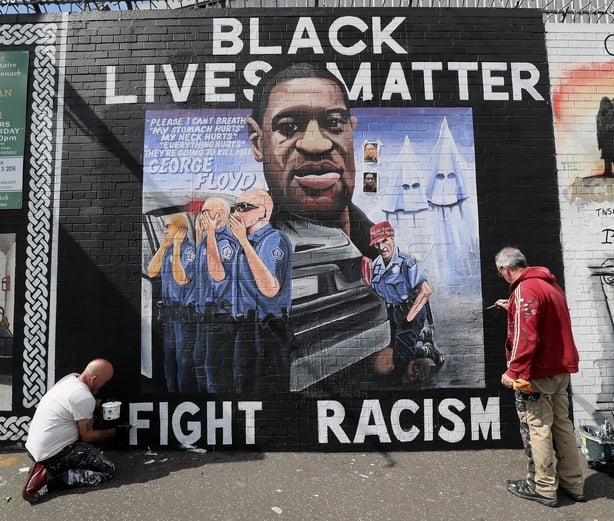
A new mural in Belfast, N. Ireland.
Sunday, April 19, 2020
Fuck George W. Bush: Three New Poems
For the rest of the lyrics, click on the "lyrics" label at the bottom.
1. Smash the Klan II. What you think it's about.
2. From Out of the Ashes. The birth of the Provisional IRA in Northern Ireland.
3. Surf the Euphrates. About the Iraq War.
“Smash the Klan II” based on “Aryan Pride” by Final War. Original lyrics are here.
1. This is about slightly militant opposition to the KKK among white people. It’s sort of inspired by the time that I joined around 100-300 people in 1995 protesting a “rally” by the Klan in Boulder. At the end we surrounded the building they had rallied in front of and trapped them there for about an hour or two until the police tried something sneaky that involved getting them out in an ambulance.
2. Instead of “crossing the border,” many Mexican-Americans are partly or totally descended from Mexicans who lived in what was Mexico until it became CA, NV and the South-West of the US (and TX).
3. The 54th Mass was the 54th Massachusetts Volunteer Infantry Regiment, the segregated Black unit that fought in the American Civil War and whose story is told, accurately or otherwise, in the movie “Glory.”
4. Racists have a greatly exaggerated sense of how much anti-white bigotry there is. In a paragraph more than half-way from the top of this post that starts with “Even without that…” I explain why I think anti-white bigotry is a very small problem.
5. I exaggerate how easy it is for white people to get a job, although if we focus on times when it’s a white person and a person of color, it IS pretty easy for the white person to get the job. Affirmative Action helps a lot, but “Hispanics” and Blacks still have an unemployment rate fairly close to twice that of white people (it’s a bit higher for Blacks than for “Hispanics” and the gap fluctuates a bit, but it’s around twice; see this). Racists think that white people are discriminated against and have more trouble getting a job. Of course, that’s probably because they think that the natural order of things should involve full employment in good jobs for white people and see anything else as unfair.
6. My thoughts about the white identity and European-American ethnic identities are in the first 2/5 of this (you should also read the conclusion, which is the second to last section) (I realize that BEFORE they read that many anti-Klan white people might not like what I say, but I think that after they read it, they will).
7. The St. Patrick Battalion was a group of American soldiers, most Irish and almost all Catholics, who deserted the US Army during the US-Mexico War and joined the Mexican Army. I’m sure it varied from individual to individual, but to one degree or another they thought that what the US was doing to Mexico was unjust (they were also alienated by anti-Catholic bigotry in the US Army (and of course Catholics *used to be* on the Klan’s list as well)).
8. After I started altering stuff, I switched the first verse with the chorus. Also, there were only three verses in the original, and the fourth verse is totally mine.
9. **70% of this poem is me, 30% is the original. I don’t know if the 3rd line of the second verse in the original lyrics I found on-line is what was actually written by the original lyricist.
Many people hate the Klan for spreading prejudice
Gay people, Muslims, and Jews are on their fucking list
Black people aren’t criminals like you see on your TV
The border crossed Mexican-Americans, its a fact of history
Chorus
Brothers and sisters, join together as one.
We’ve got the fucking KKK totally on the run
in memory of the brave 54th Mass soldiers who died
Fuck the Nazis, and fuck the Klan and fuck Aryan Pride!
Racists cry “Black man, yeah Black man full of hate”
Widespread anti-White bigotry is the bullshit story they narrate
Its fucked up how white people can secure any job by race
It’s funny how the Klan deny that that’s totally the case.
Chorus
Our solidarity won't be broken, and we won’t hide from an affray
We will keep on working until we asphyxiate the KKK
Our message will be spread. Our voices loud and clear
Inform the youth, of the truth, the Klan’s greatest fear.
Chorus
We’ll never be proud of being white, it’s an artificial identity
It’s totally steeped in privilege, hate and inequality
We’re proud of being Irish, Scottish and German, Greek, Polish and Italian
We’re in solidarity with the oppressed, just like the St. Pat’s Battalion
“From Out of the Ashes” based on “After the Fire” by Skrewdriver. original lyrics are here.
1. This is about the aftermath of the anti-Catholic pogrom in the Lower Falls Nationalist/Republican area of Belfast in Aug. of 1969 (it wasn’t INCREDIBLY Republican BEFORE that month, but not long afterwards it certainly was). In July, August, and September, and mostly during a period of 2-3 days, in Belfast, 1,505 Catholic families fled their homes (probably something like 18% of Belfast’s Catholic population, probably something like 1.8% of the North’s Catholic population). In one night alone 650 families were burnt, or at least forced, out of their homes.
2. The DUBLIN-BASED LEADERSHIP OF THE IRA had demilitarized it in the years before Aug. 1969 and only a few IRA weapons were available to help defend the area, a defense that was largely unsuccessful.
3. The Civil Rights Movement that started in mid- and late 1968 was overwhelmingly committed to non-violence and had hoped to democratize N. Ireland.
4. Provos refers to what we call in recent decades Sinn Fein and the IRA. They broke off from SF and the IRA (what became known as Official SF and Official IRA) partly because of the leadership’s decision to demilitarize the IRA.
6. Initially the British Army kind of saved the Catholics from police-led loyalist mobs and were welcomed for about 9 months, but they became increasingly like the notorious Black and Tans unit of the British Army that served in Ireland during the War of Independence 1919-1921.
7. Squaddie is a term for British soldier.
8. On the night of June 27th 1970, the Church of an isolated Catholic enclave in East Belfast was attacked by a loyalist mob. The British Army wouldn’t defend the area but members of the PIRA did. It was their first major action.
9. I like calling The Troubles the Second Anglo-Irish War, the first being the War of Independence.
10. There is or was a T-Shirt designed by either SF or their old American support organization Irish Northern Aid, that said: “From Out Of The Ashes Arose The Provisionals.” It was referring to the ashes of the mythical bird, the Phoenix (in this case representing the IRA they split off from (actually, I used to think it was the ashes of the burned out homes, and I kind of prefer that interpretation because there were some good people in the Officials in the early 1970s and I don't believe in speaking positively about the feud between the two groups)).
11. Skrewdriver were British and supported the British and Unionist causes in Northern Ireland.
12. Based on a fairly scientific look, only .3% of the PIRA’s operations resulted in civilian death.
13. **62% of this poem is me, 38% is the original.
The fires burned for hours, it was a time of terror.
Dublin had ordered the IRA disarmed but they were totally in error
Those nights there were burnt out homes, our community was battered
Non-violence had been our people’s hope, but now that hope was shattered
Chorus
After the fire, the ruins there did lay.
After the Provo victory there will come a brand new day.
The Falls stood in misery, and initially welcomed the British Army Man
But increasingly the Squaddies acted just like the old Black and Tans
Then, on the night of June 27th, it was known the Provos had come alive-
Seeds of resistance once sown, now had grown, new life that would not die.
Chorus
The new Anglo-Irish War is approaching, and with the Provos we shall be.
They rose from the ashes of August ’69 and they will fight for you and me.
“Surf the Euphrates” based on “Surf Nicaragua” by Sacred Reich (despite their name, their politics are very progressive- I'm fairly familiar with all of their music and at least some of it is more or less socially liberal and it's also economically progressive and it's anti-war). Original lyrics are here.
1. This is about the Occupation of Iraq.
2. The Euphrates is a major river going through Iraq.
3. One of the MANY reasons Bush had for invading Iraq was that it has a lot of oil.
4. A major argument in favor of invading was that Iraq was connected to Al-Qaeda. In fact, shortly after the war began a poll found that about 70-75% of Americans thought Iraq was responsible for 9/11. It was such bullshit that Tony Blair didn’t use that argument when trying to convince the British people and Parliament to invade. It’s also been strongly suggested that the % of the anti-US forces that were foreign Islamists was very tiny.
5. There were no Weapons of Mass Destruction found, and that was predictable based on what the UN weapons inspectors were saying just before the invasion and what former Marine and former UN Weapons Inspector Scott Ritter said around 2000.
6. Donald Rumsfeld was the Secretary of Defense.
7. Based on multiple pieces of anecdotal evidence and the existence of Iraq Veterans Against the War (now, About Face), and how unpopular Bush became shortly after the 2004 election, I imagine a lot of American soldiers who voted for Bush in 2000 or 2004 wished they hadn’t after they did one or more tours there.
8. I think another reason for invading Iraq is that it provided multiple opportunities to give money to corporations. Besides arms contractors and those doing privatized work for the military, corporations getting money for reconstruction spent about half of what they got doing actual reconstruction (often a contractor would keep half and give the rest to a subcontractor and sometimes THAT corporation would keep half and give the rest to another subcontractor).
9. This poem is not pro-insurgency. It was reasonable and natural that a large majority of Iraqis wanted the US out, but my favorite slogan of the anti-war movement was “Support Our Troops, Bring Them Home.” Also, some group at some point, and they may have been anti-war, was raising money to send men and women serving there body armor, and I would have supported that (it’s different than giving them extra ammunition with which to kill Iraqi civilians). (it’s also not pro-Saddam- it would be great if Saddam had been pushed out of power in a better way, but the methods that the US and UK used were bad)
10. Besides the insurgency, there was other instability caused by the invasion and occupation- Al-Qaeda attacks on Shiite neighborhoods, ethnic cleansing by Shiites and possibly some by Sunnis, and tension between some of the Shiite population and the Occupation forces. At one point it came close to a full-blown Sunni-Shiite Civil War.
11. The Surge was a brief but dramatic increase in the number of soldiers and Marines in Iraq.
12. Between 1991 and 2003 Iraq was frequently bombed by the US and UK.
13. I think that Bush supporters enjoyed the political dimension of the war, where they tangled with anti-war groups. We were in a time of a “New McCarthyism,” where disagreeing with Bush was seen by a lot of people as politically taboo. As I said, at the beginning of the war, the vast majority of Americans blamed Iraq for 9/11.
14. As far as Bush’s reasons for invading Iraq, here is something I included in two posts about anti-Semitism:
15. Bush liked the idea of being a popular war-time president the people would rally around.
16. **46% of this version is me, 54% is the original.
17. In a post here I describe what I did to oppose the invasion.
I know a place Where you're all going to go
They'll pay you to kill for oil If You're eighteen years old
First You'll need a haircut And then some new clothes
They'll stick you in Baghdad To play G.I. Joe
CHORUS:
You think you’re fighting Al Qaeda and that you’ll find WMD
But it’s total bullshit, concocted by Rumsfeld and Dick Cheney
But now it's too late You're entering Iraq
You voted for Bush, you’ll soon wish you could take it back
What is this we're fighting for and What are our goals
To create a cash cow for US corporations and improve Bush’s polls
Instability and Sunni resistance grow deeper everyday
The situation worsens, the Surge is on it's the way
CHORUS:
Lessons we have learned Are easy to forget
Hints of Vietnam How soon we all forget
First we used sanctions and bombs, now go in the troops
Another chance for the Right to slander anti-war groups
Thursday, March 26, 2020
Why And How I Organized A Very Successful Anti-War Rally in March of 2003
(when I say anti-war without saying anything more, I mean opposed to what Bush was planning and not necessarily against war in general)
In early March 2003 there was a national Day of Action to protest moves towards war with Iraq. At the University of Colorado at Boulder, I organized the rally component, something which was quite controversial among anti-war activists on campus and in Boulder. For whatever it’s worth, let me say that the main anti-war group on campus, the Coalition to Wage Peace could have handled it much worse than the way they did. I don’t know exactly what conversations took place at the meetings they had after they learned I had reserved the main rally space, but they were fairly positive about it.
I think I will start with a description of my activism in the 9 years before the rally. Between Fall of 1994 and Fall of 2002 I had done a lot of political activity at CU-Boulder (and some stuff off-campus and outside Boulder that I will sort of ignore in this explanation). About 1/8 was with (what would later be renamed) the Young Democratic Socialists in the mid-90s. That was largely about immigration and affirmative action and was slightly effective. Most of the next 1/8 was with a group I started called Students for Justice in N. Ireland and was 1997-1999 (or early 2000). For better or worse, that might have had NO effect on what progressive activists thought of me in 2003, but over all it WAS done in a very anti-racist and sort of anti-homophobic way, and was slightly progressive in some other ways (half of my NI activism is described in a post here between the paragraph “The second big thing…” and ending with the paragraph “In the late 1990s…”; Right below that section of the post is a description of my anti-racist activism). In 2000 and 2001 I swung back to mostly multi-issue progressive stuff with YDS. The biggest thing I/we did in those years was gay rights stuff. The semester before the rally, I started organizing SJNI again and A) we did one event before that rally that was anti-racist and progressive, and that attracted about 25 people, and B) we issued a statement that was anti-homophobic (for that statement and some relevant discussion, see the second half of this, starting with the paragraph “Now that that's over....”) and C) we endorsed the Coalition for Justice in Palestine. The SJNI meetings before the rally had an average attendance of about 8 people. Between 1994 and 2001, the average attendance at my N. Ireland events was 30 (it would have been higher, see the middle third of this (between the paragraphs “Going back to how much was done…” and “according to the Pew Research…”) and for everything else it was 75 (YDS-CU events in 2002 had an average of about 40 people at them, including one partly anti-war event (not the rally around Sept. 1st 2002) that attracted about 75 people).
At the 2001 National Conference of YDS in August I suffered three defeats and since that was in the context of continuing grief about my mom’s death 14 months earlier, the next semester I spent about 20 hours a day in my bedroom. Other things went wrong and it slowly became more and more of a “perfect storm” of things that were mostly personal tragedy and mostly not my fault. I had/have Tourrette’s Syndrome, OCD, Attention Deficit Disorder, and Depression, and these are all made worse by anxiety, stress, and sadness. The next semester I sort of organized the YDS chapter some although it didn’t go very well.
During the summer of 2002 there was a lot of talk about the US invading Iraq in the near future. I, and a very small YDS-CU chapter organized a rally on campus that took place around Sept. 1st in the UMC FountaIn area. I’ll be honest, it wasn’t the kind of rally you might be thinking of. Even if there WAS a large crowd, we didn’t have more than a few signs for people to hold. We had about five speakers and when they all had spoken we still had about 10-15 minutes left, so we invited people from the small crowd (about 25-50 people) to speak at the mic. The speakers were great. One benefit of doing a rally there is that you might get an audience with a fair number of people eating their lunch- including people who might not normally go to a political event, but end up listening to the speakers anyway.
Although YDS-CU had a pretty successful (and student union funded) event in Nov. (at which the speaker talked about Iraq about 1/3 of the time), it was a very small chapter that I believe barely existed in the second semester of the 2002-2003 school year.
At some point in late Oct. or very early Nov. someone put up flyers and/or sent emails about a rally in the UMC Fountain area. It’s not clear who called for it. For a lot of reasons I wish it was clearer, but to a limited degree I am almost okay with that- if they didn’t want credit for it that’s okay with me (but I think there’s also an issue of taking responsibility for your actions). It involved about 30-50 people gathered relatively close together and instead of the PA system usually used, there was a megaphone (or whatever it’s called, it amplified people’s voices so everyone could easily be heard) that got passed around democratically. I only remember a small number of the comments made. The one I remember the most is where, after a woman made an anti-war statement that involved referring to herself as an American, someone told her not to identify as an American. There was another rally just like that one about 1-2 weeks later that I attended. Although considering how I ended up in some small degree of conflict with CWP I wish I was more familiar with it’s creation (some time shortly after the 2nd rally I just mentioned) and the next 1-3 rallies it organized (I went to 1-2 of their rallies). I was probably on their email list at some point towards the beginning. I must have also picked up a faIr amount of information about them when they were tabling in the student center. Lastly, I must have also gotten some info from the unofficial campus newspaper. I wish I could be more certain of these things and offer more specific examples but 18 years have passed. There’s also the fact that at various times between the Fall of 2002 and now, I have heard miscellaneous supportive things from other activists in Boulder and I don’t remember hearing practically anything critical of what I did, so I believe that what I say here about CWP doesn’t clash with what veteran activists (some of whom acted as referees between me and CWP) observed in CWP at the time.
Sometime just before and/or just after winter break I formed a LOOSE and very small alliance with a very politically visible Democratic Party progressive activist at CU-Boulder. I don’t believe he was considered a.member of the group I tried to launch but he played a role in the College Dems adopting an anti-war position. I’ll describe the name of the new anti-war group I launched shortly, but here’s what we did. An event that took place in late January or early February was a panel discussion sponsored by YDS-CU and possibly the new group. The senior College Democrat read the anti-war statement of the CU-Boulder College Dems at the beginning of the event. The speakers were either (then) current or former members of the Democratic Socialists of America. Although there was a misunderstanding as the result of the word liberal being defined one way by some progressives and another way by other progressives, 3/4 of the brief talks were pretty good.
The name of the new group is something I cringe at when I think of mentioning it to people now, as it could give people the wrong idea about my political beliefs at that time. It was Liberals Against War. The first thing I need to do is offer a definition of a liberal. My definition is very far from philosophical. A liberal is someone to the left of Bill Clinton and to the right of Elizabeth Warren. Some will say that Clinton is a liberal, but if you look at his time in the White House, he was not very liberal on social issues, he certainly wasn’t good economically and in general he was the candidate (in the 1992 primaries) of the moderate/centrist wing of the Democratic Party. His running mate in both 1992 and 1996 was married to one of the main people behind the “Parental Warning- Explicit Lyrics” stickers on certain music albums. I AM a socialist but I’m also fairly friendly to the Democratic Party and believe that sometimes, depending on various factors a fair percentage of liberals are allies of progressives. For more of my thoughts on liberals, see this.
LAW barely existed but was one of the sponsors of the March 2003 rally. I launched LAW because I felt like CWP was trying to win people over to the anti-war position by winning them over to the progressive movement. In a misguided attempt at being good white allies (I’m certain 95% of them were white) they adopted Mumia Abu-Jamal as an issue (although I did some stuff supporting him around 1998, a better expression of solidarity would have been supporting Affirmative Action, which I guarantee you is more popular with Black people than Abu-Jamal was at the time (the gap is even greater when you poll people of color in general (see the addendum at the bottom))). At the CWP rally I attended A) one of the speakers said that the only good war was the Civil War and B) someone (probably not a neo-Confederate) yelled “BOO!” (I couldn’t find a survey about Jewish-American opinions of the Allies, probably because no one is going to waste time on that since I’m sure that around 99% of Jewish-Americans are glad that Nazi Germany was defeated (I’m sure that 99% of Blacks are glad that the confederacy was defeated)). The guy who criticized someone for identifying as American became an active member of CWP. They were taking that approach (creating progressives) instead of convincing people that an invasion of Iraq (specifically and not war in general) would be wrong. They were not responding to the arguments being made by the Bush administration and its allies. Crucially, they were not challenging the idea that there was a connection between Iraq and Al-Qaeda. Shortly after the war began, a poll found that around 75% of Americans believed Iraq was responsible for 9/11. Although I’m embarrassed that I supported the first two years of the invasion of AFGHANISTAN, the fact is that response to 9/11 was a much more legitimate and helpful one than invading Iraq, and ignoring the desire of the American people to go after those responsible for 9/11 was just politically naive. 9/11 was overwhelmingly aimed at killing as many civilians as possible (if you think I have a racist double standard, A) go fuck yourself, B) see this and C) see the first third of this). Al-Qaeda was based in Afghanistan, and I can’t imagine a successful progressive response to 9/11 that wouldn’t have included either successfully convincing the Taliban to give up Al-Aqaeda, or an invasion. The invasion of Iraq was completely unjustified and unhelpful and was predictably a disaster for the Iraqi people and the region. Refuting the allegation that Iraq was connected to Al-Qaeda was necessary and doable- it was so ridiculous that Tony Blair didn’t use it in his pro-war argument. Some would say that pointing out the lack of a connection between Iraq and Al-Qaeda as a reason to oppose the Iraq invasion would have implied that the invasion of Afghanistan was okay. But anti-war activists could have said “invading Afghanistan was bad enough, invading Iraq is an even worse idea.” (UPDATE Feb. 2021 my recent thoughts about the US and Afghanistan are here)
So, I organized the March rally. I had organized 2-3 anti-war events in the previous 6 months and I got the main rally space reserved before (perhaps minutes before) CWP tried to do that. Almost immediately, I was asked to hand it over to CWP. I refused. I refused to let CWP co-sponsor the rally, although there was some dialogue and cooperation that I’ll describe shortly. Why did I refuse?
1. At the last or second-to-last CWP rally, a small, brief “riot” took place. Although I wouldn’t be surprised if the cops were responsible for the confrontation turning violent, I am CERTAIN that A) the confrontation was the fault of some people in CWP and B) the confrontation was completely unjustified. Rallies in the UMC Fountain area with amplified sound are only allowed between noon and 1 PM because there are a lot of classrooms nearby. Some people in CWP decided that they would not end the rally and give up the PA system at 1 PM. UMC staff did something to end it that resulted in a CWP member, joined by others, trying to get the PA back on that involved walking towards the UMC building, and some cops. Like I said, I wouldn’t be surprised if the violence was started by the cops, but the confrontation was completely unjustified- partly because it wasn’t at any point described as a student strike, they just felt that in general rallies should have no time limit. Also, in general at the time, student groups at CU-Boulder at least 1994-2004 (probably before and after) had it better than student groups at other campuses (you didn’t need a faculty advisor, you could chalk, student government gave out lots of money with few strings attached, but they had some reasonable rules for student activism (the UMC is part of student government)) I thought a lot of people would be reluctant to attend a rally organized by the CWP and as I’ll explain, there is evidence I was right.
2. After the “riot” the UMC started to enforce a rule about scheduling rallies where you had to attend a formal meeting and promise to follow the rules. I was afraid that if I remained the lead organizer but CWP was a co-sponsor and some faction in CWP pulled the same thing with the PA system, I would be in a lot of trouble.
3. As I said, they were not trying to reach out beyond the progressive community.
4. I’ll go into why this was a good move on my part, but from the very beginning I intended to get the College Democrats to co-sponsor, and I did. IF and it’s huge if, anyone in CWP had suggested the group cooperate with the (anti-war) College Dems, he or she would have been laughed at. Even if I was the bridge between the two as the lead organizer, CWP may have refused to join the Dems in co-sponsoring the rally, and the Dems probably would have refused to work with CWP because of the riot.
Not long after I refused to involve CWP or just stand aside for them, a couple of professors invited me and a rep from CWP to sit down with them and they would assist us in working some things out. I was happy to participate. We agreed that CWP would sponsor the march after the rally and the “student strike” aspect. It was my idea to set aside two out of 10-12 speaker slots for anyone CWP chose to fill them with. The CWP rep. at one point said that they were going to refuse to cooperate with the UMC staff about the PA system (the UMC agreed to make the rally 90 minutes instead of 60). I just put my foot down and said “no you’re not,” and probably because of the presence of the two Profs. that was apparently enough.
I also agreed to attend a CWP meeting the night before the rally. As I sort of explained to them when someone asked why I didn’t just get involved with them, I felt neurologically, and intellectually and politically (slightly) impotent and knew I would get into arguments left and right with people in CWP and didn’t want to get into those fights on a weekly or daily basis. But it was just one meeting and if I hadn’t attended A) they and a lot of people would have thought I was a jerk, and B) it’s POSSIBLE that some CWP members would have skipped the rally and maybe even encouraged others to skip it as well (about 2 weeks earlier there was talk about them organizing their own rally elsewhere). So I did an okay job of briefly explaining why I hadn’t gotten involved in CWP. Also, the official but unpopular campus paper had been tipped off about how awesome I am and about 5 weeks before the rally they did a story about me. A big part of it was me criticizing CWP and probably not doing the best job of it either. Someone asked about that and I may have explained things half as well as I have in this post.
Before I describe the rally, I should say something about my brilliant move getting the College Dems to co-sponsor. First, I’ll be honest, it didn’t take any intellectual or political effort on my part. The progressive Dem leader I mentioned above had already laid the groundwork by getting the chapter to oppose the invasion. Some progressives would say it was a waste of time or actually counter-productive since it would allow the liberal (not progressive or Clintonite) Dems to mend their tattered record on war and militarism, and these progressives want to use that record against the Dems. But here’s the thing. A LOT of people who were against the war or who were very open-minded about opposing it were registered as Democrats. Having the College Dems co-sponsor the rally might have boosted attendance a little, and I’m sorry but if you combine the progressives and liberals in the DP, they vastly outnumber those progressives who just hate the Dems. Also, if we had any chance of stopping the war at that point (and we didn’t but it was the right thing to act like we did, and anti-war organizing at that point laid the basis for opposing the Occupation) we would have needed a MASSIVE majority of the DP. Having the College Dems co-sponsor raised the profile of the anti-war part of the DP within the DP.
The rally was petty good. 1,500 people were there, probably at least 95% were anti-war. I was busy with other stuff and heard practically none of the speeches. Twice there was a progressive song played. I screwed up and didn’t plan what I was going to say and probably about 1/3 of what I said was kind of stupid, but only kind of, and I’m sure the rest was good. After the rally, 200 people went on a march. At one point a CWP member suggested the low number was because of the riot. I’m sure some of the 1,225 anti-war protestors at the rally who didn’t join us for the march just couldn’t go on the march, but I’m sure around 800 of them didn’t go on the march because they didn’t want to be in a riot.
At the rally, a leader of CWP had encouraged people to go to the Engineering College (which has a lot of Defense-related stuff) and “take action.” As we were marching to that building, I told someone I knew with a hat saying he was a peace-keeper of sorts with the well-respected Rocky Mountain Peace and Justice Center (they may have added the word “Justice” after that date but I think they added it before, and today that’s what they’re called) about this and he said we should keep the marchers from getting in the building. I was later told it was stupid to do that, but I was concerned that A) it could lead to police attacking us, and B) it could damage the reputation of the anti-war movement. So, when he said we should stop them, I helped him. For better or worse, after making fools of ourselves for a few minutes, the marchers got in and nothing was done (no “action” was taken, we got a brief tour of part of a research/development/whatever area).
One miscellaneous thing is that a few days before or a few days after the rally, a leading member of CWP gave me a flyer. It was NOT a CWP flyer, I assure you. But it said something like “when war breaks out, people should go to the 16th St. Mall in Denver and destroy stuff.”
There is one thing that I need to address. I screwed up at one point and forgot that the rally was only 1/3 or 1/4 of that days' events. There was also the march, the Student Strike, and a series of teach-ins by Faculty And Staff Against War. There was a web-site for the national coalition of anti-war youth groups that called for the day of action and I said that YDS-CU, LAW and the College Dems were sponsoring that day’s events (I may have mentioned FASAW but I think I didn’t and I almost hope I didn’t because that would mean I was trying to deny CWP credit). That was later replaced by something saying FASAW, CWP and a High School chapter of Amnesty International.
In conclusion, I feel very good about roughly 90% of what I did. Especially getting the College Dems to co-sponsor. Also, I think I might write some poems about the Iraq War and the Occupation. UPDATE 10/11/20 Those are here and here.
**************
People of color and Mumia Abu-Jamal
Among Black people, support for Mumia was not as high as white progressives like to think. According to an article in Salon, Angela Davis and the Rev. Al Shaprton were unhappy that Black clergy in PA were not supporting Mumia. A lot of other stuff in there backs me up. The writer of the article did another piece for Salon opposing the execution of Mumia and called for a new trial.
According to a poll here, in 2002 70% of blacks supported AA and 64% of “Hispanics” supported it (that might include white Hispanics, so it might be higher for Chicana/os and Latina/os). According to an Aug. 2015 (which may be when the first poll mentioned below was conducted) report by the National Commission on Asian-American and Pacific Islander Research in Education:
(I think the frequent exclusion of A-As from polls about Affirmative Action might be because of the Model Minority Myth (and to enhance that myth) and because people like implying that A-As don’t support Affirmative Action and because they want to give as many A-As as possible the idea that their community doesn’t support it and create a wedge between A-As and other people of color)
I wouldn’t be surprised if a massive majority of American Indians support Affirmative Action, but they’re probably less likely to be included in these polls than Asian-Americans are, and when taking 7 college courses partly or totally about American Indians I didn’t hear anything about them being different than other non-white racial groups in terms of their opinion of AA.
As far as my statement implying that support for Mumia is lower among non-Black people of color than it is among Black people:
Chicanos. According to the Southern Poverty Law Center, at some point in the last 25 years, some of them were driving Black people out of certain parts of LA. Ice-T rapped “And we gotta realize, the boys on the east side/You call em S-A's, I call em allies/Because the day that we all unite/Watch the pigs get real polite.” That’s a reference to Chicana/o East LA and directly and indirectly indicates tension between Chicana/os and Blacks. A lot of Blacks are anti-immigrant and I think that narrowly popular hostility is reflected among Chicana/os.
Asian-Americans. Around 1990 there was a lot of tension between the poor black community and the community of Korean immigrants (and probably their children) and that may have been found among the larger Korean-American community. Although I’ve been told there was a very small yellow-power movement around 1970 inspired by the Panthers, in general I don’t hear a lot about A-As being enthusiastic about what the Panthers were about.
American Indians. I wouldn’t be surprised if, as the most racially fucked over population in this country, a majority of them back Mumia.
In general, the idea that ALL people of color are in solidarity with each other is just, unfortunately, ridiculous. I got my degree in Ethnic Studies.
UPDATE 4/16/20 I did a post about Affirmative Action and the working-class here.
Monday, March 19, 2018
Babylon 5 Reviews K
Last year I finally watched all five seasons of Babylon 5, another sci-fi show, one I had thought of watching once in a while stretching back a couple decades. It isn’t as political or as progressive as ST but there’s some good stuff there- in fact, on one issue, a progressive take on the working-class and/or labor movement, B5 is better than ST. Because there is so little progressive material, I’m going to do one post for every four episodes reviewed, and only mention the episodes that have some progressive political stuff. I might ignore some of the more minor and/or less unique stuff about conflict resolution because from what I remember, it’s very common in this series. Also, although less so than is the case with Star Trek, multiculturalism is a big part of Babylon Five and I will also only be commenting on that when it goes further than usual. There are issues raised about telepaths- I’m going to completely ignore stuff about telepaths when reviewing these episodes. I also will probably say nothing about the conflict with the evil race the Shadows- sure, I could say Trump is as evil as they are or compare them to Nazi Germany, but that’s kind of silly (I’m sure there is nothing political about the Shadows, they’re just evil, like the Borg or the Empire). And I might skip most of the stuff about the conflict between B5 and the Earth government- I don’t remember it involving stuff like a strong capitalist agenda or racism or something.
**Season 4, Episode 18 “Intersections in Real Time”** See this for a plot summary.
At the end of the last episode, Sheridan is captured by Earth forces. This episode is entirely about him being questioned. They aren’t looking for information, but for a false confession that crucially includes him admitting to being led by aliens. Most of what the interrogator does is not torture (very little physical torture and none of the sort of non-violent torture that was also used at Abu Ghraib in Iraq). A good example of what his interrogator does is ask him first if he’s "controlled" by “outsiders” and then, before Sheridan answers, asks if he’s "influenced" by “others.” Sheridan says no, clearly (in my opinion) not noticing the difference between the two questions and/or thinking of the first question. But the interrogator then says that EVERYONE is influenced by others and Sheridan must be lying. Of course if Sherdian had said yes either at first or after being called a liar, the Earth gov’t would have taken that (recorded answer) as an answer to the first question.
**Season 4, Episode 19 “Between the Darkness and the Light”** see this for a plot summary.
There’s about five minutes that continue with an attempt to get Sheridan to say that the rebellion he led was really an alien conspiracy. About half-way through the episode he’s freed by Garibaldi, Franklin, and Lyta.
One other thing worth mentioning is that the Narn, the Centauri, and the League of Non-Aligned Worlds agree to militarily support Sheridan (more, apparently, than they already were). G’Kar says that since the Shadow war they “have begun working together as never before. In the past we had nothing in common but now the humans have become the glue that holds us together.”
On one hand it seems like the beginning of what we see very shortly at the end of the 4th season, which is the creation of something sort of comparable to Star Trek’s "the Federation." On the other hand, I don’t like the Earth-centric nature of these developments.
**Season 4, Episode 21 “Rising Star”** See this for a plot summary.
There are at least two political things in this episode.
First, the acting President of Earth says that Sheridan did the right thing the “wrong way.” That doesn’t make much sense. In his position, I’m not sure what else he could have done. I’m not saying that armed rebellion is the only way to deal with a dictatorship. There is always the option of mass struggle- getting people in the street, or sitting down in protest, etc. But, according to the acting President of Earth, dissidents on that planet felt like they couldn’t do anything. How could Sheridan have contributed to a non-violent resistance on Earth while in command of B5? He could have used non-violent methods ON B5 without breaking from Earth, but it seems to me that breaking away was more effective. It must have been more visible and inspirational to the rest of the Earth Alliance population than marches or non-violent civil disobedience on B5 (without breaking from Earth as they did (and which could have been more easily covered up in the media than what they actually did)).
The first battle with forces loyal to the President was kind of defensive in nature. I think that, considering there were other parts of the Earth Force that broke with the Earth gov’t, Sheridan, would have been doing the wrong thing if he had abandoned them. Then, the most immediate cause of him going on the offensive was the slaughter of civilians by Earth Force ships under orders from the President.
This reminds me of N. Ireland and the Provisional IRA’s campaign. I defend it in many places on this blog, but perhaps the two main things you should read are here and here. It would be kind of reasonable of people who disagree with me about this to point to the years where the PIRA’s campaign overlapped with the last 2-3 years of the Civil Rights Movement (1970-72) and say that the PIRA should have been on cease-fire during that time. First, as far as I can tell there was probably a majority and maybe a LARGE majority of members and supporters of the Provisional Republican Movement (what we call in recent decades, Sinn Fein and the IRA) that DID participate in the CRM. And during those years, even the Official IRA (the other side of the split that produced the Provisionals and the side which was fully in support of the CRM) was waging an armed campaign of some significance.
The Officials went on cease-fire in 1972 (not long after the CRM was kind of displaced by the PIRA’s campaign as the dominant answer to unionism and British imperialism) and have remained there since (well, until some time in the 1980s their cease-fire wasn't totally solid in different ways but it was close). I haven’t heard of the Officials organizing any large-scale protests and/or marches as a replacement for armed struggle, and they had the support of about 4% of the nationalist community in the 1970s and that went down further in the 80s and 90s. They were pretty irrelevant as an example of a better form of resistance.
The SDLP was getting a large chunk of the Nationalist vote. When looking at the 70s (when PSF wasn’t running candidates) and thinking about how much support they had in the Nationalist community, it seems unavoidable and reasonable to assume that they had the same level of support that they had in the 80s and 90s, which would have been about 60% (this is based partly on voting figures and population figures in the 1970s). But after the decline of the CRM, it looked like the SDLP were not organizing marches and rallies, etc. In fact John Hume, who was a very senior member in the 70s and was the SDLP’s leader in the 80s and 90s, was not a major advocate of marches during the time of the Civil Right Movement. He opposed three key marches during that time. And about 15 years ago, I read an article where a senior SDLP member poured cold water on the idea of organizing marches.
There are two more ways in which the SDLP didn’t represent a more populist, people-based and non-violently subversive response to what was being done to the Nationalist population. In general it wouldn’t hurt if you read this post about the SDLP. Items #4, #5, and #8 are especially relevant. #3 might also be relevant. As I wrote elsewhere on this blog:
In his 1998 book "McCann: War and Peace in Northern Ireland," NI socialist and trade-unionist Eamonn McCann writes, "the trade union movement is better placed than any other to purge the politics of this island of sectarianism. No other institution brings Catholic and Protestant workers together on a regular basis in pursuit of a common purpose which is antipathetic to sectarianism." McCann makes it clear that he doesn't think this potential has been tapped more than occasionally, and [Mark] Langhammer agrees with his analysis.
(Mark Langhammer is or was for a while a senior N. Ireland member of the Irish Labour Party)
I don’t know what SDLP members in the trade-union movement did or didn’t do along those lines, but the fact is they didn’t succeed in orientating that movement the way McCann and Langhammer suggested, and that might indicate that either A) they had almost no one in that movement and/or B) they didn’t try. As far as SDLP MEMBERS (not voters) go, they have been consistently described as being middle-class.
I don’t mean to totally acquit the Provisionals when it comes to this. Speaking of republicans in general, Bernadette Devlin-McAliskey called for them to do more work organizing people and less work organizing armies. What I said about the SDLP and the trade-unions might apply, to a lesser degree, to PSF. As a more working-class party they probably had more members in the trade-unions, (but maybe not since they may have had more trouble getting jobs- because they were more likely to have a criminal record). I also won’t deny that Protestant and unionist TRADE-Unionists were probably less interested in what SF members had to say than what SDLP trade-unionists had to say. And lastly, although I’m certain PSF made more efforts to get people in the streets than the SDLP did, they weren’t ridiculously successful with it (that is, outside the context of the prisoners' struggle around 1980 when they were massively successful).
For more info about mass struggle in the Troubles, see this.
The other issue is something that was said about the creation of the Interstellar Alliance. As far as I can tell it’s similar to the Federation of Star Trek, but less centralized. While announcing the creation of the IA and inviting Earth to join, Delenn talks about free-trade (probably not anything comparable to NAFTA), a code of conduct for interstellar relations, a reserved but possibly very useful armed component, and more. At one point she says: “this new alliance will help less-advanced worlds improve their conditions.” It’s at moments like this when I wish I was about 20 times more familiar with the EU than I am, but it reminds me of the sometimes-met potential of the EU. The EU has, as far as I can tell, done a lot about civil rights and human rights and civil liberties. At the very least they have some potential to redistribute wealth around the EU. The Earth joins the IA, which requires them to recognize an independent Mars.
**Season 4, Episode 22 “The Deconstruction of Falling Stars”** See this for a plot summary.
This episode is more creative than most, and kind of special. We are shown a current affairs TV show discussion about 2-3 weeks after Sheridan defeats the forces loyal to the President. Then a similar show about 100 years after that event, and then a recording made 500 years after Sheridan’s victory and lastly, a hidden recording about 1,000 years after that event.
The first discussion involves an obnoxious supporter of the deceased President whose grip on power was broken by Sheridan. There’s a lot of talk from him about Sheridan being unsuitable as a leader of the Interstellar Alliance (IA). First, Sheridan is criticized for firing on "his own ships." What’s intentionally ignored is that there was a civil war raging, a war that Sheridan hadn’t started, and a war that involved the late President’s ships firing on their former colleagues in the Earth military. Second, he says that Sheridan arranged for independence for Mars “at gunpoint.” This ignores the fact that Earth was keeping Mars under Earth control, “at gunpoint.”
In the third part of this episode, we learn that one of two factions on Earth is preparing to launch a propaganda campaign aimed at weakening support for the IA by creating fake recordings of the top four Babylon 5 figures doing horrible things like summary executions, following speeches about how there will be no mercy. I am wondering how much of that is aimed at supporters of that faction, or undecideds, or the other faction. If it’s the latter, I guess it’s because they want to sow doubt and confusion about what the founders of the IA were really like.
Their motivation for this is that they feel the need and/or desire to colonize and conquer new worlds and the IA and it’s military (the Rangers) are obstacles. Which is exactly what they should be. The imperialist faction is also planning on launching a first strike, probably with nuclear weapons and aimed at civilian targets in areas their opponents govern. The virtual reality version of Garibaldi engages in some cleverness and warns the IA-aligned areas who strike at the military targets in areas governed by the imperialists.
Saturday, September 16, 2017
Two New Poems: "Black and White, Unite and Fight," and "Surf the Volga"
“Black and White, Unite and Fight” based on “Unity is Power” by Kill, Baby Kill. Original lyrics can be found here.
1. The first half of the third verse is about the split in the AFL-CIO that produced Change to Win. Although I've practically never had any official connection to the labor movement and am not incredibly familiar with labor issues, I wrote those lines after reading "Solidarity Divided: The Crisis in Organized Labor and a New Path toward Social Justice" by Bill Fletcher Jr. and Fernado Gapasin. It is partly about why Change to Win was wrong to leave and after reading it I briefly discussed it with Fletcher Jr. to make sure he hadn't changed his mind.
2. I got the name from a fairly creative and inspirational t-shirt promoting a far-left socialist group, but I’m not saying which one because some people would get the wrong idea about my beliefs.
**3. 26% of this version is me, 74% is the original.
4. I give this poem four stars out of five.
So much wrong in our country today, the worker’s being oppressed.
What’s the point of fighting each other, when our country’s in a mess?
Killer cops on every corner, Chambers of Commerce in every town.
The Republicans are always wrong, they’re trying to bring our country down.
This is the voice of the socialists, a voice against white pride
calling out with a message now to stick together and not divide
So listen workers, listen well, unity’s a must.
If we can’t achieve to unite as one our efforts will go bust
Chorus
Unity is power to defend our class. Unity’s the weapon as we struggle en masse.
Unity’s the answer to the worker’s call.
Unity will set our brothers and sisters free. Unity will bring us final victory.
If we stand united, we will never fall.
That senseless split only makes the bosses thrilled.
union workers we must be reconciled and rebuild
Shoulder to shoulder, brothers and sisters, make sure we’ll never fail.
So stick together and act as one, united we’ll prevail.
Chorus
To all of those who share our beliefs: United we will win
Unity, brings victory, it's the power from within
So join our ranks on the battlefield, together side by side
To fight the people's enemies and crush ‘em nationwide
**********
“Surf the Volga” based on “Surf Nicaragua” by Sacred Reich (despite their name, their politics are very progressive- I'm fairly familiar with all of their music and at least some of it is more or less socially liberal and it's also economically progressive and it's anti-war). Original Lyrics are here.
1. This is about the battle of Stalingrad in WWII. It’s from the perspective of a dissident German.
2. The Volga is a large river going through Stalingrad.
3. The “May” reference is about May Day.
4. **65% of this version is me, 35% is the original.
5. I give this poem four stars out of five.
6. UPDATE 3/13/19 The "giants" part of the very last line is based on a comment a senior Japanese Admiral made about the effect (on America) of attacking Pearl Harbor.
7. UPDATE 3/11/20 I changed "in may" to "on the 1st of May."
I know a place Where you're all going to go
They'll pay you to kill If You're eighteen years old
First You'll need a haircut And then some new clothes
They'll stick you on the Eastern Front where the blood flows
CHORUS:
You fight for the fuhrer and the Fatherland
You ask “what am I doing here?” it’s not your homeland
But now it's too late, You're entering Stalingrad
You’re fighting Soviet workers at the gate, those you should call comrade
What is this we’re fighting for, What's the ultimate goal?
Empire and genocide, at the price of Germany’s soul
The mass graves are deeper Every single day
Full of Jews, communists, and those who are gay
CHORUS:
invading nation after nation, in the east and the west
We thought that we couldn’t lose, we thought we were the best
But we underrated the US and the Soviets that celebrate on the 1st of May
We have awoken two giants, and our defeat is on it’s way
Monday, July 17, 2017
Strategically Comprehensive
My friend in Dublin felt that abstention should be seen as a tactic and that SF could embarrass the DUP in the state-wide Parliament and reduce the strength of the Tory/DUP arrangement.
Initially I wrote the following:
“I’ve been thinking of SF and abstentionism. My opinion of Devlin-McAliskey is not hurt by the fact that she took her seat, but I’m inclined to go with what SF says about them taking their seats. I mean, clearly their voters seem just fine with that policy. I also wonder, what is behind that policy? Would they see it as recognizing British rule over the Six-Counties? is it that they have [outside the European Parliament] absolutely zero desire to vote on laws that effect the British people the way British politicians [in the Westminster Parliament] pass laws that govern Irish people [in the North]? Also, isn’t there a good chance it would result in another split in SF- not necessarily a tiny one?
I’m open-minded about what you’re saying, but so far I’m more inclined to just back whatever decision they make about it.”
(although I usually read a LOT about N. Ireland current events in the Irish News and the BBC News, I don’t have the money or time to also read more than a few things a month from republican sources of news and opinion and thus am not REAL familiar with the current thinking in SF)
(Bernadette Devlin-McAliskey is described here)
I’ll return to talk of abstention TODAY shortly.
After the 1981 Hunger-Strike which saw prisoner Bobby Sands elected to Westminster, SF started contesting elections in N. Ireland- I believe for the first time since the ’69/’70 split that saw the Provisionals created. This was a major step forward strategically for the Republican Movement (what back then would have been called the Provisional Republican Movement and what are called in more recent decades Sinn Fein and the IRA). I believe that during most of the years 1982-1997 the PRM was doing almost everything they could do to A) put pressure on the British and the Unionists, B) strengthen their movement, and C) help people. (although I wasn’t doing N. Ireland activism at the time, I would have supported the 1994-96 cease-fire by the IRA (the now permanent cease-fire started in 1997))
I’ll be briefly describing (and here and there evaluating) each part of this effort.
Armed Struggle
First, I did some research and some estimating and some math and concluded that only in .3% of their operations did the (P)IRA attempt to kill civilians. A post about that is here. Also, even though SF’s vote was only (on average) 40% of the Nationalist vote this is not the end of the story. There is plenty of evidence that almost the entire nationalist community supported the 1981 Hunger-Strikers (see the middle third of this). There is also evidence that almost no one in the Nationalist community went to the police about crime and instead almost everyone went to the IRA (this is supported by a statement by Eamonn McCann on pages 22-23 of the 1993 edition of his book “War and an Irish Town” and by an article around 2003 in the Irish Times). Most Nationalists who didn’t support the IRA’s campaign nonetheless agreed more or less with the IRA’s goals and wanted Volunteers (IRA members) around- for defense during times of sectarian tension and for when crime HAD to be dealt with violently.
Armed struggle was many things. It was a statement to the world that (independent of how that statement was made) Republicans and Nationalists in general had serious problems with being ruled by Britain and with the inequality they experienced at the hands of the British and most of their Protestant neighbors. It was a refutation of Thatcher’s “Normalization” policy. The deaths of British soldiers, RUC officers and UDR (a locally recruited British Army unit) members made the news and underlined the occupation as such (and kind of suggested the possibility that if it weren’t for the British Army the IRA could defeat the local security forces and loyalist paramilitaries to such a degree that it would change the attitude of the Unionist population towards (and in) negotiations with their Nationalist neighbors and the Southern state). Those deaths were also aimed at sapping the will of the British to remain in N. Ireland. The bombing campaign in England had similar goals- sapping the will of the British, making the news and occasionally (in ways that RARELY resulted in civilian death) giving the British people some small sense of the terror their Army inflicted on the Nationalist population. Bombing of economic targets specifically in both England and the North was aimed at pressuring the business community into pressuring the British and the Unionists to change their attitude to negotiation with SF (bearing in mind what I write in the next paragraph (with parentheses), some IRA bombs in the North and in England were aimed largely at just disrupting life for people, to hopefully put more pressure on British and Unionist politicians). Armed struggle might have shown the security forces that they couldn’t brutalize the Nationalist community with impunity. Attacks on loyalist paramilitaries were relatively infrequent and probably rightly so- I think an argument has been made that they helped the British with their propaganda about being peace-keepers between two mutually hate-filled tribes.
(about 99% of the time that the IRA bombed civilian property the plan was to place the bomb, leave, phone in a warning, the place would be evacuated, and the bomb would go off. About 99% of the time that that was the plan that is what happened)
When I offered .3% as a relatively solid estimate for IRA operations where civilian life was targeted, I was not counting their efforts to help keep loyalist mobs outside Catholic areas and (towards the very beginning of the conflict) their efforts to help keep the security forces outside of some Catholic areas. The former saw them viewed as defenders of the Nationalist community. The latter made the “no-go” areas (especially Free Derry) possible for about two years. Including that stuff would lower it from .3% to something like .2%
As part of the Truth and Reconciliation Commission process after the first democratic election in South Africa, the ANC partly justified it’s use of force by saying that by attacking the infrastructure and security forces of the Apartheid state they were encouraging others to resist in other ways- that is, they showed that it was possible to strike at the state oppressing them.
Mass Struggle
Mass Struggle might be defined as the mobilization of large numbers of people for non-violent political conflict where their numbers (not arms or money or political power) are their weapons and public spaces are their battlefields- what we saw with the civil rights movements in both the US and N. Ireland. Marches and rallies around the prisoners issue (roughly 1978-1981) were organized (frequently by members or supporters of the Provisional Republican Movement). In terns of getting people in the street it was a massively successful effort, but when the prisoners struggle was over mass struggle appears to have decreased. The nationalist community broke back down into it’s constituent parts and marched separately or not at all. But SF still did organize marches and rallies and such and some WERE very large. Such actions demonstrate how DEEP a movement’s support is, and can result in helpful confrontations with the security forces, in a way more widely accepted than armed struggle.
Young People Rioting
I don’t know how many of those young people were members or supporters of the PRM but I think this is very relevant to putting pressure on the British. This was closer to being mass struggle than armed struggle was and could have been the result of mass struggle. But it also contained some plusses that were found more with armed struggle. It was probably more likely to get in the news than mass struggle, it could have resulted in serious injuries for the security forces (and often did) and even in the absence of an injury it could have sapped the will of the non-local part of the British Army, who were reminded more deeply than usual that they were unwanted in certain areas. But as it was less lethal than armed struggle and less likely (probably a LOT less likely) to result in civilian deaths caused by nationalists and republicans, it was more acceptable than armed struggle to many people.
Elections
Although I feel safe assuming that the PIRA campaign had the support of about 40% of the nationalist community in the 1970s, it is helpful to be able to point to votes for SF as proof that almost half that community DID support the PIRA’s armed campaign in the years 1982-1997. I believe in both “parliamentary” and “non-parliamentary” methods for creating political change but I, and a LOT of people attach a lot of value to how much popular support underground armies have. Election campaigns also give another chance to interact with voters and with the media and explain a party’s platform. Elected politicians, even those who don’t take their seats, might get more respect and/or a larger audience of (for example) potential converts and and might get more assistance of one sort or another from other politicians or activists, etc. (although less relevant, elections were also contested in the South)
Local Government Battles
SF not only contested local government elections, when elected they took their seats. This resulted in two different kinds of important battles engaged in by SF councilors and activists. First, to gain equality within the council- MANY SF councilors were blocked from access to the chamber, and/or to funding they and their areas were entitled to. Second, battles over issues relevant to local government. For example, around 1990 (according to the 1993 edition of McCann’s “War and an Irish Town” (p. 43)) a SF councilor in Derry led a successful campaign against the building of a toxic waste incinerator outside the city. Lastly, in general I think that sitting on local government councils proved that they were willing to try non-violent democratic engagement with their Unionist political opponents.
Propaganda
Propaganda is often defined neutrally and just means putting out a party’s message. SF did one newspaper during this time. One thing that might be sort of unusual in such situations was the HUGE number of murals in areas that were at least heavily if not mostly republican. Murals about the IRA, murals about international struggle, murals comparing the experience of nationalists to the experiences of people of color elsewhere, murals about community issues like poverty or eating disorders, murals about other topics. (I am almost certain that at least 90% of those murals were commissioned by SF, SF members or SF supporters)
International Solidarity
SF has done a fairly good job of generating international solidarity with them and with the nationalist community in some countries outside Ireland and Great Britain. But as I have explained elsewhere on this blog, in my opinion they are handicapping this work by making their approach in America much more moderate than progressive. (although significantly different, semi-successful efforts were made to mobilize supporters in Britain)
There is one tool that was used against Apartheid and that is being used against Israel that they have not pushed and that is boycott of, divestment from, and sanctions against the UK (not UN sanctions of course because of the veto the UK has in the Security Council). SF might have been silent about BDS because they knew that they didn’t have enough support globally to make it work. I go into that in a post here, starting with the paragraph that begins with “Was S. Africa much worse?”
One reason I have done this post is to say that members and supporters of the Republican Movement (and others in the Nationalist community in the North, but I have focused on SF because I support them) have done almost everything they could do to get the British out. Which makes it even more infuriating when I think of how little was done by the Left in western Europe and by the Left in America.
Abstention Today
Going back to abstention in Westminster today, exchanging some emails about it with my Dublin friend got me thinking more about SF taking their seats. I wonder if Westminster could be/should be seen by SF as just another battlefield on which to push the peace process, equality and even Irish Unity. In general it could be a forum to raise those issues. Also, it could help build a broad-based movement of British people supporting the Nationalist community if SF were to consistently vote progressively on things affecting British people like austerity, the environment, etc. (there’s a small mystery for me- the Troops Out Movement, which had good relations with SF, seems to have evaporated??????)
I should say that I believe that what we are talking about here are tactics and strategy but not principles (I have supported the 1997 IRA cease-fire since day one). I believe that the PRM usually did a great job of using them during the conflict and has usually been doing a great job using most of them since the conflict died down and basically ended (I would say around 2005) (with the exception of armed struggle and rioting the others are still being used by members and supporters of SF).
IF SF decide to take their seats, I would not criticize them about that (possibly about some of their votes, but with the exception of abortion I doubt even that would happen).